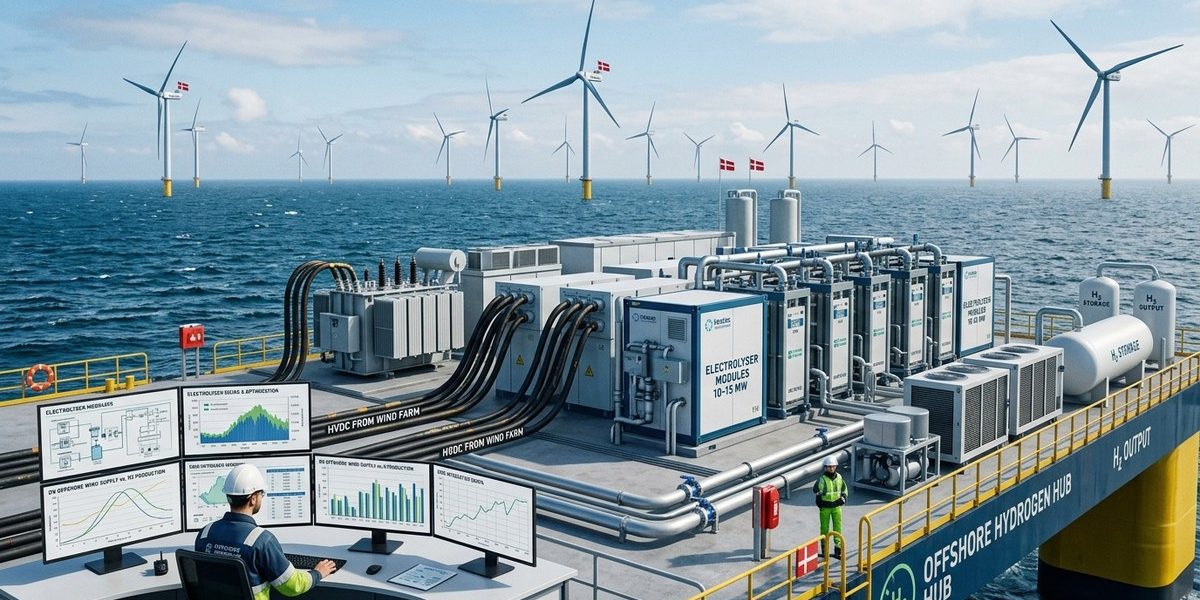
Getting the size of an electrolyser right for a Danish offshore wind farm is a bit like choosing the right battery for a solar panel on your summerhouse roof. You want to capture as much energy as possible without wasting money on capacity you will rarely use. In Denmark, where wind profiles shift with the seasons and the North Sea can roar one day and rest the next, sizing an electrolyser is a balancing act between capital cost and operational output. Too small and you spill valuable electrons. Too large and your stack sits idle too often, driving up your levelised cost of hydrogen. This guide walks you through the practical steps to get that balance right for your next project.
Sizing an electrolyser for a Danish offshore wind farm means matching its rated capacity to the wind farm’s capacity factor, not its peak output. Use hourly wind data, decide on a capacity factor target (typically 40% to 60%), and choose between PEM or alkaline technology based on ramp rates and stack replacement costs. Avoid oversizing by more than 20% above the wind farm’s average power.
Why Electrolyser Sizing Matters More in 2026
Denmark is pushing hard on its 2026 green hydrogen targets. New offshore wind leases in the North Sea and the Baltic are being awarded with hydrogen production in mind. The Danish Energy Agency now expects project developers to show a credible plan for electrolyser integration as part of their bid. That means getting the size wrong can cost you the tender.
The challenge is that offshore wind is not a steady power source. A 1 GW wind farm might produce at full capacity for only a few hundred hours a year. Most of the time it runs at partial load. An electrolyser sized to match the farm’s peak nameplate capacity would run at full power for just a fraction of the year. The rest of the time it would be underutilized, driving up the cost per kilogram of hydrogen.
The Core Principle: Match the Load Factor
Think of the electrolyser as a factory that needs raw material (electricity) delivered at a certain rate. You do not build a factory that can process 100 tonnes of grain per day if your supply averages 40 tonnes. You build it for the average supply, not the peak.
For electrolyser sizing offshore wind Denmark, the key metric is the wind farm’s capacity factor. Danish offshore wind farms typically achieve capacity factors between 45% and 55%. That means over a year, they produce about half of what they would if the wind blew at full force all the time. Your electrolyser should be sized to match that average output, not the peak.
A Simple Calculation
- Find the wind farm’s annual average power output. For a 500 MW farm with a 50% capacity factor, that is 250 MW average.
- Decide on your electrolyser’s operating range. Most modern PEM electrolysers can operate between 10% and 100% of rated load. Alkaline systems are typically limited to 20% to 100%.
- Set a target utilisation. A good starting point is to size the electrolyser at 80% to 100% of the wind farm’s average power. That gives you a system that runs at or near full load for a significant portion of the year.
- Check the duration curve. Use hourly wind data (available from the Danish Meteorological Institute or the wind farm operator) to see how many hours per year the wind farm exceeds your chosen electrolyser size. You want to spill no more than 5% to 10% of total annual energy.
A Practical Step-by-Step Process
Here is a numbered list of steps you can follow for your next feasibility study.
-
Collect hourly wind data for at least three years. Single year data can be misleading. A mild winter and a stormy one will give very different profiles. Use a full set to capture variability.
-
Build a power duration curve. Sort all hourly power values from highest to lowest. This shows you how many hours per year the farm produces above any given power level.
-
Choose a target electrolyser capacity factor. For a first pass, aim for 50% to 60% utilisation. That means the electrolyser runs at its rated power for at least 50% of the hours in a year. Adjust based on your hydrogen offtake agreement and electricity price assumptions.
-
Select a technology. PEM electrolysers offer faster ramp rates and a wider operating range, which suits the variability of offshore wind. Alkaline electrolysers are cheaper per MW but slower to respond. For Danish offshore projects in 2026, PEM is the more common choice.
-
Run an economic optimisation. Use a simple model that balances capital cost (electrolyser, balance of plant, grid connection) against revenue from hydrogen sales. Vary the electrolyser size in 10 MW increments and find the size that gives the highest net present value.
Common Mistakes and How to Avoid Them
| Mistake | Why It Happens | Better Approach |
|---|---|---|
| Sizing to peak wind farm capacity | Assumes full power is common | Use average power, not peak |
| Ignoring electrolyser degradation | Stack efficiency drops over time | Oversize by 5% to 10% to account for end-of-life performance |
| Using annual averages without hourly data | Misses the real shape of wind | Always use hourly or 10-minute data |
| Choosing alkaline for fast-ramp sites | Alkaline ramps slower than wind changes | Use PEM for sites with high variability |
| Forgetting grid connection costs | Larger electrolysers need bigger cables | Include grid upgrade costs in the model |
What the Experts Say
“The single biggest mistake I see in Danish electrolyser projects is treating the wind farm like a baseload power plant. It is not. You have to design for the variability, not against it. A PEM electrolyser that can track the wind profile minute by minute will always outperform a larger alkaline unit that needs time to warm up.”
Senior Project Manager, Danish Hydrogen Valley Consortium
Technology Choices for Danish Conditions
Denmark’s wind regime is different from the UK’s North Sea or Germany’s Baltic. The wind is stronger in winter, but summer can bring long periods of low wind. That seasonal pattern matters for electrolyser sizing.
PEM Electrolysers
PEM systems are the default for most new Danish offshore projects. They can ramp from 10% to 100% load in under a minute. That makes them ideal for following the short-term fluctuations of a wind farm. They also produce hydrogen at higher pressure, which reduces the need for compression. The downside is cost. PEM stacks are more expensive than alkaline, but prices are falling as manufacturing scales up.
Alkaline Electrolysers
Alkaline technology is mature and cheaper per MW. However, it has a narrower operating range (typically 20% to 100%) and slower ramp rates. For a wind farm with low variability, such as a site in the Baltic with more consistent winds, alkaline can be a good choice. For the North Sea, where gusts are common, PEM usually wins.
For a deeper comparison of these two technologies, see our article on comparing PEM and alkaline electrolysers for Denmark’s green hydrogen projects.
How to Handle the Wind Profile
Denmark’s offshore wind farms typically have capacity factors between 45% and 55%. A 600 MW farm in the North Sea might produce an average of 300 MW over a year. If you size your electrolyser at 300 MW, it will run at full load for roughly half the year. During the other half, it will run at partial load or be turned off during maintenance.
You can improve utilisation by adding a small amount of grid power. Danish regulations allow electrolysers to draw from the grid as long as the overall electricity supply is from renewable sources (the so-called additionality rules). If you size your electrolyser at 350 MW, you can run it at full load for more hours by pulling extra power from the grid when the wind is low. This increases your hydrogen output but adds a cost for grid electricity.
For more on integrating electrolysers with wind power, read our guide on how to integrate electrolysers with Denmark’s wind power for optimal green hydrogen production.
Key Metrics to Track
When you present your sizing study to investors or partners, use these three metrics.
- Full load hours (FLH). The number of hours per year the electrolyser runs at its rated capacity. A good target is 4,000 to 5,000 hours for a Danish offshore project.
- Capacity utilisation factor. The ratio of actual hydrogen production to theoretical maximum. Aim for 50% to 60%.
- Spilled energy percentage. The fraction of wind energy you cannot use because the electrolyser is too small. Keep this under 10%.
Avoiding the Oversizing Trap
There is a natural temptation to oversize “just in case” the wind farm performs better than expected. That is a costly mistake. An electrolyser that is 20% larger than the wind farm’s average power will cost 20% more in capital but will only produce about 5% more hydrogen. The economics rarely work.
A better approach is to design for modular expansion. Install a base electrolyser sized to the wind farm’s average power. Leave space and grid capacity for additional stacks later. If the wind farm exceeds expectations, you can add capacity without the upfront cost.
Bringing It All Together for Your Project
Electrolyser sizing offshore wind Denmark is not a one-size-fits-all calculation. It depends on the specific wind profile of your site, your hydrogen offtake price, your capital budget, and your tolerance for risk. The method outlined here gives you a solid starting point. Use hourly data, match the electrolyser to the wind farm’s average output, and choose PEM for most North Sea sites.
If you are just starting a feasibility study, begin with the power duration curve. That single graph will tell you more about the right size than any rule of thumb. From there, you can build a simple economic model and test a few scenarios. The goal is not perfection on the first pass. It is a defensible size that you can refine as you get better data and firmer offtake agreements.
For a broader view of how Denmark’s green hydrogen infrastructure is developing, take a look at how Denmark is leading the transition to green hydrogen infrastructure.
Your Next Step
Start with the data. Get three years of hourly wind production from your chosen site. Plot the duration curve. Draw a line at 80% of the average power. That is your first candidate size. Run the numbers, adjust, and repeat. The right size is out there, and with the approach above, you will find it.