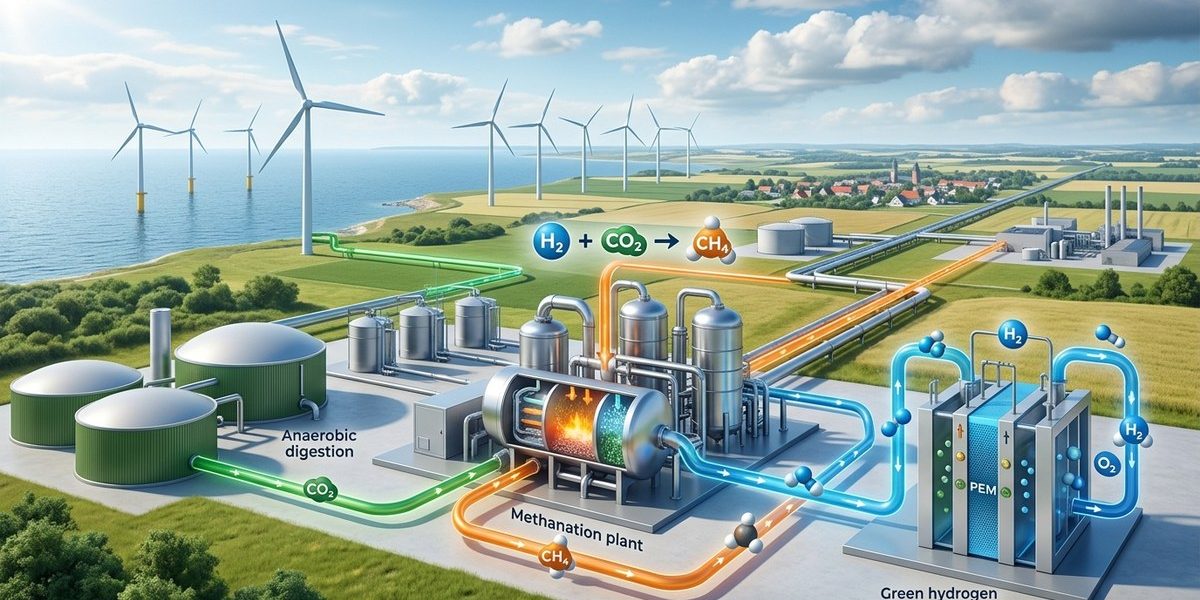
Denmark has a surplus energy problem. On blustery days, the country’s wind turbines spin faster than the grid can absorb, and wholesale electricity prices occasionally fall to zero or even negative. That is a strange kind of success: too much renewable power, and nowhere useful to send it. The standard answer so far has been to export the excess to neighbouring countries, but that trick only works when those neighbours also need the power. The smarter, longer-term solution is to turn that surplus into something storable, transportable, and valuable. That is where methanation comes in.
Methanation converts surplus green hydrogen and captured carbon dioxide into synthetic methane, a drop-in fuel that uses existing gas infrastructure. For Denmark, this process solves two problems at once: it stabilises the electricity grid when wind output is high, and it creates a dispatchable energy carrier that can meet industrial demand on cold, still days. Without methanation, Denmark’s green hydrogen system risks being either stranded or underused.
The grid stability problem no one expected
Denmark already generates more than half of its electricity from wind and solar. On a good day, that share climbs well above 100 per cent. The national grid operator, Energinet, has become very good at managing fluctuations, but there is a physical limit to how much variable generation a synchronous grid can handle. When wind turbines produce more power than the market can consume, the system frequency rises. Too much frequency damages equipment and risks blackouts.
The traditional response has been curtailment: paying wind farms to shut down. That wastes clean energy and costs money. A better response is to use that excess electricity to produce green hydrogen via electrolysis, then convert that hydrogen into methane. The methane can be injected directly into the existing natural gas network, which Denmark has in abundance, and stored in salt caverns or depleted gas fields for months at a time.
How methanation actually works
Methanation is not a new chemistry. The Sabatier reaction was discovered in the early twentieth century. What is new is the industrial application at the scale needed to absorb gigawatt-hours of surplus wind power. The process combines hydrogen with carbon dioxide over a nickel or ruthenium catalyst to produce methane and water. The overall reaction looks like this:
CO2 + 4H2 -> CH4 + 2H2O
The hydrogen comes from electrolysis powered by wind or solar. The carbon dioxide can come from biogas upgrading, industrial point sources, or direct air capture. The output is synthetic natural gas, chemically identical to fossil methane, which means it can be burned in existing boilers, turbines, and combined heat and power plants without any modifications.
Three practical steps in a Danish methanation plant
-
Electrolysis: Surplus wind power drives a proton exchange membrane or solid oxide electrolyser to split water into hydrogen and oxygen. This step is covered in detail in our guide on maximizing green hydrogen production with Danish electrolyser technologies.
-
Carbon capture: CO2 is sourced from a nearby biogas plant or from an industrial cement kiln. In Denmark’s future hydrogen valleys, this CO2 will be piped directly to the methanation unit.
-
Catalytic conversion: The hydrogen and CO2 are fed into a fixed-bed reactor at temperatures between 200 and 550 degrees Celsius, depending on the catalyst. The resulting methane is dried, compressed, and sent to the gas grid.
Why methanation is the missing link for grid stability
Without methanation, a green hydrogen system faces a fundamental timing problem. Electrolysers can ramp up and down in seconds, which is excellent for absorbing short-term wind spikes. But hydrogen itself is difficult to store in large quantities over long periods. Salt caverns work well, but they are not everywhere. Pressurised tanks are expensive at scale. Methane, on the other hand, can be stored in the existing Danish gas storage facility at Stenlille or the larger facility at Lille Torup, which together hold enough gas to cover several months of winter demand.
The table below compares the three main ways Denmark can handle excess wind power. Methanation sits in a sweet spot: it offers high storage density and full compatibility with existing infrastructure.
| Method | Storage duration | Infrastructure need | Round-trip efficiency |
|---|---|---|---|
| Battery storage | Hours to days | New battery parks | 85 to 95 per cent |
| Hydrogen storage | Days to weeks | New salt caverns or tanks | 30 to 40 per cent (power-to-power) |
| Methanation | Months | Existing gas grid and storage | 35 to 45 per cent (power-to-gas) |
The efficiency numbers for methanation look lower than batteries, but that comparison misses the point. Batteries store electricity for hours. Methanation stores energy for months, and the output is a fuel that can be used for heating, industrial processes, or transport, not just electricity. For a country like Denmark that aims to decarbonise its entire energy system, not just its power sector, that flexibility is essential.
What the experts say about Danish methanation projects
“Methanation is the only power-to-X pathway that lets us use the gas network as a giant virtual battery. We can inject renewable methane in the summer when wind is plentiful and withdraw it in January when the heating demand peaks. No other storage technology gives us that seasonal shifting at such low marginal cost.” — Senior energy analyst, Danish Energy Agency, speaking at a 2025 Nordic grid forum.
That quote captures the core value. Denmark’s gas network already connects every major town and industrial zone. By injecting synthetic methane, the country avoids building a separate hydrogen distribution system for heating. The hydrogen stays inside the power-to-X loop, while the methane does the heavy lifting of seasonal balancing.
Common mistakes in methanation system design
Even with a sound concept, several pitfalls can undermine a methanation project. Here are the ones Danish developers watch most carefully:
-
Sizing the electrolyser for average wind output instead of peak surplus. An electrolyser sized for average conditions will sit idle during calm periods and be too small to capture the real wind spikes. The best projects oversize the electrolyser by 30 to 50 per cent and run it at partial load most of the time.
-
Ignoring catalyst deactivation. The Sabatier catalyst can be poisoned by sulphur compounds in the CO2 feed. Danish biogas plants often produce biogas with trace hydrogen sulphide, which must be removed before the CO2 reaches the reactor. A good gas cleaning step is non-negotiable.
-
Assuming the gas grid will always accept injection. The methane must meet strict gas quality standards for Wobbe index and calorific value. Some Danish distribution zones have limits on hydrogen blending, so the methanation unit must produce near-pure methane to avoid blending restrictions.
-
Underestimating heat integration. The methanation reaction is exothermic. That heat can be recovered and used for district heating or for preheating the reactor feed. Projects that neglect heat recovery lose up to 20 per cent of their potential efficiency.
For a deeper look at how Danish projects avoid these errors, read our article on 5 challenges facing electrolyser deployment in Denmark and how to overcome them.
How methanation fits into Denmark’s 2026 energy goals
Denmark’s official climate目标是 to reduce greenhouse gas emissions by 70 per cent from 1990 levels by 2030. Methanation supports that target in several ways:
- It provides a use for captured CO2, turning a waste stream into a fuel.
- It enables deeper penetration of wind power without destabilising the grid.
- It produces a fuel that can replace natural gas in hard-to-electrify sectors like industrial high-temperature heat and maritime shipping.
Several Danish demonstration projects are already proving the concept. The GreenHyScale project in western Jutland combines a 100 MW electrolyser with a methanation unit that feeds synthetic methane into the local gas distribution network. The project is designed to absorb wind power from the nearby Horns Rev offshore wind farm and is expected to be fully operational by late 2026.
The role of hydrogen valleys in scaling methanation
Denmark is establishing several hydrogen valleys, regional clusters where hydrogen production, storage, and end use are co-located. Methanation plants are a natural anchor for these valleys because they provide a flexible outlet for hydrogen that cannot be used immediately.
In a typical hydrogen valley layout:
- Wind turbines feed power to a central electrolyser hub.
- A portion of the hydrogen goes directly to industrial users, such as refineries or fertiliser plants.
- The remaining hydrogen passes through a methanation reactor where it combines with captured CO2 from a neighbouring biogas plant.
- The synthetic methane enters the gas grid or is stored for winter use.
This layered approach ensures that no hydrogen is wasted, even when industrial demand fluctuates. For more on how these valleys are being designed, see our piece on how hydrogen valleys in Denmark are creating a blueprint for regional green hydrogen hubs by 2026.
What the UK can learn from Denmark’s methanation strategy
British energy policymakers are watching Denmark’s methanation experiments with genuine interest. The UK has its own offshore wind surplus, especially in Scotland, and a well-developed gas grid that could accept synthetic methane. The challenges are similar: grid constraints, seasonal storage needs, and a desire to decarbonise heating without forcing every household to rip out their boiler.
Denmark’s approach offers a practical template. Start with a few anchored projects that connect directly to existing gas infrastructure. Use biogas CO2 as the carbon source to avoid the complexity of direct air capture at first. Oversize the electrolyser to capture peak wind. And above all, treat methanation as a grid stability service first and a fuel production process second.
For a broader comparison of the two countries’ strategies, read what can the UK learn from Denmark’s green hydrogen pioneers.
Making the economics work at scale
The biggest barrier to methanation today is cost. A tonne of synthetic methane currently costs two to three times more than fossil natural gas, even with carbon pricing. That gap will narrow as electrolyser costs fall and carbon taxes rise, but it will not close entirely without policy support.
Denmark has introduced a contract-for-difference scheme for power-to-X projects that guarantees a minimum price for synthetic methane. The scheme covers the difference between the market price and the cost of production, giving developers the confidence to invest in first-of-a-kind plants. Similar mechanisms exist in Germany and the Netherlands, and the European Union’s hydrogen bank is expected to extend support to methanation projects under its upcoming auction rounds.
For analysts tracking the economics, the key metric is the utilisation rate of the electrolyser. A methanation plant that runs for more than 4,000 full-load hours per year can produce methane at a cost close to 80 euros per megawatt-hour, competitive with imported LNG once carbon costs are included. Denmark’s high wind capacity factors make that utilisation rate achievable.
Why methanation is not a distraction from direct electrification
A common criticism of methanation is that it wastes energy. Converting electricity to hydrogen to methane and then burning it is less efficient than using the electricity directly. That argument is true for applications where direct electrification is feasible, such as heating a well-insulated home with a heat pump. But for seasonal storage, industrial heat above 500 degrees Celsius, and heavy transport, direct electrification is either impractical or prohibitively expensive.
Methanation does not compete with electrification. It complements it. The two strategies address different parts of the energy system. Electrification handles the low-hanging fruit. Methanation tackles the hard-to-abate sectors that would otherwise remain dependent on fossil gas.
A practical checklist for energy analysts evaluating methanation projects
When you are reviewing a Danish methanation proposal, these are the questions that matter most:
- What is the source of CO2? Biogenic CO2 from biogas is preferable because it creates a carbon-negative cycle.
- How many full-load hours does the electrolyser expect? Anything below 3,000 hours per year raises the levelised cost significantly.
- Is there a heat off-taker nearby? District heating networks or industrial steam users improve the overall system efficiency.
- Does the gas grid operator have capacity for injection? Some rural distribution lines are already saturated with biomethane.
- What is the catalyst replacement schedule? Nickel catalysts last several years but require monitoring for sintering and poisoning.
For a more detailed framework, read our guide on 5 key performance metrics for evaluating electrolyser efficiency in Danish energy projects.
The future of methanation in Denmark beyond 2026
Several trends point towards accelerated methanation deployment in Denmark over the next five years. The first is the expansion of offshore wind in the North Sea, which will produce enormous volumes of surplus electricity, especially during autumn and winter storms. The second is the development of a cross-border hydrogen pipeline to Germany, which will create a liquid market for hydrogen and its derivatives. The third is the increasing availability of captured CO2 from biogenic sources, as more biogas plants and biomass-fired combined heat and power plants install carbon capture equipment.
By 2030, Denmark could be producing enough synthetic methane to replace 10 to 15 per cent of its current natural gas consumption. That would represent a significant step towards energy independence and a powerful demonstration of the power-to-X model for other countries.
Turning surplus into stability
Methanation is not the flashiest part of Denmark’s green hydrogen story. It does not have the same narrative appeal as a giant offshore electrolyser or a hydrogen-powered ferry. But it is the part that makes the whole system work. Without a way to store surplus renewable energy across seasons, Denmark’s grid would hit a stability ceiling long before the country reached its climate targets. Methanation breaks through that ceiling by turning excess wind power into a fuel that fits perfectly into the existing energy infrastructure.
For energy policy analysts and renewable researchers, the lesson is clear. The future of green hydrogen is not just about producing the molecule. It is about integrating that molecule into a balanced, resilient energy system. Methanation is one of the most practical tools for achieving that integration, and Denmark is showing the rest of Europe how to do it at scale.
If you are working on grid integration or power-to-X strategy, take a close look at the methanation projects now under development in Denmark. They may well provide the blueprint for your own market.