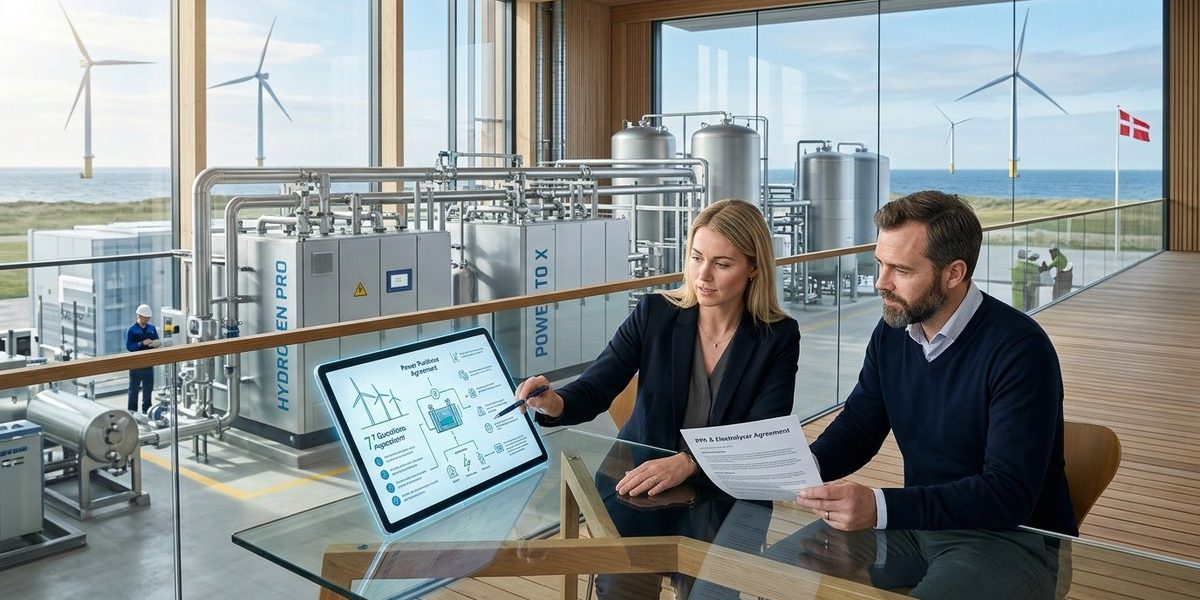
You have secured the site permit. The electrolyser technology is selected. The offtake agreements are under negotiation. Now comes the contract that will determine your project economics for the next decade: the power purchase agreement. For any electrolyser project in Denmark, the PPA is not just a utility bill. It is your single biggest cost input and your main exposure to energy price risk. Signing the wrong one can turn a viable green hydrogen project into a money pit. Here are the seven questions you must ask before you put pen to paper.
A power purchase agreement for a Danish electrolyser project must balance low electricity costs with operational flexibility. The seven questions in this guide cover volume risk, grid connection fees, green certification, balancing responsibility, contract duration, indexation, and exit clauses. Getting these right protects your margin and keeps your hydrogen bankable.
Why your PPA structure matters more than the technology
Electrolysers consume vast amounts of electricity. A 50 MW facility running at full load uses around 400 GWh per year. That is roughly the annual consumption of 100,000 Danish households. Even a small difference in the PPA price per MWh translates into millions of kroner over the contract term.
The challenge is that renewable generation is variable. Your electrolyser needs to run as many hours as possible to recover its capital cost, but you also want to buy power when it is cheapest. A fixed-price PPA gives certainty but may force you to buy expensive power during low-wind periods. A merchant or hybrid PPA can lower your average cost but adds complexity.
Let us walk through the seven questions that will help you choose the right structure for your Danish electrolyser project.
1. How much volume risk can you actually take?
The first question is about the shape of the PPA. There are three main types:
-
Baseload or fixed-volume PPA. You commit to take a set number of MWh each hour, day, or month. The price is fixed or has a known formula. This is simple to model but dangerous for an electrolyser. If wind generation is low and prices spike, you still pay the high price. Your hydrogen production may not align with the hours you are buying power.
-
Pay-as-produced PPA from a specific wind farm or solar park. You only buy the power when the asset generates. This matches renewable supply to your load. The downside is that your electrolyser may sit idle for long periods, which hurts the utilisation rate.
-
Merchant or hybrid PPA. You buy a base volume at a fixed price and then source the rest from the day-ahead or intraday market. This gives you flexibility to ramp down when prices are high. Most Danish electrolyser projects in 2026 use a hybrid structure with 60 to 80 percent fixed volume and the rest merchant.
Expert advice: Start with a conservative volume assumption. Many developers overestimate the number of operating hours in year one. A PPA that looks cheap at 6,000 full-load hours becomes expensive if you only run 4,000 hours. Build in a volume flexibility clause that lets you reduce offtake during periods of negative margins.
2. Who pays for grid connection and balancing?
This is where many PPAs get messy. The cost to connect your electrolyser to the Danish transmission or distribution grid can be significant. In Denmark, Energinet handles the transmission grid, and local distribution system operators manage the lower voltage levels.
Your PPA should clearly state:
- Who pays the connection fee (often the developer, but sometimes the seller shares it)
- Who is responsible for balancing your portfolio
- Whether the PPA includes the cost of grid tariffs and taxes
Balancing responsibility is especially important. If your PPA does not include balancing, you will need to contract separately with a balance responsible party or use an aggregator. The fees for being out of balance in the Danish system can add 10 to 15 percent to your total power cost.
Here is a comparison table of common PPA structures for Danish electrolyser projects:
| PPA Type | Volume Certainty | Price Risk | Best For |
|---|---|---|---|
| Fixed baseload | High | High | Projects with guaranteed offtake |
| Pay-as-produced | Low | Low | Sites co-located with wind or solar |
| Hybrid (fixed + merchant) | Medium | Medium | Most Danish electrolyser projects in 2026 |
| Sleeved PPA via utility | Medium | Low | Developers without trading desk |
3. Does the PPA support green hydrogen certification?
This is a non-negotiable point. To sell green hydrogen in Europe under the Renewable Energy Directive (RED III), you must prove that your electricity comes from additional renewable sources. Danish electrolyser projects must comply with the EU delegated acts on additionality, temporal correlation, and geographical correlation.
Your PPA must include:
- Guarantees of origin (GOs) for every MWh consumed
- A clear chain of custody for the renewable attributes
- A contract term that matches the certification period
If your PPA does not transfer the GOs to you, your hydrogen cannot be certified as green. That kills the premium price you are banking on. Check that the PPA explicitly assigns the environmental attributes to your project. Some sellers try to retain the GOs for their own reporting.
For a deeper look at certification, see our guide on maximizing green hydrogen production with Danish electrolyser technologies.
4. How is the price indexed and hedged?
Electricity prices in Denmark are influenced by fuel costs, carbon prices, and renewable penetration. A PPA price that looks attractive today may become uncompetitive if the market shifts.
Common indexation mechanisms include:
- Fixed annual escalation (e.g., 2 percent per year)
- CPI or inflation linkage
- Direct indexation to the Danish day-ahead price (DK1 or DK2 zone)
- A floor price with a cap (collar structure)
For a Danish electrolyser project, a collar structure is often sensible. You set a floor price that guarantees the seller a minimum return, and a cap that protects you from extreme spikes. The difference between the floor and cap is the “collar.” This gives both parties some protection.
One common mistake is signing a PPA indexed to the German day-ahead price. Danish prices are correlated but not identical, especially in DK1 (West Denmark) which is more connected to Germany. Use the correct bidding zone index.
5. What happens during negative price hours?
Negative electricity prices are becoming more common in Denmark, especially during windy spring and autumn days. For an electrolyser project, negative prices are a gift. You get paid to consume power.
Your PPA must address how negative prices are handled. Some contracts:
- Pass the full negative price to you (ideal)
- Set a floor of zero (you get free power but no payment)
- Prorate the negative value between buyer and seller
If your PPA has a floor of zero, you lose the economic benefit of negative prices. Since electrolysers can ramp up quickly, you want full exposure to negative prices. This is where a merchant element in your PPA pays off.
A related point is the minimum load of your electrolyser. If you cannot ramp down below 20 percent, you may be forced to buy power at high prices during price spikes. Make sure your PPA allows you to curtail offtake without penalty when prices exceed your hydrogen breakeven point.
6. Can you assign or terminate the PPA if the project changes?
Project timelines slip. Technology choices change. Offtake agreements fall through. Your PPA needs to accommodate this reality.
Check these clauses:
-
Assignment rights: Can you transfer the PPA to a new special purpose vehicle or a new owner? This is critical if you plan to sell the project after commissioning.
-
Termination for convenience: Can you walk away with a penalty? Some PPAs allow termination before the commercial operation date if you pay a break fee.
-
Force majeure and change in law: Danish energy regulation is evolving. The EU ETS, the hydrogen support schemes, and the grid tariff structure are all subject to change. A change-in-law clause should let you renegotiate or terminate if the regulatory environment shifts materially.
-
Step-in rights for lenders: Your bank will want the ability to step in if the project defaults. Ensure the PPA does not automatically terminate upon a change of control or insolvency.
For more on project financing, read our article on 6 financial incentives supporting electrolyser projects in Denmark for 2026.
7. How long should the contract term be?
The ideal PPA term for a Danish electrolyser project is a balancing act. A 10-year PPA gives bankability but locks you into a price that may not reflect future market conditions. A 3-year PPA gives flexibility but makes it harder to secure project finance.
Here are some guidelines:
-
For a first-of-a-kind project: Aim for a 7 to 10 year PPA with a price review at year 5. This gives lenders enough certainty while allowing you to renegotiate as the hydrogen market matures.
-
For a project with a fixed offtake contract: Match the PPA term to your offtake contract. If you have a 10-year hydrogen sales agreement, you want a 10-year PPA.
-
For a merchant project: Consider a 3 to 5 year PPA with renewal options. You keep the ability to shop around for cheaper power as more renewables come online.
Remember that Danish offshore wind farms are being built at scale. By 2030, the price of offshore wind power in Denmark could be 20 to 30 percent lower than today. A long-term fixed PPA signed now may look expensive in five years. A shorter term with an option to extend protects you.
Putting it all together for your Danish electrolyser project
Let us imagine you are developing a 50 MW PEM electrolyser in Esbjerg. You plan to supply hydrogen to a local refinery and to the growing trucking market. Here is how the seven questions apply:
-
You choose a hybrid PPA with 70 percent baseload from a new offshore wind farm and 30 percent merchant exposure. This gives you a base cost of around 40 EUR/MWh with the ability to capture negative prices.
-
The PPA transfers all guarantees of origin to you. You can certify your hydrogen as green under RED III.
-
The contract has a 10-year term with a price review at year 5. There is a collar structure with a floor of 30 EUR/MWh and a cap of 60 EUR/MWh.
-
You have the right to curtail offtake when the day-ahead price exceeds 80 EUR/MWh, which protects you from extreme spikes.
-
The PPA includes assignment rights and a change-in-law clause. Your lenders are comfortable.
This structure gives you a bankable project with manageable risk. You are not overexposed to volume risk or price spikes, but you still benefit from the low-cost hours that make green hydrogen competitive.
Avoiding the most common PPA mistakes
Developers in Denmark often make these errors when signing a power purchase agreement for an electrolyser project:
-
They sign a PPA that does not align with the electrolyser’s operating profile. A baseload PPA for a flexible asset wastes money.
-
They ignore grid connection costs. The PPA price may look good, but the total cost including grid tariffs and balancing fees is much higher.
-
They do not check the GO transfer mechanism. Without it, the hydrogen cannot be sold as green.
-
They lock in a long-term fixed price without an escalation clause. Inflation eats the margin.
-
They forget to include a termination option. When the project hits a delay, they are stuck paying for power they cannot use.
For a full overview of project risks, see our guide on 5 challenges facing electrolyser deployment in Denmark and how to overcome them.
Getting your PPA ready for 2026 and beyond
The Danish PPA market is maturing. Sellers are more experienced, and standard contracts are emerging. But the market is still thin compared to the UK or Germany. You may need to negotiate harder to get the terms you need.
Here are three practical steps to take before you sign:
-
Run a sensitivity analysis. Model your project economics under different PPA structures. Use at least three price scenarios: low, base, and high. Include a stress case with 20 percent lower full-load hours.
-
Get a PPA advisor who knows Danish energy law. The legal framework for hydrogen is still developing. A generic PPA template from another country will not work.
-
Talk to your offtaker first. The terms of your hydrogen sales agreement should drive the PPA structure. If your offtaker wants a fixed hydrogen price, you need a fixed power price. If they want a floating price, you can take more merchant risk.
Your next steps with the Danish PPA market
The seven questions above are your checklist. Print them out. Take them to every negotiation. A well-structured power purchase agreement for your Danish electrolyser project is the difference between a project that runs at a profit and one that bleeds cash.
Start with question one and work through them in order. Volume risk first, then grid costs, then certification. By the time you reach question seven on contract term, you will know exactly what kind of PPA you need.
And when you are ready to move forward, our team can help you model the economics and connect you with PPA sellers who understand the hydrogen sector. The Danish renewable energy market is one of the best in Europe for green hydrogen. Get the PPA right, and your project will thrive.