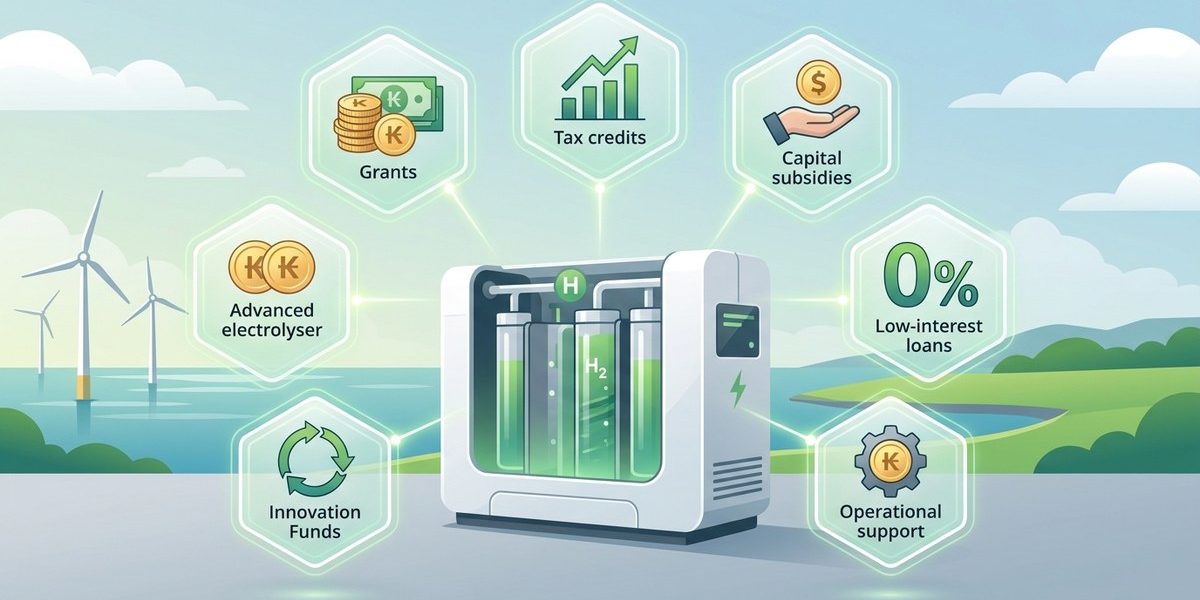
Denmark is serious about green hydrogen. If you are a project developer or investor looking at electrolyser projects in Denmark, 2026 is shaping up to be a pivotal year. The Danish government has put real money on the table, not just promises. But navigating the funding landscape can feel like trying to read a map in a foreign language. This guide breaks down the main financial incentives available right now, how they work, and what you need to do to get a slice of the pie.
Denmark offers a multi-layered funding ecosystem for electrolyser projects in 2026, including direct capital grants from the PtX tender, operational subsidies via a fixed premium, EU-level support from the Innovation Fund, and loan guarantees from EIFO. The key is to layer these sources correctly and align your project with both Danish and EU green hydrogen criteria.
The Main Pillars of Danish Electrolyser Funding
Denmark has structured its support around a few core programmes. They are designed to de-risk early projects and help the country hit its ambitious Power-to-X (PtX) targets. Let us look at the main ones.
1. The Danish PtX Tender (Direct Capital Grants)
This is the headline act. The Danish Energy Agency (Energistyrelsen) has run a series of tenders specifically for PtX projects, including electrolysers. In 2026, the focus is on projects that can demonstrate a clear path to commercial operation.
The tender works on a competitive bidding model. You submit a bid stating how much support you need per unit of hydrogen produced. The lowest bids win the funding. In previous rounds, the total pot was around DKK 1.25 billion (about $155 million), and it funded six projects across the country.
What you need to know for 2026:
- Eligibility: Your project must produce green hydrogen using renewable electricity. The hydrogen must then be used for purposes like industrial feedstock, transport fuel, or grid balancing.
- Award criteria: Price is the biggest factor, but you also get points for project maturity, off-take agreements, and your plan for creating a hydrogen valley.
- Timing: Keep an eye on the Energistyrelsen website for the next application window. They usually open in the first half of the year.
2. The Fixed Premium (Driftsstøtte)
Capital grants are great, but they do not cover your operating costs. That is where the fixed premium comes in. This is a per-kilogram subsidy paid over a set number of years (typically 10 years) once your electrolyser is running.
The premium covers the gap between the cost of producing green hydrogen and the market price a buyer is willing to pay. It is designed to make your project bankable.
How to qualify for the fixed premium:
- You must first win a grant in the PtX tender.
- You need to prove that your hydrogen meets the EU’s definition of renewable hydrogen (additionality, temporal correlation, and geographical correlation).
- You must have a signed off-take agreement with a credible buyer.
- Your electrolyser must be operational within a set timeframe (usually 3 to 4 years from the award date).
- You must report your production and emissions data to the Danish Energy Agency annually.
3. The EU Innovation Fund (Innovationsfonden)
Denmark also channels significant EU funds into electrolyser projects. The Innovation Fund Denmark (Innovationsfonden) provides grants for research, demonstration, and pilot projects. This is perfect if you are testing a new electrolyser stack design or an innovative way to integrate heat recovery.
What they look for:
- A high degree of technical innovation.
- A clear plan for commercialisation after the grant period.
- Collaboration with Danish universities or research institutions.
- Projects that can reduce the cost of electrolysis or improve efficiency.
The Innovation Fund is less about scale and more about proving a concept. If your project is at Technology Readiness Level (TRL) 5 to 7, this is the fund for you.
A Practical Comparison of Funding Routes
Choosing the right funding route depends on your project stage and size. Here is a table to help you compare.
| Funding Route | Best For | Typical Amount | Key Requirement |
|---|---|---|---|
| Danish PtX Tender | Large-scale commercial projects (10+ MW) | DKK 100m+ per project | Competitive bid, off-take agreement |
| Fixed Premium | Operational cost support for winners of PtX tender | Per-kg subsidy for 10 years | EU renewable hydrogen certification |
| Innovation Fund Denmark | Pilot and demonstration projects (1-10 MW) | DKK 5m to 50m per project | High technical innovation, research partner |
| EIFO Loan Guarantees | Reducing risk for debt financing | Up to 70% of loan amount | Solid business plan, credible off-taker |
What the EU Hydrogen Bank Means for Danish Projects
Denmark is not just a national player. It is a key part of the European Hydrogen Backbone. The European Hydrogen Bank, through its auctions, has already funded Danish projects. For example, European Energy secured up to €228 million in German funding for a Danish electrolyser project under this framework.
This cross-border funding is becoming more common. If your project is located in Denmark but plans to export hydrogen to Germany or other EU countries, you could apply for support from both Danish and EU programmes. The key is to show that your project contributes to the EU’s overall hydrogen targets, not just Denmark’s.
Expert advice: Do not think of funding as a single source. Think of it as a stack. You might combine a Danish PtX grant with an EU Innovation Fund grant and an EIFO loan guarantee. The most successful project developers in 2026 are the ones who know how to layer these instruments without creating conflicts.
Common Mistakes When Applying for Funding
Even a strong project can fail if the application is not right. Here are the most common pitfalls we see.
- Ignoring the EU rules on additionality. Your electrolyser must be powered by new renewable energy capacity, not existing wind farms. Failing to prove this is a deal-breaker.
- Not having a credible off-taker. The Danish Energy Agency wants to see a signed contract, not just a letter of intent. If you do not have a buyer, your project is seen as too risky.
- Underestimating the timeline. Getting a grant awarded is only step one. You then need to secure permits, grid connection, and construction financing. Many projects fail because they cannot meet the operational deadline.
- Focusing only on capital costs. The fixed premium is based on your operating costs. If your application does not show a realistic cost per kilogram, you will not win.
- Trying to go it alone. The most successful bidders have strong consortia. They include an energy supplier, a technology provider, an off-taker, and often a university partner.
How to Build a Winning Application in 2026
Let us turn that around. Here is a step-by-step process that improves your chances.
- Assemble your consortium. Find a credible off-taker first. Without them, you have no project.
- Secure your renewable energy supply. Sign a Power Purchase Agreement (PPA) with a wind or solar farm that meets the EU’s additionality rules.
- Choose your technology. Decide between PEM, alkaline, or SOEC electrolysis. Each has different cost profiles and efficiencies. Read our guide on comparing PEM and alkaline electrolysers for Denmark’s green hydrogen projects for help.
- Model your costs. Build a detailed financial model that shows your capital expenditure, operating expenditure, and the levelised cost of hydrogen (LCOH).
- Write your application. Focus on the project’s technical maturity, financial viability, and environmental impact. Be specific and avoid vague claims.
- Prepare for due diligence. If you win, the agency will check everything. Have your permits, contracts, and technical studies ready.
The Role of EIFO in De-Risking Your Project
The Export and Investment Fund of Denmark (EIFO) is another critical piece of the puzzle. They do not give grants. Instead, they provide loan guarantees and direct loans to projects that have already secured some funding.
Think of EIFO as the backstop. If you have a PtX grant and a bank is nervous about lending you the rest of the capital, EIFO can step in and guarantee part of the loan. This lowers the bank’s risk and makes it easier for you to get financing.
HydrogenPro used this route. They received DKK 35 million from EIFO to support their H2-GIGA factory in Aarhus. The funding helped them build production capacity for next-generation electrodes.
What EIFO looks for:
- A clear export potential (Danish technology sold abroad).
- A strong management team.
- A realistic repayment plan.
- Alignment with Denmark’s green transition goals.
A Final Look at the 2026 Funding Landscape
The funding environment in 2026 is more mature than it was two years ago. The rules are clearer, the application processes are more streamlined, and the total amount of money available is larger. But it is also more competitive. The era of easy grants is over. Now, you need to show real commercial viability.
If you are looking for a deeper understanding of how these incentives connect to the wider energy system, you might find our piece on integrating power-to-gas systems for sustainable Danish industry useful.
Making the Most of Denmark’s Green Hydrogen Momentum
Denmark is not just handing out cash. It is building an ecosystem. The funding is there to support projects that will create jobs, reduce emissions, and strengthen energy security. If you can show that your electrolyser project does all three, you have a strong chance.
Start preparing your application now. Talk to potential off-takers. Secure your renewable energy supply. And do not be afraid to ask for help from the Danish Energy Agency or EIFO. They want good projects to succeed.
The window for 2026 funding is open. With the right preparation, your project could be one of the ones that helps Denmark lead the green hydrogen transition in Europe.