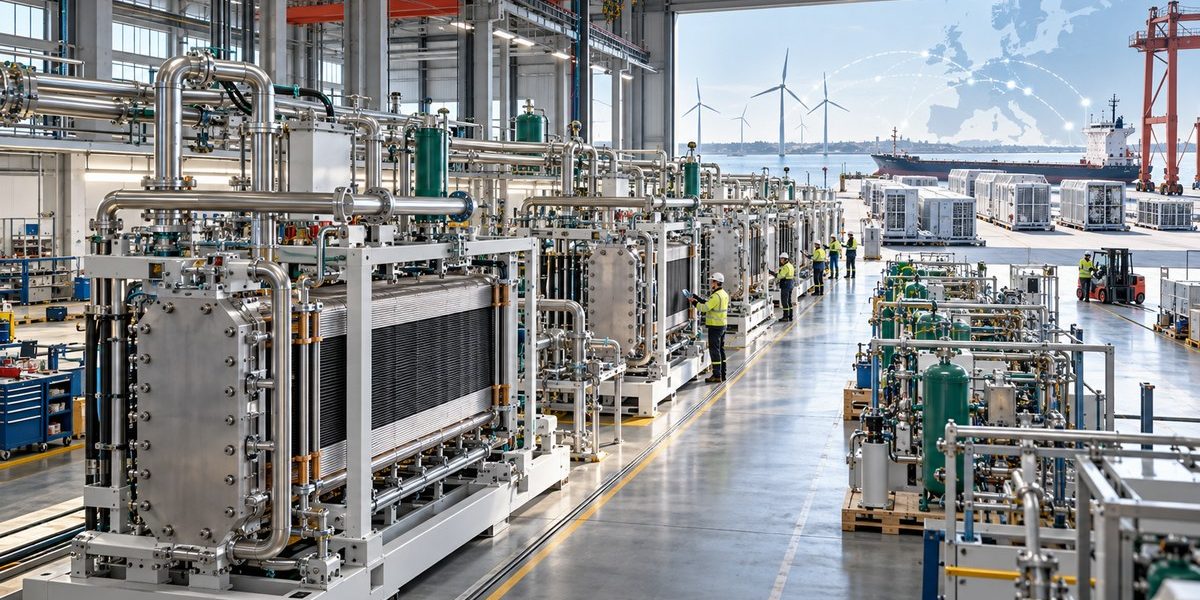
Denmark is no longer just a wind energy pioneer. It is quietly building the factories that will supply Europe with green hydrogen machines. For anyone watching the hydrogen sector, this shift matters. The country has set a target of 4 to 6 GW of electrolysis capacity by 2030, and manufacturers are racing to build the production lines that can deliver on that promise. But scaling up a factory from prototype to gigawatt output is a different game entirely. It requires capital, supply chain coordination, and a clear export route to markets like Germany, the Netherlands, and the UK.
Denmark’s path to scaling electrolyser manufacturing depends on three things: securing supply chains for critical raw materials, standardising stack designs for mass production, and building portside logistics for European export. The country’s strong wind grid and political support give it a head start, but execution will decide whether it meets its 4-6 GW target.
Why Denmark Has an Edge in Electrolyser Production
Denmark brings three advantages that are hard to replicate. First, it has a mature wind energy sector that already supplies cheap renewable electricity. Second, the government has backed hydrogen with clear policy, including the 4-6 GW target and funding for Power-to-X projects. Third, Danish engineering firms have decades of experience in energy equipment manufacturing, from wind turbines to heat pumps.
These factors lower the risk for factory investors. When you build a production line in Denmark, you are not guessing whether there will be demand. The domestic market is real, and the export routes to Germany and the Netherlands are already being mapped. For a business strategist or project developer, this reduces the uncertainty that usually kills manufacturing scale-up projects.
But having an edge is not the same as executing. The real work is in the details of factory design, supply chain management, and logistics.
Practical Steps for Scaling Your Manufacturing Line
If you are planning to scale electrolyser production in Denmark, here is a numbered list of practical processes that work in 2026:
-
Standardise stack designs before you automate. Many manufacturers try to automate too early, while the design is still changing. Lock down your stack architecture first. Once you have a design that can run for 60,000 hours without major changes, you can invest in robotic assembly lines. This alone can cut production costs by 30 to 40 percent.
-
Secure long-term contracts for nickel and titanium. Electrolysers, especially PEM types, rely on these materials. Global supply is tight. Danish manufacturers who sign five-year offtake agreements with European refineries are avoiding the price spikes that hit spot buyers in 2025 and 2026.
-
Build modular assembly bays. Instead of one giant production line, design your factory as a set of identical bays. Each bay can produce a complete stack. This lets you add capacity in 50 MW chunks as orders come in, rather than betting everything on one massive line.
-
Integrate testing stations into the production flow. Every stack should be tested before it leaves the factory. In Denmark, where winter weather can be harsh, testing under simulated load conditions catches failures early. This reduces warranty claims and builds trust with European buyers.
-
Partner with a logistics provider at Esbjerg or Frederikshavn. These ports are the natural gateways for electrolyser exports to Germany and the UK. Having a dedicated loading area for oversized hydrogen equipment can save weeks of shipping delays.
Common Mistakes That Slow Down Scale-Up
Even the best plans can go wrong. Here are the most frequent errors I see in Danish electrolyser manufacturing projects, along with the better approach.
| Mistake | Why It Happens | Better Approach |
|---|---|---|
| Ordering custom components instead of standard parts | Engineers want the perfect part | Use off-the-shelf components for 80 percent of the system; customise only the core stack |
| Building a single, rigid production line | Management wants one big solution | Use modular bays that can be added one at a time |
| Ignoring port logistics until late in the project | Focus is on the factory itself | Involve port authorities during site selection |
| Underestimating the cost of quality control | Pressure to ship fast | Build a dedicated QC station for every 10 stacks produced |
| Hiring only local talent | Assumption that Danish engineers are enough | Recruit supply chain specialists from Germany and the UK who know European rail and sea freight |
The Export Logistics Puzzle
Selling electrolysers to Europe sounds simple, but the logistics are not. A single 10 MW stack can weigh over 40 tonnes. Moving it by road from a factory in Herning to a customer in Rotterdam requires special permits, escort vehicles, and careful route planning. Rail is an option for some routes, but not all European rail networks can handle the height and weight.
Danish manufacturers are solving this by pre-assembling stacks at the factory and shipping them in standardised containers that can be loaded directly onto ships. This approach, sometimes called “containerised electrolysis,” is gaining traction in 2026. It means the customer receives a plug-and-play unit that can be installed in days rather than weeks.
For the UK market, the route through Esbjerg to Immingham or Hull is becoming the standard. Several Danish firms have already run pilot shipments along this corridor, and the feedback is positive. The key is to book shipping slots early, as demand for heavy-lift vessels is rising across the North Sea.
What the Numbers Say About Capacity Targets
Denmark’s official target of 4 to 6 GW of electrolysis capacity by 2030 sounds ambitious, but it is achievable if the manufacturing scale-up happens on schedule. To put it in context, 6 GW of electrolysers would require roughly 60,000 stacks per year, assuming each stack handles around 100 kW. That is a lot of factories.
Current production capacity in Denmark is around 500 MW per year, mostly from pilot lines. To reach 6 GW, the country needs to build at least ten new factories, each with a 500 MW annual output. That is a massive construction programme, but it is not unprecedented. The wind turbine industry did something similar in the 1990s and 2000s.
The difference is that electrolysers require more specialised materials and tighter quality control. Factories cannot be rushed. A typical lead time for a new electrolyser factory is three to four years, from site selection to first output. That means the factories needed for the 2030 target must break ground by 2026 or 2027 at the latest. Some are already under construction, but more are needed.
How Policy Shapes the Manufacturing Landscape
Danish policy has been a strong driver. The government’s Power-to-X strategy includes direct subsidies for electrolyser manufacturers, not just for hydrogen producers. This is a smart move. By supporting the factories themselves, Denmark ensures that the value of manufacturing stays in the country, rather than just importing finished stacks from Asia.
“The Danish approach of supporting manufacturing alongside hydrogen production is exactly what Europe needs. If we only subsidise hydrogen, we end up buying electrolysers from outside the continent. By supporting factories