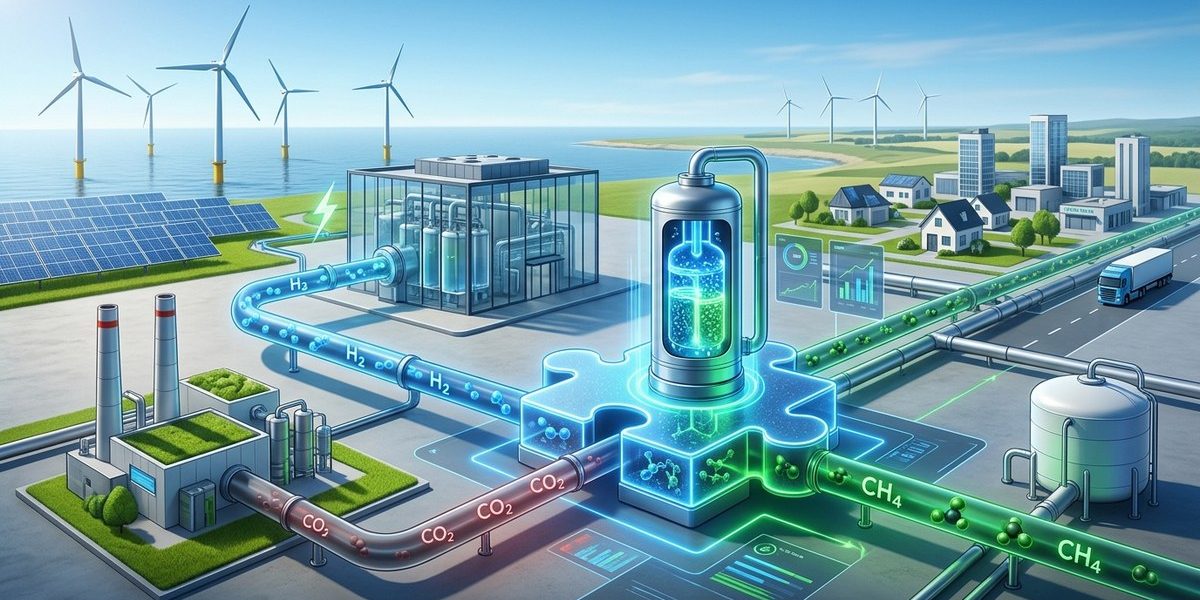
Denmark has built a world class wind fleet. Every gust over the North Sea spins a turbine somewhere. But here is the problem that keeps energy analysts awake at night. When the wind blows hardest, electricity prices can drop to zero or even negative. That surplus power has to go somewhere. Electrolysers can turn it into green hydrogen, which is brilliant. Yet hydrogen itself is notoriously difficult to store and move at scale. You need high pressure, cryogenic tanks, or expensive pipeline infrastructure. So what if we could turn that hydrogen into something that fits straight into the existing gas grid? Something that burns clean, stores easily, and uses pipes that already run under Danish streets. That is exactly what methanation does. It is the missing piece in Denmark’s green hydrogen puzzle, and in 2026 it is more relevant than ever.
Methanation converts green hydrogen and captured CO2 into synthetic methane, a drop-in fuel for Denmark’s existing natural gas network. This solves the storage and transport bottlenecks that pure hydrogen faces. For policy analysts, it means grid stability. For investors, it unlocks a revenue stream from excess wind power. For researchers, it closes the carbon loop.
What methanation actually does
Let us strip away the jargon. Methanation is a chemical reaction. You take hydrogen (H2) and carbon dioxide (CO2) and pass them over a nickel or ruthenium catalyst at the right temperature. The Sabatier reaction does the rest.
CO2 + 4H2 -> CH4 + 2H2O
The output is methane, water, and heat. That methane is chemically identical to the natural gas that heats homes in Copenhagen and powers industrial furnaces in Esbjerg. The beauty is that you can inject it into the existing gas grid without modifying a single burner tip.
For Denmark, this is a game changer. The country already has a sophisticated gas transmission network operated by Energinet. Instead of building a parallel hydrogen grid from scratch, which is costly and slow, you can use methanation to produce a fuel that flows through pipes that already exist.
Why pure hydrogen hits a wall
Hydrogen is a fantastic energy carrier. It is also a nuisance to handle. Its molecules are tiny, so it leaks through seals that hold methane perfectly fine. It embrittles steel over time. It requires compression to 350 or 700 bar for storage, or liquefaction at minus 253 degrees Celsius. Both processes eat up around 13 to 20 percent of the energy you started with.
Denmark’s plans for a dedicated hydrogen pipeline to Germany, originally slated for 2028, have already slipped to 2031. That delay, reported by Hydrogen Insight in early 2026, shows the real world friction of building new hydrogen infrastructure.
Methanation sidesteps these headaches. You produce methane at the electrolyser site, compress it modestly, and feed it into the grid. The gas network becomes your battery.
The three step process that makes it work
Here is how a typical Danish power-to-gas facility operates.
-
Electrolysis. Surplus wind energy splits water into hydrogen and oxygen. Modern PEM electrolysers from Danish manufacturers can ramp up and down in seconds, matching the variability of wind.
-
Carbon capture. CO2 is sourced from biogas upgrading, industrial point sources, or direct air capture. For a truly circular system, biogenic CO2 is the gold standard because it does not add fossil carbon to the atmosphere.
-
Methanation. Hydrogen and CO2 enter the reactor. The Sabatier reaction produces methane and water. The methane is dried, polished to grid specification, and injected.
The entire chain, from gust to gas meter, can achieve round trip efficiencies of 50 to 60 percent. That is competitive with other long duration storage technologies like pumped hydro, and far better than burning hydrogen in a gas turbine.
Where methanation fits into Denmark’s energy system
Denmark is not building one giant methanation plant. It is building a network of smaller, distributed units. Think of them as chemical batteries scattered across the country.
-
West Denmark has enormous wind capacity from the North Sea. When offshore farms produce more power than the interconnectors can export, methanation plants absorb the surplus and turn it into grid gas.
-
Biogas plants in Jutland already produce CO2 as a byproduct. Putting a methanation unit next to a biogas facility creates a closed loop. The biogas plant provides CO2 and a pipeline connection. The electrolyser provides hydrogen. The output is pipeline grade methane.
-
Industrial clusters around Aalborg and Fredericia can use the methane for high temperature heat. Cement and chemical manufacturers need flames, not electrons. Synthetic methane burns just like natural gas.
| Application | Storage method | Infrastructure needed | Best for |
|---|---|---|---|
| Pure hydrogen | High pressure tanks or cryogenic | New pipelines, new storage caverns | Industry with onsite H2 use |
| Methanation | Existing gas grid | No new pipes, existing storage in Lille Torup | Grid balancing, heating, export |
| Ammonia (H2 carrier) | Refrigerated tanks at minus 33 deg C | New ports, new cracking units | Maritime fuel, international trade |
The table shows that methanation wins on infrastructure reuse. Denmark already stores natural gas in the Lille Torup underground cavern. That same cavern can hold synthetic methane.
Common mistakes people make about methanation
There is a persistent myth that methanation is inefficient or that it wastes green hydrogen. Let us clear that up.
“Methanation is not a competitor to hydrogen. It is a complement. Hydrogen should go to industry and transport where it is irreplaceable. Methane should go to heating and grid storage where the existing infrastructure is already paid for.” – Dr. Henrik Lund, senior researcher at the Danish Energy Agency
The real mistake is treating all hydrogen use cases as equal. You would not use a sledgehammer to crack a walnut. Similarly, you would not build a hydrogen pipeline for seasonal storage when the gas grid already exists.
Another error is assuming that biogenic CO2 is scarce. Denmark’s biogas sector produces roughly 1.5 million tonnes of CO2 per year. That is enough to methanate around 270,000 tonnes of hydrogen, which corresponds to several gigawatts of electrolyser capacity.
What this means for energy policy analysts
If you model Denmark’s 2030 targets, you will notice something. The official roadmap assumes that 30 percent of Power-to-X output will be hydrogen and 70 percent will be derivatives like methane and methanol. That ratio matters.
For policy makers, the implication is clear. Support mechanisms should not favour hydrogen over methanation. Both need a level playing field. The Danish government’s 2026 tender for 1.2 GW of electrolysis capacity explicitly includes bonuses for projects that integrate with the gas grid. That is a smart move.
Methanation also changes the economics of electrolysers. Without it, an electrolyser sits idle when hydrogen demand is low or when storage is full. With methanation, the electrolyser can run whenever wind is cheap, because the methane output has a guaranteed home in the gas grid. This improves the project’s internal rate of return.
What this means for renewable energy investors
The investment case for methanation in Denmark is strengthening.
-
Revenue stacking. You earn money from hydrogen production, from grid balancing services, and from selling synthetic methane with a green certificate premium.
-
Carbon credits. Synthetic methane from biogenic CO2 can qualify for negative emissions accounting under the EU’s Carbon Removal Certification Framework.
-
Export potential. Germany needs green gas. Its hydrogen pipeline from Denmark is delayed, but its gas grid is already connected. Methane flows today.
Several Danish projects are already proving the model. The GreenLab facility in Skive combines electrolysis, biogas, and methanation on one site. The HySynergy project in Fredericia plans to inject synthetic methane into the grid from 2027.
What this means for sustainability researchers
The carbon accounting is where methanation gets really interesting.
If you use fossil CO2, the process is carbon neutral at best. You release the same CO2 that you captured. But if you use biogenic CO2 from a biogas plant, you are effectively recycling carbon that was already in the biosphere. The methane you burn releases biogenic CO2, which is part of the short term carbon cycle. That is a net reduction in atmospheric CO2 compared to burning fossil gas.
Researchers should focus on three areas.
-
Catalyst longevity. Nickel catalysts deactivate over time. New formulations with promoters like iron or cerium are showing promise in Danish trials.
-
Dynamic operation. Methanation reactors traditionally run at steady state. But wind power is variable. Can the reactor handle load changes without degrading? Early results from DTU suggest yes, with proper thermal management.
-
System integration. How do you size the electrolyser, the CO2 capture unit, and the methanation reactor relative to each other? Overbuild the reactor and it sits idle. Underbuild it and you curtail hydrogen.
The practical checklist for getting started
If you are evaluating a methanation project in Denmark, here is a bulleted checklist to guide your feasibility study.
-
Confirm CO2 source. Biogas upgrading is the cheapest. Industrial point sources are next. Direct air capture is still expensive at scale.
-
Check grid injection point. Energinet publishes capacity maps. Some nodes have limited capacity for new gas injection.
-
Size the electrolyser to match wind curtailment patterns. Historical data from Energinet shows that West Denmark has 400 to 800 hours of negative price events per year.
-
Plan for heat recovery. The Sabatier reaction is exothermic. That heat can feed district heating networks, improving overall economics.
-
Secure a gas purchase agreement. Danish gas traders are increasingly interested in certified green methane for corporate PPAs.
Why 2026 is the year methanation moves from pilot to commercial
Several factors have aligned.
The EU’s revised Renewable Energy Directive sets a target for 42 percent of hydrogen in industry to come from renewable sources by 2030. That creates demand for green molecules. Methanation is the fastest way to deliver them.
Denmark’s carbon tax on agriculture, introduced in 2025, makes biogas upgrading more attractive. Biogas operators are looking for ways to add value to their CO2 stream. Methanation does exactly that.
The cost of PEM electrolysers has fallen by 40 percent since 2022. That makes the hydrogen input cheaper. At the same time, carbon prices under the EU ETS are hovering above 90 euros per tonne. That makes methane from biogenic CO2 more valuable than fossil methane.
Putting it all into perspective
Denmark’s green hydrogen story has always been about more than just hydrogen. It is about using every electron wisely. Methanation is the tool that lets you store wind energy for months, use existing infrastructure, and produce a fuel that the market already understands.
For the energy policy analyst, it is a grid stability asset. For the investor, it is a diversified revenue stream. For the researcher, it is a rich field of chemical and systems engineering challenges.
The puzzle pieces are on the table. The electrolysers are being built. The CO2 is available. The gas grid is waiting. Methanation is the piece that connects them all.
Your next move
If you are working on a Danish Power-to-X project, take a hard look at methanation. Model it alongside pure hydrogen and ammonia. Run the numbers with 2026 capital costs and current carbon prices. You might find, as many project developers have, that methanation offers the shortest path to a positive net present value.
The technology is proven. The infrastructure exists. The policy framework is supportive. What is missing is simply the decision to build.
For a deeper look at how electrolysers integrate with methanation systems, read our guide on integrating power-to-gas systems for sustainable Danish industry. And if you want to understand the storage angle, our article on why green hydrogen storage is Denmark’s next big challenge covers the trade offs in detail.
The Danish energy transition is not waiting. Neither should you.