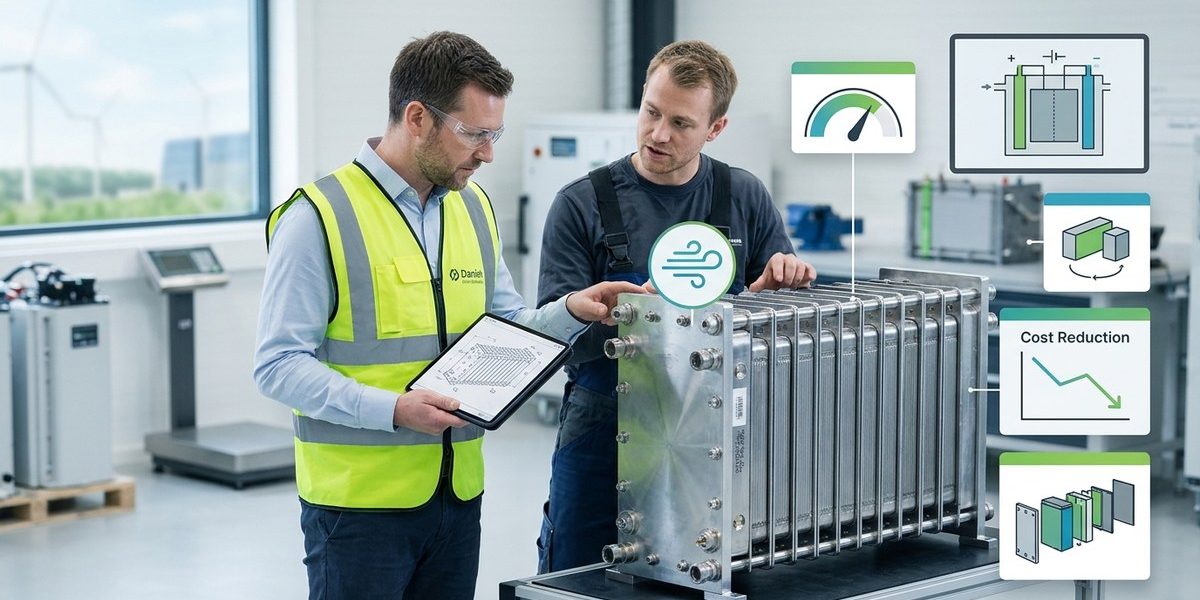
If you are evaluating technology suppliers for a green hydrogen project in the UK, you already know the single biggest barrier to final investment decision: capital expenditure. The stack is where the biggest cost lives. And for years, the accepted wisdom was that you had to trade performance for price. Danish manufacturers have been quietly rewriting that rule. They are not just building better stacks. They are building stacks that fundamentally change the project economics for developers like you.
Danish electrolyser stack design is cutting green hydrogen CapEx through seven specific innovations: modular cell architecture, advanced membrane coatings, standardised balance of plant interfaces, high current density operation, automated assembly, integrated thermal management, and novel end plate materials. Each one reduces the total installed cost per megawatt for UK developers.
Why Danish Stack Design Matters for Your Project Budget
Let us be direct about the numbers. The stack typically represents 40% to 50% of the total electrolyser system cost. When you are building a multi-megawatt plant in the UK, every percentage point reduction in stack cost translates directly into a healthier project IRR. Danish engineers have focused their attention on exactly this problem. They have not invented a completely new chemistry. They have instead made smart, incremental improvements to the things that matter most for your bottom line: material usage, manufacturing speed, and operational efficiency.
The result is a generation of stacks that cost less to build and less to run. And because these designs come from a country with some of Europe’s highest electricity prices, they have been optimised for the kind of variable renewable input you will see from a UK wind farm or solar array.
Seven Ways Danish Electrolyser Stack Design Lowers CapEx
Here is the numbered breakdown of the seven specific design choices that are driving down costs for developers like you.
-
Modular cell architecture. Danish stacks use standardised cell units that can be stacked in increments. You do not buy a fixed 10 MW block and leave capacity idle. You add cells as your hydrogen demand grows. This reduces upfront CapEx because you are not paying for future capacity you cannot yet use.
-
Advanced membrane coatings. The membranes in Danish stacks now use a thin ceramic coating that reduces ionic resistance. Less resistance means you can run the stack at higher current density without degrading efficiency. Higher current density means you need fewer cells to produce the same amount of hydrogen. Fewer cells means lower stack cost.
-
Standardised balance of plant interfaces. Danish manufacturers have agreed on common flange sizes, electrical connection points, and control protocols. This sounds boring. It is not. It means you can swap a stack from one supplier with minimal re-engineering of your balance of plant. That competition keeps prices down.
-
High current density operation. Typical alkaline stacks run at around 0.4 A/cm2. New Danish designs push past 0.6 A/cm2. The same physical footprint produces more hydrogen. Your building, your foundations, and your electrical infrastructure all get smaller. That is a direct CapEx saving.
-
Automated assembly lines. Danish factories have invested heavily in robotic cell stacking and welding. Manual assembly is expensive and inconsistent. Automation brings down manufacturing cost and improves quality. Those savings pass to you.
-
Integrated thermal management. Instead of a separate cooling system bolted on the side, Danish stacks embed cooling channels directly into the end plates. This removes a whole subsystem from your bill of materials. Less piping, fewer pumps, fewer leak points.
-
Novel end plate materials. Traditional stainless steel end plates are heavy and expensive. Danish designers now use a reinforced polymer composite that is lighter, cheaper to manufacture, and just as strong. Lower material cost and easier installation.
The Practical Impact on Your Project Economics
Let us put some rough numbers around this. A typical UK green hydrogen project in 2026 might target a total installed CapEx of around GBP 1,200 per kilowatt. The stack portion of that is roughly GBP 500 per kilowatt. The seven Danish design innovations can together reduce stack cost by 20% to 30%. That is GBP 100 to GBP 150 per kilowatt saved.
For a 50 MW plant, that is GBP 5 million to GBP 7.5 million off your total project cost. That kind of saving can be the difference between a project that gets financed and one that sits on the shelf.
How to Evaluate Stack Designs for Your Project
When you are sitting across the table from a technology supplier, here are the questions you should ask. I have put them in a table so you can use it as a checklist during your next supplier meeting.
| Evaluation criterion | What to look for | Why it matters |
|---|---|---|
| Cell area | Larger active area (above 2,000 cm2) | Fewer cells needed per MW, lower assembly cost |
| Current density rating | Rated above 0.5 A/cm2 | Smaller stack for same output, lower building cost |
| Membrane type | Thin composite with ceramic coating | Lower resistance, higher efficiency at high load |
| End plate material | Polymer composite or aluminium | Lighter, cheaper, easier to install |
| Cooling integration | Embedded channels in end plates | Removes external cooling system cost |
| Assembly method | Robotic or semi-automated | Consistent quality, lower manufacturing cost |
| Interface standard | Common flange and electrical spec | Easier supplier switching, competitive pricing |
What Experienced Developers Are Saying
I have spoken with senior project managers who have already specified Danish stacks for UK projects. One engineering manager at a large UK hydrogen developer put it this way:
“We ran the numbers on a 20 MW project using a traditional stack versus a Danish modular design. The Danish stack saved us nearly GBP 1.2 million on the balance of plant alone. That is before we even turned on the production. The integrated thermal management was the clincher.”
That kind of feedback is becoming more common. The Danish approach is not theoretical. It is being deployed in real projects today.
Common Mistakes When Specifying Electrolyser Stacks
Avoid these pitfalls during your technology evaluation:
- Choosing based on stack price alone. A cheap stack that requires expensive balance of plant is not a bargain. Look at total system CapEx.
- Ignoring current density. A stack rated for low current density means you need more cells and a larger building. That adds cost everywhere.
- Overlooking interface standardisation. A proprietary interface locks you into one supplier. That kills your ability to negotiate on price for future expansions.
- Assuming all alkaline stacks are the same. Danish designs are not your grandfather’s alkaline electrolyser. The material science has moved on.
The Role of Manufacturing Scale in Cost Reduction
Danish stack manufacturers have been scaling up production lines since 2023. By 2026, several factories are running at annual capacities above 500 MW. Scale brings down unit costs. It also drives process improvements. The more stacks they build, the better they get at building them.
This is a virtuous cycle. Lower costs attract more orders. More orders justify more factory capacity. More capacity drives costs down further. UK developers benefit from being early adopters of this scaling curve.
What This Means for Your 2026 Project Decisions
If you are planning a final investment decision in 2026, the timing is good. Danish stack designs have matured. The manufacturing capacity is there. The cost data from early projects is now available. You are not taking a gamble on unproven technology.
You can compare real performance data from operating plants. You can visit factories. You can talk to engineering teams who have already commissioned similar systems. The risk profile is lower than it was even two years ago.
How to Start Your Supplier Evaluation
Here is a practical process to follow:
- Gather performance data from at least three Danish stack manufacturers. Ask for current density curves, efficiency maps, and degradation rates.
- Request a total system CapEx breakdown. Not just the stack price. Include balance of plant, installation, and commissioning.
- Visit a reference plant. See the stack operating in real conditions. Talk to the plant operator.
- Run your own financial model. Use the supplier’s data to calculate your project IRR. Do not rely on generic assumptions.
- Negotiate a framework agreement. If you have multiple projects in your pipeline, a volume commitment can unlock better pricing.
For a deeper look at how Danish electrolyser technologies are transforming production economics, read our guide on maximizing green hydrogen production with Danish electrolyser technologies.
What the UK Can Learn from Denmark’s Approach
Denmark has a few advantages that UK developers can replicate. Strong offshore wind resources. A tradition of cooperative energy policy. And a pragmatic engineering culture that values simplicity over complexity. The stack designs coming out of Denmark reflect that culture.
But the UK has advantages too. A larger domestic market. More ambitious hydrogen production targets. And a growing pool of experienced project developers. The smart move is to take the best of Danish stack engineering and apply it within the UK’s policy and regulatory framework.
For a broader perspective on the lessons the UK can draw from Denmark’s experience, see our analysis on what the UK can learn from Denmark’s green hydrogen pioneers.
Your Next Steps for Lowering Green Hydrogen CapEx
The evidence is clear. Danish electrolyser stack design is not a marginal improvement. It is a structural shift in how stacks are built and how they perform. The seven innovations we have covered modular architecture, advanced membranes, standardised interfaces, high current density, automated assembly, integrated cooling, and novel materials all work together to reduce your total installed cost.
If you are a senior project developer or engineering manager, the question is not whether to evaluate Danish stacks. It is how soon you can start the evaluation process. The projects that move first will capture the best pricing and the shortest delivery times.
To understand how Denmark is building the infrastructure to support these technologies at scale, read about how Denmark is leading the transition to green hydrogen infrastructure.
The Bottom Line for Your Project Budget
You have a job to do. You need to deliver green hydrogen at a cost that makes your project viable. Danish electrolyser stack design gives you a clear path to lower CapEx without sacrificing performance or reliability. The technology is proven. The manufacturing capacity exists. The cost savings are real.
Start your supplier conversations this quarter. Request the data. Run your model. And see for yourself what a difference these seven design innovations can make to your project numbers.