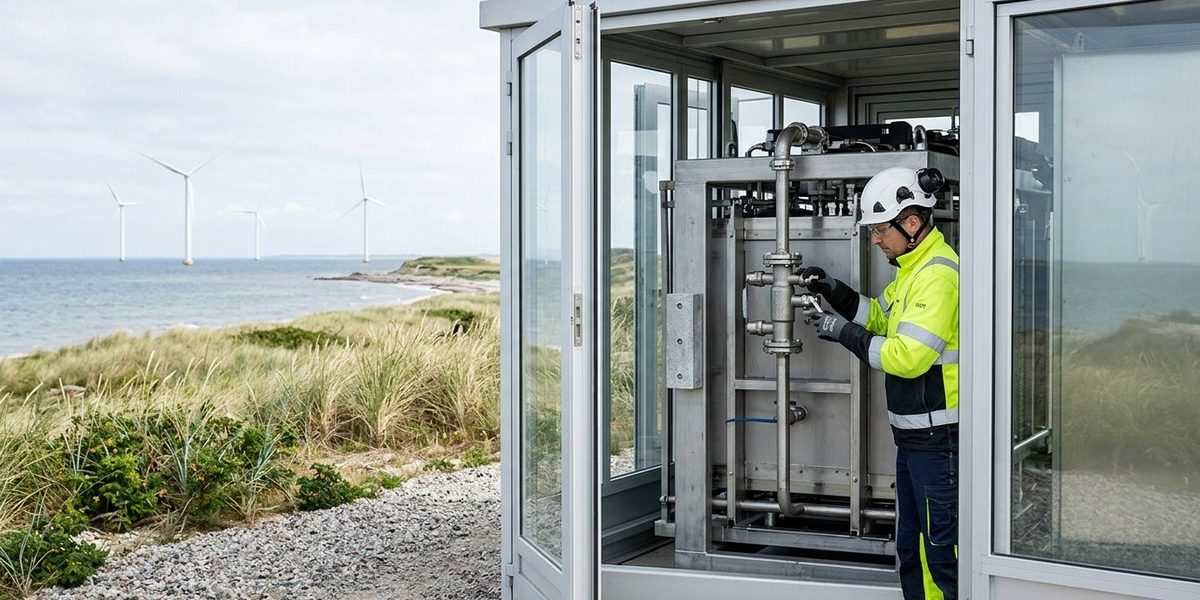
Denmark’s coastline is a gift. It gives us strong winds, reliable waves, and a natural advantage for green hydrogen production. But if you manage a PEM electrolyser near the North Sea or the Baltic, you know that gift comes with a price. Salt spray, high humidity, and the constant cycle of wind and weather create a uniquely aggressive environment for your most valuable asset.
You have likely seen the warning signs. A slow rise in cell voltage. A dip in hydrogen purity. Or the dreaded pinhole failure that shuts down a stack weeks ahead of schedule. These problems are not random. They follow predictable patterns when you understand how Denmark’s coastal conditions attack the membrane, the bipolar plates, and the balance of plant. The best maintenance strategies treat these threats as a known enemy.
The most effective PEM electrolyser maintenance in Denmark’s coastal environment focuses on three priorities: preventing salt ingress through rigorous air filtration, managing humidity inside the stack enclosure, and scheduling proactive membrane inspections based on operating hours rather than calendar months. A tailored plan can extend stack life by 20 to 30 per cent.
Why the Danish Coast Puts Unique Stress on PEM Electrolysers
PEM electrolysers are sensitive machines. They rely on thin proton exchange membranes that can degrade when exposed to contaminants. On Denmark’s coast, the main contaminant is sodium chloride carried by sea breezes. Even trace amounts of salt ions can leach into the membrane and cause premature failure.
The problem is not just the salt itself. It is how salt combines with humidity. When relative humidity stays above 80 per cent, which it often does in Jutland’s coastal zones, salt particles become hygroscopic. They attract moisture and form conductive bridges across the bipolar plates. This accelerates corrosion and increases cell resistance.
Wind patterns also matter. A site near Esbjerg faces different exposure than one near Helsingør. The prevailing westerlies carry marine aerosol inland, so facilities on the west coast need stronger defences than those in the sheltered Baltic. You cannot use a one size fits all maintenance plan.
The Three Pillars of a Coastal Maintenance Plan
A robust strategy for PEM electrolyser maintenance in a Danish coastal environment rests on three interconnected pillars. Ignore one, and your system’s reliability will suffer.
1. Air Intake and Filtration
Your electrolyser breathes the local air. If that air is salty, your system is under attack from the moment it starts. The first line of defence is the air intake for the ventilation and cooling systems.
- Install multi stage filters with a minimum efficiency reporting value (MERV) of at least 13.
- Add a dedicated pre filter that captures salt aerosols before they reach the main filter bank.
- Replace pre filters every three months during winter storms, when sea spray is heaviest.
- Monitor differential pressure across the filters to spot clogging early.
2. Enclosure Climate Control
The stack enclosure should maintain a stable, low humidity environment. Condensation is the enemy. When warm, humid air hits cool metal surfaces inside the enclosure, water droplets form. Those droplets can carry dissolved salts directly onto the membrane.
- Use desiccant dehumidifiers rather than refrigerant types, because they work better at lower temperatures.
- Seal all cable and pipe penetrations with marine grade gaskets.
- Install humidity sensors inside the enclosure and set an alarm at 60 per cent relative humidity.
- Run a purge cycle with dry nitrogen whenever the system shuts down.
3. Proactive Stack Diagnostics
Waiting for a voltage alarm is expensive. By the time you see a high cell voltage, damage has already occurred. Instead, schedule regular diagnostic tests that catch degradation early.
- Perform a weekly cell voltage scan. Log every cell and look for outliers.
- Run a crossover test monthly to check for membrane thinning or pinholes.
- Conduct a polarisation curve test every quarter to track overall stack health.
- Replace gaskets and seals on an annual schedule, not a reactive one.
- Use a borescope to inspect the stack end plates for corrosion every six months.
Common Mistakes and How to Avoid Them
Even experienced teams make errors when adapting to coastal conditions. Here are the most frequent mistakes and the correct approach.
| Mistake | Why It Happens | Better Approach |
|---|---|---|
| Using standard HVAC filters | Cost saving on initial build | Upgrade to marine rated filters from day one |
| Ignoring enclosure humidity | Focus only on stack performance | Install continuous humidity monitoring |
| Following OEM maintenance intervals blindly | OEM assumes inland conditions | Shorten intervals by 30 to 40 per cent for coastal sites |
| Skipping pre filters | Maintenance team unaware of salt load | Add pre filters and train staff on coastal risks |
| Relying only on voltage monitoring | Voltage is a lagging indicator | Add crossover and polarisation tests |
A Seasonal Maintenance Calendar for Danish Coastal Sites
Denmark’s seasons are not subtle. The difference between a calm July day and a November storm is enormous. Your maintenance schedule should reflect that.
- Winter (November to February). This is the high risk season. Storm surges and strong winds push salt spray further inland. Increase filter inspections to every two weeks. Check enclosure seals after every major storm. Run the dehumidifier at maximum capacity.
- Spring (March to May). The weather is milder but humidity remains high. This is the best time for a full stack inspection. Replace any gaskets that show signs of hardening. Clean the air intake louvers thoroughly.
- Summer (June to August). Lower humidity means less stress on the membrane. Use this window for major maintenance like stack replacement or membrane exchange. The conditions are more forgiving for opening the enclosure.
- Autumn (September to October). Prepare for winter. Test all backup systems including the nitrogen purge. Stock spare pre filters. Review the data logs from the previous winter to spot any emerging trends.
Expert advice. “The most reliable indicator of coastal degradation is not voltage. It is the rate of fluoride ion release in the product water. If you measure fluoride levels weekly, you can see membrane thinning weeks before it shows up in performance data. This single test has saved my clients millions in avoided stack replacements.” — Henrik Sørensen, Senior Electrolyser Engineer, Green Hydrogen Denmark.
How to Build a Coastal Specific Maintenance Plan
You need a written plan that your team can follow without guesswork. Here is a practical structure.
- Site Assessment. Map the prevailing wind direction. Identify the closest seawater source. Measure baseline salt concentration in the air at the intake point.
- Filtration Strategy. Specify filter types, replacement intervals, and alarm set points. Include a protocol for post storm filter checks.
- Enclosure Management. Define target humidity levels. List all seal points. Document the nitrogen purge sequence.
- Diagnostic Schedule. Create a table of tests with frequencies and acceptable thresholds. Assign responsibility for each test.
- Seasonal Adjustments. Add or remove tasks based on the calendar. Include a pre winter checklist and a post winter review.
- Spare Parts Inventory. Keep critical spares on site. Coastal sites cannot rely on next day delivery during a storm.
The Financial Case for Proactive Maintenance
A PEM electrolyser stack for a 10 MW system costs around 3 million DKK to replace. A full set of upgraded filters, dehumidifiers, and monitoring equipment costs roughly 150,000 DKK. That is a 20 to 1 return on investment if it extends stack life by just one year.
But the savings go deeper. Unplanned downtime at a coastal facility can cost 50,000 DKK per day in lost hydrogen production. A single unplanned shutdown during a winter storm, when wind power is abundant and hydrogen prices peak, can wipe out a month of profit. Proactive maintenance is not an expense. It is a revenue protection strategy.
Integrating Your Plan with Wider Operations
A maintenance plan does not exist in isolation. It connects to your overall asset management, your safety protocols, and your long term investment strategy. For example, if you are planning to expand your site, the lessons from your current coastal maintenance should influence the design of new enclosures and air handling systems.
You can also use the data from your diagnostics to optimise your operating strategy. If you notice that cell degradation accelerates during periods of high current density, you can adjust your production schedule to avoid those peaks during stormy months. This kind of operational intelligence comes directly from a disciplined maintenance regime.
For a deeper look at how Danish projects are tackling these challenges, read about what Denmark’s green hydrogen pilot projects reveal about future infrastructure needs. The lessons from those early sites directly inform the maintenance strategies we use today.
Preparing for the Next Generation of Electrolysers
The PEM electrolysers being installed in 2026 are more resilient than their predecessors. Manufacturers have improved bipolar plate coatings and membrane durability. But no coating can withstand constant salt exposure without help.
As you plan for future upgrades, consider specifying systems with sealed enclosures and integrated dehumidification as standard. Some manufacturers now offer “coastal protection packages” that include upgraded filtration and corrosion resistant materials. These packages add about 5 per cent to the capital cost but can reduce maintenance spend by 25 per cent over the system’s life.
Also, look at the latest innovations in top innovations in Danish electrolyser technologies for 2026. Many of these advances focus on robustness in real world conditions, not just laboratory efficiency.
Your Next Steps
Start small. If you manage a single site, begin with the air filtration audit. Check your current filter specifications. Measure the humidity inside the enclosure. Buy a handheld fluoride ion tester for the product water. These three actions will tell you more about your system’s coastal health than a year of voltage data.
If you oversee multiple sites, create a standardised coastal maintenance template. Use it across all locations, but adjust the filter intervals and inspection frequencies based on each site’s specific exposure. Share the learnings between sites. A problem spotted in Thyborøn can be prevented in Køge.
The Danish coast will not get less salty. The wind will not blow less often. But your PEM electrolysers can thrive here if you treat maintenance as a strategic advantage rather than a reactive chore. Build the plan, train the team, and check the data. Your stacks will thank you.