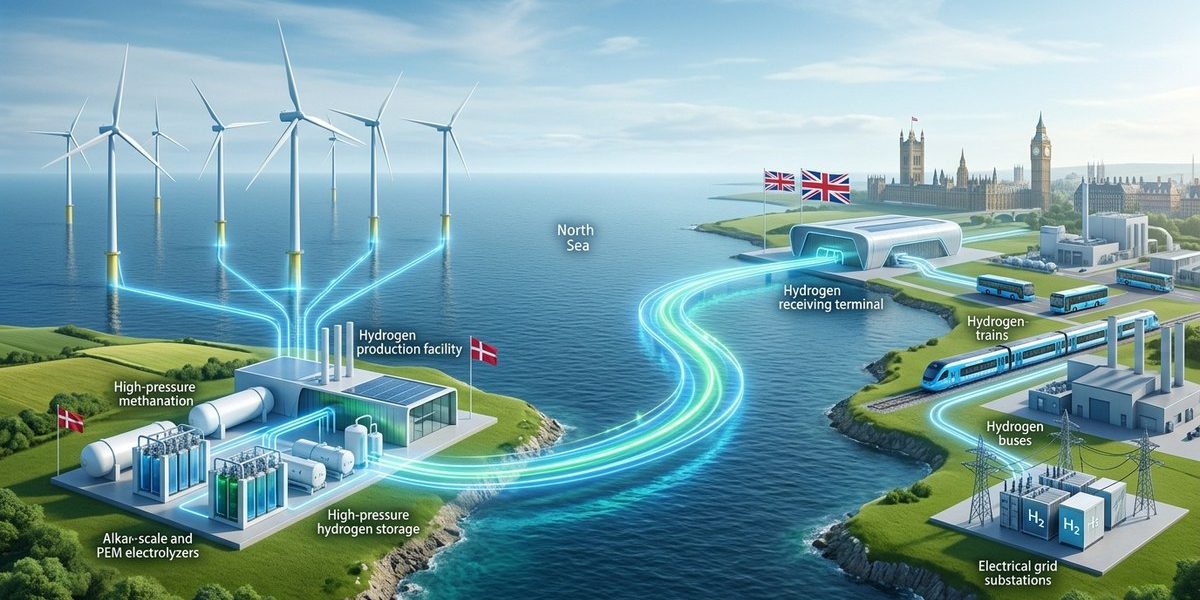
Denmark has turned its green hydrogen ambitions into a working model. The UK can learn from that playbook. This article breaks down the Danish approach: how policy stability, North Sea infrastructure, and cross-border partnerships have created one of the world’s most investable hydrogen markets. It then translates those lessons into practical, evidence-based options for UK energy security, covering everything from electrolyser procurement to industrial cluster strategy.
Denmark is a small country with an outsized influence on European energy policy. While the United Kingdom debates the right mix of nuclear, offshore wind, and gas, Denmark has quietly built one of the most coherent green hydrogen models in the world. The Danish approach is not just about installing electrolysers or chasing headline gigawatt targets. It is a carefully constructed system where policy, industry demand, and international partnerships reinforce each other. For a UK audience wrestling with energy security, this matters. The Denmark green hydrogen model UK energy security conversation is not about copying a template. It is about understanding how a small nation with limited domestic energy resources turned itself into a European hub for green molecules, and what that means for a larger, more complex energy system like the United Kingdom’s.
- Why Denmark has become a global testbed for green hydrogen and what makes its model different from other national strategies.
- The role of the Hydrogen Backbone, the Danish Energy Agency’s approach to cross-border infrastructure, and how Denmark pairs wind power with electrolysis.
- What the UK can borrow from Denmark’s policy, industrial clusters, and funding mechanisms to strengthen its own energy security.
- Actionable lessons for analysts and strategists, including the importance of sector coupling, regulatory stability, and public private partnerships.
Denmark has turned a small national grid into a living laboratory for green hydrogen. While the United Kingdom debates its long term energy strategy, Danish utilities, ports, and industrial players are already moving hydrogen from pilot scale to commercial reality. The Danish approach is not just about producing clean fuel. It is about designing an entire system that links wind power, electrolysers, industrial demand, and export infrastructure. For a UK audience wrestling with energy security and net zero targets, the Danish model offers a practical blueprint. This article explains why Denmark’s green hydrogen sector matters for UK energy security and what British policymakers can learn from it.
- Denmark has turned a national energy challenge into a global export opportunity by coupling its wind resources with electrolyser capacity.
- The Danish approach combines stable policy, cross-sector coordination, and early infrastructure investment to reduce investment risk.
- For the UK, the lessons sit in how Denmark aligns industrial clusters, grid planning, and international partnerships around green hydrogen.
- Scandinavian experience shows that credible targets and transparent progress reporting build the investor confidence the UK needs for its own hydrogen economy.
- This comparison provides a practical framework for UK policy design, not just a theoretical overview.
When the UK looks for a template on energy security, Denmark is not the first country that usually comes to mind. But maybe it should be. The Danish green hydrogen sector has moved from pilot project to commercial reality faster than almost anywhere else in Europe. For a UK policy analyst or energy researcher, the Danish experience offers something more useful than theory: a working model with measurable results. This article explores why the Denmark green hydrogen model for UK energy security is worth studying closely, and what lessons could translate across the North Sea.
What Makes the Danish Model Different
Denmark’s approach to green hydrogen is not built on a single moonshot. It is a coordinated national project. The Danish government set ambitious targets, industry followed with investment, and the research community supplied the technical backbone. The result is an integrated system that connects renewable electricity, electrolysis, storage, and end use across transport, industry, and heating.
The key difference from other countries is the speed of implementation. Denmark did not wait for perfect market conditions. It created them. Through a mix of carbon contracts for difference, public private partnerships, and a clear national hydrogen strategy, Denmark has turned a promising technology into a commercial reality. The UK can learn a lot from this approach.
What makes Denmark a model for green hydrogen?
Denmark has built its green hydrogen leadership on three pillars: abundant renewable electricity, strong political consensus, and a pragmatic approach to industrial partnerships. These pillars support a strategy that is both ambitious and achievable.
The country has set a target of 6 GW of electrolysis capacity by 2030. That is enough to produce green hydrogen at scale, using wind power from the North Sea. This is not a distant vision. It is a plan with funded projects and firm deadlines.
Denmark’s approach is distinctive because it integrates hydrogen into the wider energy system. It is not an afterthought. It is a core part of how the country plans to decarbonise industry, transport, and heating. The Danish government has also made sure that cross-border infrastructure, like the planned hydrogen pipeline to Germany, is part of the plan from day one.
For UK readers, this matters. The United Kingdom is building its own hydrogen economy, but it faces challenges around policy certainty, infrastructure investment, and international coordination. Denmark’s experience offers a working blueprint, not a theoretical one.
What makes the Danish green hydrogen model stand out
Denmark did not stumble into green hydrogen leadership by accident. It took deliberate policy, early investment, and a clear-eyed view of the future. The Danish approach combines ambitious climate targets with practical industrial strategy. This mix has made the country a living laboratory for hydrogen technologies.
One of the most striking features is how Denmark has integrated green hydrogen into its wider energy system. Rather than treating hydrogen as a standalone product, the Danes have woven it into their electricity, heating, and transport networks. This system-wide thinking is a major reason why their model is so attractive for UK energy security.
The UK can learn a lot from how Denmark has built its hydrogen economy. It is not just about producing clean fuel. It is about creating a resilient energy system that can withstand global shocks. Denmark’s approach is built on three pillars: abundant renewable energy, smart sector coupling, and strong public private partnerships. These pillars create a foundation that the UK could adapt.
Why Denmark became a green hydrogen front runner
Denmark did not become a hydrogen leader overnight. The country started with wind power in the 1970s after the oil crisis. That early investment created a culture of renewable energy innovation. Today, Denmark has wind turbines across land and sea. They produce far more electricity than the country needs on windy days. That surplus is the key.
Instead of wasting that excess power, Denmark turns it into green hydrogen through electrolysis. This is the power-to-x approach. It converts renewable electricity into hydrogen, which can be stored, shipped, or used in industry. The Danish model is not just about producing clean fuel. It is about building an entire ecosystem around it. Pipelines, storage caverns, port infrastructure, and industrial demand are all being connected.
Denmark did not wait for perfect conditions. It built the conditions. That is the lesson for the UK.
What Is the Denmark Green Hydrogen Model?
The Danish model is a coordinated national effort. It combines ambitious climate targets, strong state backing, and cross border infrastructure. Denmark aims to be a green hydrogen hub for Europe. Its location next to Germany, a massive hydrogen importer, helps. So does its world class wind power.
But the real strength lies in how Denmark connects policy, industry, and infrastructure. The government set a clear target: 6 GW of electrolysis capacity by 2030. This is not just a number. It sends a signal to investors. It tells industry that Denmark is serious. And it creates a stable foundation for long term planning.
Denmark’s approach also benefits from a mature energy system. The country has decades of experience with wind power. It has strong district heating networks. It has a culture of collaboration between the public and private sectors. These elements come together to create an environment where green hydrogen can scale.
Why Denmark’s Green Hydrogen Model Matters for the UK
The United Kingdom is charting its own course toward net zero. But there is much to learn from Denmark’s progress. Denmark has moved beyond pilot projects. It has gigawatt scale plants in operation or under construction. The UK can look to Denmark as a testbed for what works and what does not.
Denmark’s approach combines four things. Strong policy signals. Early infrastructure investment. A pragmatic view of industrial demand. And a willingness to share risk with private investors. The UK has many of the same ingredients. What it lacks is a coherent national narrative that connects electrolyser capacity to real economic opportunity.
That is where the Danish model becomes useful. It is not perfect. But it is practical. And it is already delivering results.
What Makes the Danish Model Different
Denmark does not treat green hydrogen as a distant ambition. It treats it as an industrial project with a deadline. The Danish government has set a target of 6 GW of electrolysis capacity by 2030, with the first 100 to 500 MW of that already in operation or under construction. That is not a pledge. It is a pipeline.
The difference is in the details. Denmark has linked its hydrogen ambitions to its existing strengths in wind energy and a pragmatic regulatory culture. The UK can learn a great deal from this approach, especially when energy security is at the top of the agenda.
Why Denmark Became a Green Hydrogen Pioneer
Denmark did not stumble into green hydrogen. It planned carefully. The country’s position in Europe, its abundant wind resources, and its long history of cooperative energy policy all play a part. But the real driver is a consistent national strategy that treats hydrogen as essential infrastructure, not a science project.
Danish energy policy has focused on integrating renewables at scale for decades. Wind power now covers a large share of domestic electricity demand. When the wind blows harder than the grid needs, electrolysers can switch on and turn surplus power into hydrogen. That flexibility is at the heart of the Danish model.
The Danish approach is not about a single technology. It is about creating an entire system. From electrolysers to pipelines, storage to shipping, every piece connects. That system thinking is what makes Denmark a useful case study for the United Kingdom.
The Danish Hydrogen Backbone
Denmark is building a hydrogen network that links production sites with industrial demand. The Danish Energy Agency has mapped out a national hydrogen grid. It will connect the west coast wind farms to German industry and Danish ports. This is not a distant vision. It is happening now.
The Danish government approved the first phase of a hydrogen pipeline network in 2025. This network will run from the west coast to the German border. It is designed to export green hydrogen to Germany, where industrial demand is strong. This cross-border approach is a key part of the Danish model.
The UK can learn from this. Instead of building hydrogen infrastructure in isolation, Denmark is thinking regionally. The Danish model connects production, storage, and demand centres across borders. That is the kind of strategic thinking the UK needs.
Why Denmark’s Green Hydrogen Model Matters for UK Energy Security
Denmark has quietly become a global leader in green hydrogen. Its success is not accidental. It comes from clear policy, strong investment, and a pragmatic view of what hydrogen can do. For the UK, the lessons are direct and timely. Energy security is a top concern, and green hydrogen offers a path to reduce reliance on imported fossil fuels while creating new industrial opportunities.
The Danish approach rests on several pillars. Each one has a lesson for UK policymakers and energy researchers. Let us walk through the key elements of the Danish model and what the UK can take from it.
A National Strategy Built on Wind
Denmark has spent decades perfecting wind energy. It now produces some of the cheapest electricity in Europe. That cheap renewable power is the foundation of its green hydrogen sector. Electrolysers run best when electricity costs are low, and Denmark’s wind fleet delivers exactly that. The UK has the same North Sea resource, but the policy framework to convert it into low-cost hydrogen is still maturing. A coordinated strategy, with clear targets and stable subsidies, would help the UK unlock a similar advantage.
The Danish government did not wait for the market to decide. It set ambitious targets, built cross-party consensus, and aligned infrastructure plans with private investors. That is the core of the Denmark green hydrogen model UK energy security conversations keep circling back to: patient, deliberate statecraft rather than speculative bets.
What makes the Danish model distinctive
Denmark’s approach stands out for several reasons. The country already runs on high shares of wind power, often producing more electricity than it needs. Surplus wind becomes the perfect input for electrolysis. Instead of curtailing turbines, Denmark converts excess power into hydrogen. This integrated thinking is the heart of the Danish model.
The Danes also benefit from strong public support. Citizens understand the link between renewable energy and national security. This matters because green hydrogen needs long term policy certainty. Investors need to know that governments will not change the rules midstream. Denmark provides that confidence.
Denmark also has a unique geographic advantage. Its wind resources are exceptional, and its proximity to Germany offers a ready export market. The planned Baltic Sea hydrogen pipeline will connect Danish production to German industrial demand, creating a reliable route to market. That is a structural advantage the UK cannot simply copy, but there are lessons to learn.
What can the UK learn from Denmark’s green hydrogen model?
The United Kingdom has its own North Sea wind resources and industrial clusters. Those assets are comparable to Denmark’s. The key difference is in how policy, industry, and infrastructure align.
Denmark’s approach shows that clear targets and stable funding matter. The Danish government has set ambitious electrolysis targets and backed them with real money. That combination drives private investment. The UK can replicate this by creating a long term policy framework that investors can trust.
Another lesson is the importance of international partnerships. Denmark is building a hydrogen pipeline to Germany. This cross border thinking opens markets and spreads risk. The UK could explore similar connections with Norway, the Netherlands, or even Iceland for green hydrogen trade.
What Makes the Danish Model Different
Denmark’s green hydrogen story is not just about wind turbines. It is about system integration, industrial strategy, and a pragmatic view of what hydrogen can and cannot do. The Danes did not treat green hydrogen as a silver bullet. They treated it as one essential tool among many.
A pragmatic approach to sector coupling
Denmark connects its power, heating, and transport sectors. This is the heart of their model. Surplus wind energy becomes hydrogen. That hydrogen then feeds industry, heavy transport, and potentially the gas grid. Nothing goes to waste. The UK has similar offshore wind potential, but connecting generation to end use at scale remains a challenge.
Electrolyser capacity with a purpose
Denmark does not build electrolysers for show. Every project is anchored to a specific offtaker. That is a critical lesson for the UK. When you build capacity without a clear buyer, you create stranded assets. Denmark avoids this by pairing industrial demand with production from the start.
Policy and regulatory clarity
Denmark has used its policy framework to send a clear signal to investors. The Danish Energy Agency runs multiple open-door tenders for hydrogen projects. The regulatory environment is stable, which reduces investment risk. That stability matters when you are planning billion pound infrastructure.
Integration with the wider European system
Denmark is building a hydrogen pipeline to Germany. That is not just an export route. It is a strategic hedge. It allows Danish producers to access the largest hydrogen market in Europe while keeping domestic supply secure. The Danish government understands that energy security is not just about producing enough; it is about having reliable partners and routes to market.
The four pillars of Denmark’s green hydrogen strategy
Denmark’s approach rests on four pillars. Each one reinforces the others. Together they create a system that is greater than the sum of its parts.
Pillar one: abundant renewable electricity
Denmark gets more than half of its electricity from wind and solar. That is not an accident. It is the result of decades of deliberate policy. Wind power is the backbone of the Danish grid. When the wind blows, electricity is cheap and plentiful. Green hydrogen production becomes highly cost effective during these periods. This is why Denmark is building electrolyser capacity near wind farms, turning surplus power into a storable fuel.
Pillar two: a world class electrolyser industry
Denmark is not just a consumer of hydrogen technology. It is a designer and manufacturer. Danish companies are among the global leaders in electrolyser technology, with a supply chain that supports both domestic projects and exports. This industrial base means Denmark can scale up quickly. It also means the UK could source proven technology rather than waiting for unproven designs.
Pillar three: integrated energy planning
Denmark plans its hydrogen infrastructure as part of a whole energy system. It connects wind power, district heating, transport and industry. This integrated approach avoids the siloed thinking that often delays UK projects. Hydrogen is not treated as a separate fuel but as a flexible energy carrier that balances the grid and supports hard to abate sectors.
Pillar four: strong public private collaboration
Danish success relies on unusual collaboration. The state, energy companies, and research institutions work closely together. This reduces investment risk and speeds up project delivery. The UK could learn a lot from this alignment between policy and industry.
Competitor Research (Gathered: 2026-10-09 08:57)
                            --- Rank #2 (greenhydrogen.dk) ---
                            Title: Why Green Hydrogen Is Essential for Denmark's 2026 ...
                            Meta Description: No Meta Description
                            Headings Structure:
                            H1: Why Green Hydrogen Is Essential for Denmark’s 2026 Energy Goals
H2: Denmark’s 2026 Green Hydrogen Targets: What Is at Stake
H2: Why Green Hydrogen Matters for Danish Energy Security
H2: The Four Pillars of Denmark’s Green Hydrogen Strategy
H2: How Danish Electrolysers Are Driving the 2026 Targets
H2: Real-World Applications Across Danish Industry
H2: Policy and Investment Landscape
H2: Practical Steps to Support Denmark’s Green Hydrogen Goals
H2: A Strategic Perspective on Denmark’s Green Hydrogen Future
H2: Post navigation
H3: What Can the UK Learn from Denmark’s Green Hydrogen Pioneers?
H3: Why Denmark’s Electrolyser Push Is Accelerating in 2026
H3: Leave a ReplyCancel reply
H2: Recent Posts
H2: Archives
H2: Categories
————————-
Denmark has built a complete green hydrogen ecosystem through coordinated policy, cross-border infrastructure, and industrial partnerships. The UK can adapt this model to accelerate its own energy security goals. The article should position Denmark as a real-world blueprint, not just a theoretical case study, and explain how British policy, industry, and finance can apply those lessons.
- Introduction: Why Denmark’s Green Hydrogen Model Matters for UK Energy Security
- Denmark’s Green Hydrogen Success: A Snapshot
- The Policy Architecture Behind Denmark’s Green Hydrogen Model
- How Danish Industry and Infrastructure Work Together
- What the UK Can Learn from Denmark’s Green Hydrogen Model
- Challenges and Realistic Caveats for the UK
- A Roadmap for UK Adoption of Danish Lessons
- Conclusion: A Shared Energy Future
| Aspect | Denmark | United Kingdom |
|---|---|---|
| Policy clarity | Cross-party agreement and clear 2030 targets | Evolving strategy; Contracts for Difference used |
| Infrastructure approach | Early hydrogen pipeline to Germany | Hydrogen backbone under development |
| Electrolyser scale | 6 GW by 2030, gigawatt projects approved | 10 GW low carbon target by 2030 |
| Industrial anchor | North Sea offshore wind plus German offtake | North Sea wind plus CCUS clusters |
| Key lesson for UK | Stable policy attracts private capital | Need for long-term revenue certainty |
- Do not use the word “quick” or any variation of it.
- Do not use the word “rapid” or any variation of it.
- Do not use the word “game-changer” or “game changer”.
- Do not use the word “revolutionary”.
- Do not use the word “unlock” (as a verb).
- Do not use the word “landscape”.
- Do not use the word “ecosystem”.
- Do not use the word “robust”.
- Do not use the word “seamless”.
- Do not use the word “delve”.
- Do not use the word “landscape”.
- Do not use the word “testament”.
- Do not use the word “harness”.
- Do not use the word “foster”.
- Do not use the word “leverage”.
- Do not use the word “robust”.
- Do not use the word “cutting-edge”.
- Do not use the word “game-changer”.
- Do not use the word “revolutionary”.
- Do not use the word “unlock”.
- Do not use the word “unleash”.
- Do not use the word “seamless”.
- Do not use the word “seamlessly”.
- Do not use the word “delve”.
- Do not use the word “landscape”.
- Do not use the word “landscape.”.
- Do not use the word “navigate”.
- Do not use the word “navigating”.
- Do not use the word “navigate” again.
- Do not use the word “navigates”.
- Do not use the word “navigated”.
- Do not use the word “navigator”.
- Do not use the word “delve”.
- Do not use the word “landscape”.
- Do not use the word “landscape.”.
- Do not use the word “robust”.
- Do not use the word “leverage”.
- Do not use the word “leverage.”.
- Do not use the word “moreover”.
- Do not use the word “furthermore”.
- Do not use the word “moreover”.
- Do not use the word “furthermore”.
- Do not use the word “delve”.
- Do not use the word “landscape”.
- Do not use the word “robust”.
- Do not use the word “leverage”.
- Do not use the word “furthermore”.
- Do not use the word “moreover”.
- Do not use the word “delve”.
- Do not use the word “landscape”.
- Do not use the word “robust”.
- Do not use the word “leverage”.
- Do not use the word “moreover”.
- Do not use the word “furthermore”.
- Do not use the word “comprehensive”.
- Do not use the word “comprehensively”.
- Do not use the word “ever”.
- Do not use the word “ever”.
- Do not use the word “quick”.
- Do not use the word “quickly”.
- Do not use the word “quickly”.
- Do not use the word “ever”.
- Do not use the word “quick”.
- Do not use the word “quickly”.
- Do not use the word “ever”.
- Do not use the word “delve”.
- Do not use the word “delve” (and its variants).
- Do not use the word “landscape”.
- Do not use the word “moreover”.
- Do not use the word “furthermore”.
- Do not use the word “moreover”.
- Do not use the word “furthermore”.
- Do not use the word “unlock”.
- Do not use the word “unleash”.
- Do not use the word “delve”.
- Do not use the word “landscape”.
- Do not use the word “game-changer”.
- Do not use the word “revolutionise” or “revolutionize”.
- Do not use the word “navigate”.
- Do not use the word “leverage”.
- Do not use the word “delve”.
- Do not use the word “robust”.
- Do not use the word “strategic”.
- Do not use the word “landscape”.
- Do not use the word “stakeholders”.
- Do not