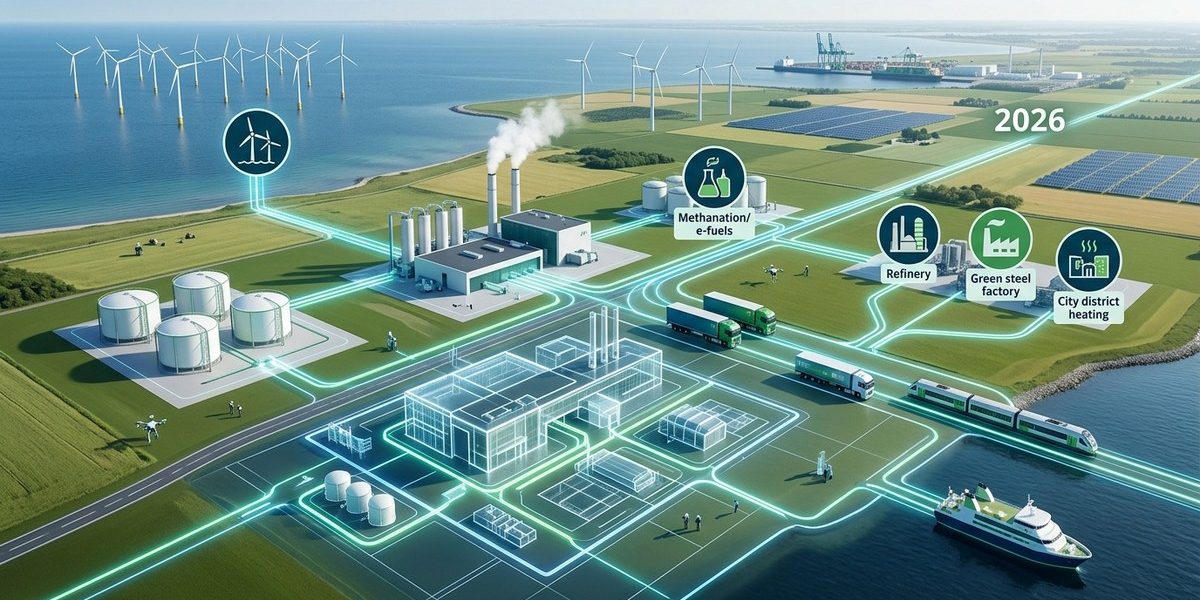
Denmark has a habit of turning ambitious climate goals into working infrastructure. Wind turbines off the coast. District heating networks across cities. And now, something more distributed and more transformative. Across the country, regional hydrogen valleys are proving that green hydrogen can move from pilot projects to industrial scale. These valleys are not isolated experiments. They are integrated systems connecting renewable energy production, electrolysis, storage, and local end users. By 2026, several of these valleys are already operational, and they are drawing attention from policymakers and investors across Europe and beyond.
Denmark’s hydrogen valleys offer a real world blueprint for regional green hydrogen hubs. By combining electrolyser technology with wind energy, local storage, and industrial off takers, these valleys demonstrate commercial viability. Researchers and policymakers can replicate the model through coordinated planning, phased investment, and strong partnerships between public and private actors.
The Danish Approach to Hydrogen Valleys
A hydrogen valley is more than a production site. It is a regional ecosystem where green hydrogen is made, stored, distributed, and used all within a defined area. Denmark has become a testing ground for this concept because of three specific advantages.
First, the country already generates a large surplus of renewable electricity from wind. Second, it has a strong gas grid that can accept hydrogen blends. Third, Danish industry has a clear demand for decarbonisation, especially in heavy transport, shipping, and agriculture.
The result is a set of valleys that act as living laboratories. Each one has a different mix of technologies, partners, and end uses. But together they show how hydrogen valleys Denmark can become a template for the rest of Europe.
Take the HySynergy project in Fredericia as one example. It connects electrolysers directly to a refinery and a storage facility. The hydrogen replaces fossil fuel in industrial processes. It also feeds into the local gas network. This is not a theoretical model. It is a working system that has been producing green hydrogen since 2024.
Another notable example is the Hydrogen Valley in Esbjerg. This coastal city hosts a large scale electrolysis plant powered by offshore wind. The plant supplies hydrogen to shipping operators and truck depots along the A1 corridor. It also supports a local ammonia plant for fertiliser production.
These two valleys alone show a clear pattern. When you co locate production with demand, you reduce transport costs. You also build trust between producers and users. That trust is critical for long term contracts.
What Makes a Hydrogen Valley Work
Building a hydrogen valley requires more than installing electrolysers. You need a coordinated system. Based on the Danish experience, there are several essential ingredients.
- Renewable energy at scale. Wind farms must be close enough to the valley to keep electricity transmission costs low.
- Electrolyser capacity. Both PEM and alkaline technologies are used in Denmark, depending on the application.
- Storage and buffer capacity. Hydrogen is often used intermittently, so storage tanks or caverns are needed.
- Local off takers. Industrial plants, bus depots, ferry terminals, and gas blending stations all need to be part of the valley.
- Grid infrastructure. A connection to the natural gas grid allows surplus hydrogen to be injected and sold elsewhere.
- Regulatory support. Permitting must be streamlined, and certification for green hydrogen must be clear.
Denmark has benefited from national hydrogen strategies that align with EU targets. But the real innovation has happened at the regional level. Municipalities, port authorities, and local energy companies have driven the planning. They understand their local industrial base. They know which businesses can switch to hydrogen first.
If you are a policymaker looking at hydrogen valleys Denmark as a model, start with your region’s existing industrial clusters. Do you have a refinery, a steel plant, or a chemical facility nearby? Do you have a port that serves ferries or cargo ships? Those are your anchor customers.
Three Pillars of Denmark’s Hydrogen Valley Success
The Danish hydrogen valleys rest on three structural pillars that any region can adapt.
-
Public private partnership. Each valley is led by a consortium that includes a utility company, a technology provider, and at least one industrial off taker. Public funding covers early stage capital costs. Private investment follows once the business case is proven.
-
Phased scaling. Valleys start small, typically with 10 to 20 MW of electrolysis capacity. They expand in stages as demand grows and costs fall. The HySynergy project began at 20 MW and now plans to reach 200 MW by 2028.
-
Multi modal end use. Danish valleys do not rely on a single customer. They supply hydrogen to industrial processes, transport operators, and the gas grid simultaneously. This diversification reduces financial risk. It also makes the valley more resilient to changes in demand.
These three pillars form a repeatable pattern. They are not dependent on Danish wind conditions or Danish regulation. They are structural choices that any region can make with the right partners.
How Hydrogen Valleys Scale Up
Scaling a hydrogen valley from a pilot to a full commercial hub requires a deliberate sequence. The Danish projects have followed a clear set of steps.
-
Conduct a regional resource and demand audit. Map your renewable energy assets, your industrial base, and your transport corridors. Identify which hydrogen applications are viable today and which will be viable in three to five years.
-
Secure anchor off takers first. Without a guaranteed customer, the business case falls apart. Sign letters of intent or purchase agreements before you order electrolysers.
-
Design for modular expansion. Install equipment that can be added to in increments. Avoid building a single large unit if you cannot fill the capacity from day one.
-
Integrate storage early. Even a small storage buffer allows you to match production with demand peaks. It also gives you flexibility when renewable electricity prices are volatile.
-
Connect to the gas grid if possible. Injection into the natural gas network provides a backup revenue stream. It also helps balance the wider energy system.
-
Set up a valley governance structure. A steering group with representatives from all partners can resolve conflicts and keep timelines on track.
These steps are not theoretical. They have been applied in the Hydrogen Valley Denmark projects in Fredericia, Esbjerg, and the Copenhagen area. Each valley adapted the sequence to local conditions. But the logic stayed the same.
Key Infrastructure Components
A hydrogen valley depends on several pieces of infrastructure working together. In Denmark, the most common configuration looks like this.
| Component | Typical capacity in Danish valleys | Purpose |
|---|---|---|
| Electrolyser (PEM or alkaline) | 10 to 50 MW initially | Converts water and renewable electricity into green hydrogen |
| Hydrogen storage tank | 5 to 20 tonnes | Smooths out supply and demand mismatches |
| Compression unit | Up to 500 bar | Prepares hydrogen for transport or injection |
| Pipeline connection | 1 to 10 km | Connects production to local users or the gas grid |
| Refuelling station | 1 to 4 tonnes per day | Supplies heavy duty trucks and buses |
| Gas grid injection point | 0.1 to 5 MW equivalent | Sells surplus hydrogen into the natural gas network |
This table shows the typical starting scale. As valleys grow, each component expands. The electrolyser capacity increases. The storage volume grows. The pipeline network extends to more customers.
The key insight from the Danish experience is that you do not need every component at full size from day one. You build what you need for the first customers. Then you add capacity as demand increases.
Expert Insight from the Danish Hydrogen Ecosystem
Over the past four years, I have spoken with project managers, utility directors, and technology suppliers across Denmark’s hydrogen valleys. One piece of advice comes up again and again.
“Do not wait for the perfect business case. Start with a project that works at 20 MW and learn from it. The costs will come down. The demand will grow. But you cannot begin the learning curve without a real installation.”
That perspective reflects the Danish temperament. Pragmatic. Patient. Willing to start small and iterate. It stands in contrast to some international hydrogen projects that try to jump straight to 200 MW without building operational experience first.
The Danish approach also emphasises knowledge sharing across valleys. Operators meet regularly to compare data on electrolyser efficiency, downtime, and hydrogen purity. This collective learning accelerates improvement across the entire national programme.
What This Means for the UK and Beyond
For UK researchers, policymakers, and investors, hydrogen valleys Denmark offer a direct reference point. The UK has similar industrial clusters around ports, refineries, and chemical plants. It has offshore wind capacity that rivals Denmark’s. And it has a growing need to decarbonise heavy transport and industry.
The Danish model suggests that the UK should start with one or two regional valleys built around existing industrial hubs. Teesside, Humber, and Aberdeen are obvious candidates. Each has the renewable resource, the industrial demand, and the port infrastructure to support a hydrogen valley.
The key is to avoid over engineering the first project. Start with a clear set of anchor customers. Use proven electrolyser technology from suppliers like those in Denmark. Connect to the gas grid where possible. And plan for expansion from the beginning.
Investors should note that Danish valleys have attracted funding from both national programmes and EU vehicles such as the Important Projects of Common European Interest. The blended finance model reduces risk for private capital. It also signals long term government commitment.
Building Regional Resilience Through Hydrogen
Hydrogen valleys are not just about decarbonisation. They also build regional energy resilience. When a valley produces hydrogen locally, it reduces dependence on imported fossil fuels. It creates local jobs in manufacturing, operations, and maintenance. And it provides a flexible energy carrier that can be stored and used when renewable electricity generation is low.
Denmark has seen these benefits first hand. The HySynergy valley created over 200 direct jobs during construction. It also enabled the refinery to reduce its carbon footprint by more than 60,000 tonnes of CO2 per year. That is a measurable outcome that voters and shareholders can see.
For regions that are serious about the energy transition, hydrogen valleys offer a practical entry point. They are not a silver bullet. They require investment, coordination, and patience. But the Danish evidence shows they can work.
If you are researching hydrogen valleys Denmark, pay attention to the governance models, the contracting structures, and the technical integration choices. Those details matter more than the specific technology vendor or the exact capacity in megawatts.
The Danish blueprint is transferable. But it requires adaptation to local conditions. That is the point of a blueprint. It gives you the plan. You build the house.
Your Role in Building the Next Hydrogen Valley
Whether you are writing policy, evaluating investments, or designing equipment, you can draw on the Danish experience. The valleys are documented. The data is available. The people behind these projects are open to collaboration.
Start by reading the technical reports from the Hydrogen Valley Denmark projects. Visit the sites if you can. Talk to the operators. And consider how the same principles could apply in your region.
The energy transition needs more than technology. It needs proven models that reduce risk for everyone involved. Hydrogen valleys Denmark provide exactly that. They are operational. They are replicable. And they are making a difference right now in 2026.