“`
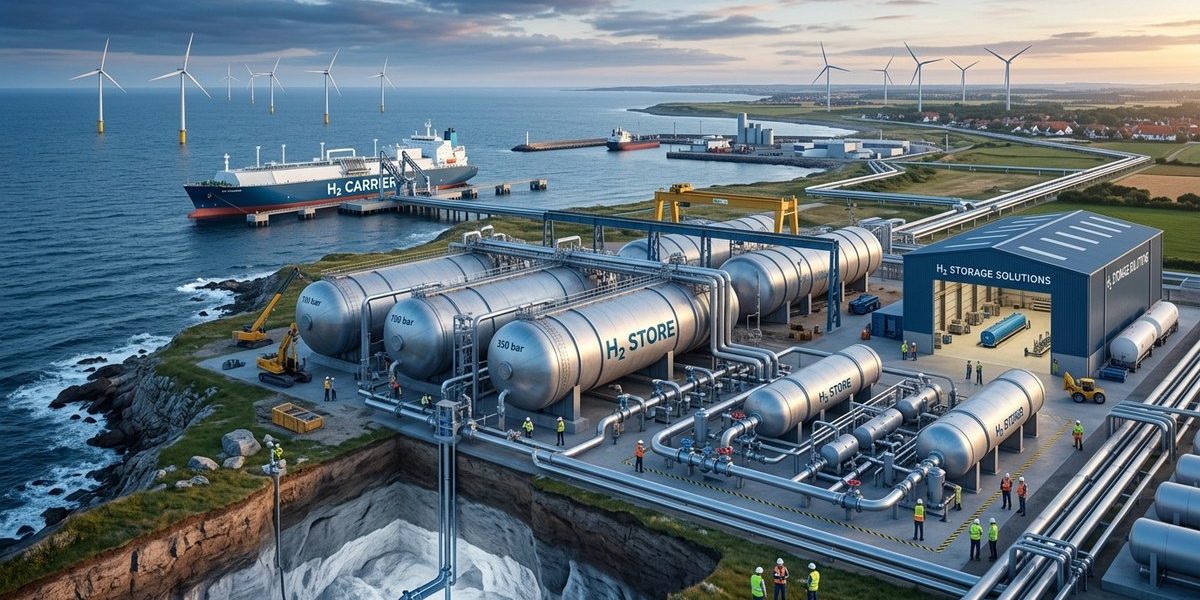
Denmark has made huge strides in producing green hydrogen. Its wind turbines spin with gusto, and new electrolyser projects pop up faster than ever. Yet there is a snag. Making hydrogen is one thing; keeping it safe and ready for use is another challenge entirely. Storage is the unsung hero of the hydrogen economy, and right now it is holding Denmark back.
Denmark leads Europe in green hydrogen production, but storage infrastructure lags behind. The biggest hurdles are geological suitability for salt caverns, high compression or liquefaction costs, material embrittlement in pipelines, and seasonal demand mismatch. Policy gaps and grid integration issues add complexity. Solving these challenges is critical for 2026 targets and beyond.
Why storage matters more than production
You might think the hard part is splitting water molecules with renewable electricity. In Denmark, that part is going well. By mid 2026, several large scale electrolysers are already running, thanks to the efforts described in our piece on maximising green hydrogen production with Danish electrolyser technologies. But hydrogen is a fickle gas. It takes up a lot of space, leaks easily, and can make metals brittle. If you cannot store it affordably, all that clean hydrogen goes to waste.
Denmark’s renewable electricity is abundant but variable. Wind power peaks in winter storms and dips in calm summer weeks. To use hydrogen as a flexible energy carrier, you need buffers that hold surplus production for days or months. Right now, the country’s storage capacity is tiny compared to what 2026 goals require.
The four main storage options for green hydrogen
When energy policy analysts look at Denmark, they usually consider four storage methods. Each has pros and cons for the Danish context.
- Salt caverns. Compressed hydrogen stored in underground salt domes. Denmark has good geology in parts of Jutland and under the North Sea. These are the cheapest option for large volumes, but they need suitable rock formations and take years to develop.
- Pressurised above ground tanks. Steel or composite vessels storing hydrogen at 200 to 700 bar. They are modular and can be sited near demand hubs like industrial parks or refuelling stations. However, they are expensive for bulk storage and have a limited lifespan.
- Liquid hydrogen. Cooling hydrogen to minus 253°C reduces its volume almost 800 times. That sounds great, but the liquefaction process uses about 30% of the energy content. Boil off losses add further costs. It only makes sense for specific use cases, like aviation or shipping.
- Chemical carriers (ammonia, LOHC). Hydrogen bonded to another molecule (like ammonia or liquid organic hydrogen carriers) that can be stored at ambient conditions. This avoids the cryogenic or high pressure challenges, but you need extra processes to “crack” the hydrogen back out, reducing overall efficiency.
Below is a comparison table showing how these methods stack up for Denmark’s 2026 landscape.
| Storage method | Typical capacity | Energy loss (round trip) | Suitable for Denmark? | Main challenge |
|---|---|---|---|---|
| Salt caverns | 10s of GWh | 5–10% | Yes, where geology permits | Development time and site selection |
| Pressurised tanks | 1–100 MWh | 5–15% | Yes, for smaller scale | High cost per kWh stored |
| Liquid hydrogen | 100s of MWh | 30–40% | Limited | Energy penalty and boil off |
| Ammonia carrier | 100s of GWh | 10–20% (with cracking) | Yes, for export | Efficiency and cracking energy |
As the table shows, salt caverns offer the best economics for seasonal storage. But Denmark only has a handful of suitable salt domes, and they are already being evaluated for natural gas storage conversion.
Geological limits: not everywhere is salt
Denmark sits on a mix of chalk, sandstone, and salt. The salt structures that work best for hydrogen storage are found in a band across northern Jutland and under the North Sea. The southern islands and eastern Denmark (Copenhagen area) have less favourable geology. That means the hydrogen produced near Esbjerg or on the west coast might need to travel long distances to reach a cavern.
This geographical mismatch adds cost. You either build a dedicated hydrogen pipeline or convert part of the existing natural gas grid. The good news is that Denmark already has a strong gas network; the bad news is that it was designed for methane, not hydrogen.
“Repurposing natural gas pipelines for hydrogen is possible, but you must account for hydrogen embrittlement and leak tightness. Even a small leak can cause safety issues or degrade the gas quality. It is not a trivial retrofit.”
– Dr. Mette Andersen, Danish Energy Agency hydrogen infrastructure lead
This blockquote highlights a real engineering hurdle. Denmark’s gas pipes are made of steel; hydrogen diffuses through steel over time and makes it brittle. Injection points and compression stations also need new seals. It is doable, but expensive.
Scalability vs. cost: the storage investment gap
In 2026, Denmark’s storage ambition is around 100 to 200 GWh of working gas capacity. That sounds large, but it is still a fraction of what the country will need by 2030. The investment required is enormous. Salt cavern development can take five to seven years from concept to operation. Few projects have reached final investment decision yet.
Why the hesitation? Policy uncertainty. The Danish government has set ambitious targets, but the regulatory framework for storing hydrogen (especially across borders) is still being written. Investors worry about changing subsidies or tariff structures. Without clear long term rules, raising capital for storage projects remains tough.
On top of that, the cost of pressurised tanks has not fallen as fast as electrolyser costs. A 20 MWh tank farm can cost £10 to £20 million. That works for a bus depot or a small industrial site, but not for balancing the national grid.
Seasonal balancing: the winter summer puzzle
One of the biggest green hydrogen storage Denmark challenges is the seasonal swing. Denmark uses more electricity in winter (heating, lighting, shorter days) and less in summer. Wind power is also stronger in winter. That means hydrogen production is high in winter, but demand for heat and power is also high. In summer, production dips while demand is lower.
The real need for storage arises in the shoulder seasons and unexpected calm periods. If a week of low wind coincides with a cold snap, you need to draw on stored hydrogen. Right now, Denmark relies on natural gas for that backup. To replace gas with hydrogen, you need enough stored volume to cover several days of high demand.
A practical example: imagine a district heating plant in Aarhus that uses hydrogen boilers. In January, it might burn 50 tonnes of hydrogen per day. If the wind drops for three days, the plant needs 150 tonnes of stored hydrogen. With a salt cavern of 1 GWh capacity (about 30 tonnes), you run out in half a day. The storage requirement quickly multiplies.
Infrastructure integration: linking electrolysers to storage to users
Storage does not exist in isolation. It has to connect to electrolysers (production) and offtakers (industry, transport, power plants). Denmark’s hydrogen backbone project, called “Hydrogen Infrastructure DK”, plans to build a 600 km pipeline network by 2028. That will link western Jutland (where most electrolysers are planned) with southern Sweden and northern Germany.
But planning permissions and land acquisition are slow. In 2026, only a few short pipelines are operational. The rest are still on paper. Without the pipes, you can only store hydrogen near the production site. That limits the flexibility that storage should provide.
To see how electrolyser integration works on a smaller scale, read our article on integrating power to gas systems for sustainable Danish industry. The principles are similar, but scaling up to grid level is a different ball game.
Technical risks: embrittlement, leaks, and purity
Even if you build the infrastructure, you must manage technical risks. Hydrogen is the smallest molecule known. It can sneak through seals, welds, and even some metals. In a storage cavern, the hydrogen has to stay pure. If it mixes with residual natural gas or water vapour, the fuel cell efficiency drops.
Material embrittlement affects compressors, valves, and pipelines. Stainless steel grades exist that resist hydrogen, but they are expensive. Retrofitting existing equipment with compatible materials adds millions to any project.
Denmark’s cold winters also matter. Compressed hydrogen stored at 200 bar stays gaseous even at minus 20°C, but if water vapour freezes inside a valve, you get blockages. Moisture management is a dull but essential detail.
Policy and market design: who pays for storage?
The biggest challenge might not be technical. It is deciding who pays. Storage is a shared resource, like a public battery. Should grid operators own it? Or should private developers build it and charge for capacity? Denmark’s model leans towards regulated assets, but the exact tariff design is still debated.
In 2026, the Danish Energy Agency is consulting on a “storage obligation” for hydrogen producers. That would require every producer to hold a minimum reserve. It sounds sensible, but it adds cost to already thin margins. Smaller producers might struggle to comply.
Meanwhile, Germany and the Netherlands are moving ahead with their own storage plans. Denmark risks becoming a hydrogen supplier that cannot deliver reliable volumes because it lacks storage. Cross border trade, such as the cross border hydrogen trade from Denmark to Germany, depends on both parties having reliable storage buffers.
What Denmark can learn from other countries
The UK and Germany have more experience with salt cavern storage (for natural gas). Denmark can borrow their geological survey data and safety protocols. Germany is building a hydrogen storage facility in Gronau; Denmark should watch that project closely. The lessons on cap rock integrity and brine disposal are directly transferable.
Another useful example comes from the United States, where the Gulf Coast salt domes store large volumes of hydrogen for chemical plants. The technology is proven. Danish projects just need the political will and funding.
How to decide which storage method fits your project
If you are an investor or analyst evaluating a Danish hydrogen project, consider these practical steps:
- Assess the geology first. Is your project within 50 km of a salt dome? If yes, plan for cavern storage. If no, look at pressurised tanks or liquid hydrogen based on volume and distance to demand.
- Match storage duration to use case. Daily peaking needs 8–12 hours; weekly balancing needs 2–7 days; seasonal needs months. Do not overbuild for seasonal if your offtake is a constant industrial process.
- Check the pipeline timeline. If the Hydrogen Infrastructure DK pipeline will reach your site by 2028, you can delay storage investment. If not, you need on site storage now.
- Factor in boil off and efficiency. When choosing between liquid and compressed, calculate the total cost including energy losses over a year. Liquid hydrogen might look cheaper per unit volume but cost more in electricity wasted.
- Engage with regulators early. Apply for storage permits as soon as your electrolyser permit is filed. The queue is getting longer.
For a deeper look at what makes Danish electrolyser technology stand out, see how Denmark is leading the transition to green hydrogen infrastructure.
Turning the corner: what 2026 tells us about 2030
By the end of 2026, Denmark will have more clarity. The first two or three salt cavern storage projects should be under construction. The Hydrogen Infrastructure DK pipeline will be partially built. And the market rules for storage tariffs should be finalised.
If these milestones slip, the country risks missing its 2030 hydrogen export targets. Norway is already developing its own hydrogen storage, and Germany might look north instead of west. Denmark cannot afford to be the weak link in the European hydrogen chain.
Where the rubber meets the pipeline
The conversation around green hydrogen in Denmark usually focuses on electrolysers and wind turbines. Storage is less glamorous. It is underground, out of sight, and requires long term planning. But without it, Denmark’s hydrogen economy will be like a car with a huge engine and a tiny fuel tank. It can sprint, but it cannot go far.
The technical, geological, and policy hurdles are real. Yet they are not insurmountable. Denmark has solved harder puzzles in energy before, like integrating high wind penetration into the grid. Storage is just the next one. For policymakers, investors, and engineers, the takeaway is simple: start planning storage now, because 2027 is already too late.
If you are curious about the production side and how electrolysers are evolving to lower costs, check out 5 ways Danish electrolysers are reducing green hydrogen costs. It complements the storage picture nicely.
And if you are thinking about exports, our article on why crossborder hydrogen trade from Denmark to Germany is pivotal for 2026 explains the bigger economic picture.
Storage might be the next big challenge, but it is also the next big opportunity. Denmark can lead here too, so long as the industry, government, and investors work together to make it happen. That is a challenge worth taking on.