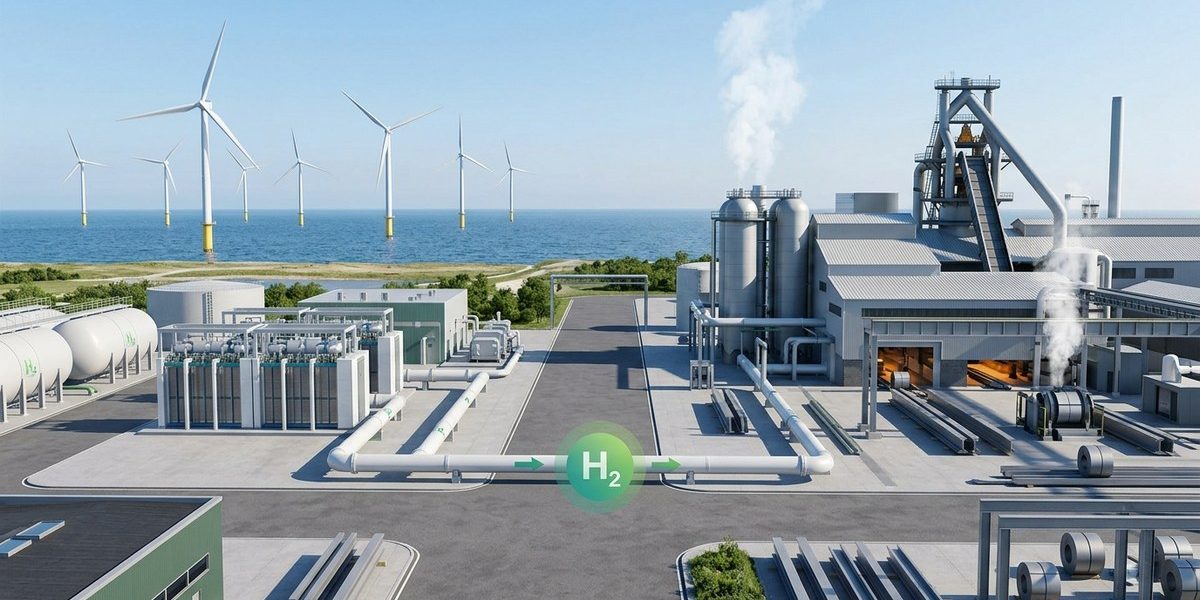
Making steel is one of the dirtiest things humans do. The global steel industry pours around 2.6 billion tonnes of CO2 into the atmosphere every year. That is more than the entire aviation sector put together. Denmark, a country of just 6 million people but with a huge surplus of wind energy, thinks it has found a cleaner way. The answer is green hydrogen. By 2026, the first industrial-scale projects on Danish soil are starting to produce real, low-carbon iron. Here is how they plan to do it and what it means for the rest of Europe.
Green hydrogen offers steelmakers a route to zero-carbon production by replacing coking coal in the direct reduction of iron (DRI). Denmark’s early leadership in electrolysis, powered by abundant wind energy, positions it as a testbed for the global steel transition. This article examines the real projects, technologies, and bottlenecks shaping Danish green steel in 2026.
The old way is not an option
Traditional steelmaking relies on coking coal inside a blast furnace. This process uses coal both as a heat source and as a chemical reducing agent to strip oxygen from iron ore. For every tonne of steel made this way, almost two tonnes of CO2 go into the sky.
Carbon capture can help, but it is expensive and eats up a lot of energy. It also does not solve the fundamental chemical problem. You cannot make conventional steel without generating CO2 unless you change the core ingredients. Executives at ArcelorMittal and Thyssenkrupp have admitted that the only long-term solution is to replace fossil carbon with green hydrogen. Denmark is proving that this switch is possible.
Replacing coal with electrons and molecules
Green hydrogen acts as the reducer instead of coal. When you react hydrogen gas (H2) with iron ore (Fe2O3), you get iron (Fe) and water vapour (H2O). No CO2. The process has three clear steps:
-
Electrolysis: A large electrolyser uses renewable electricity to split water into green hydrogen and oxygen. In Denmark this electricity comes almost entirely from wind and solar. The waste heat from the electrolyser can be captured and fed into district heating networks, improving the overall efficiency of the system.
-
Direct reduction: The green hydrogen is heated and fed into a direct reduction shaft furnace. It passes over iron ore pellets and strips away the oxygen. The output is solid Direct Reduced Iron (DRI), sometimes called sponge iron. This is the same basic equipment used in natural gas DRI plants, but swapping the gas for hydrogen eliminates the emissions.
-
Melting in an EAF: The DRI is fed into an Electric Arc Furnace (EAF) alongside some scrap steel. An electric current melts it down to produce high-quality steel. No coal is used at any stage. If the electricity comes from renewable sources, the entire chain is near zero carbon.
This pathway is not theoretical. It is already being tested in Sweden with HYBRIT and in Germany with Salcos. Denmark brings something extra to the table: a deeply integrated renewable grid and a clear plan for hydrogen infrastructure at scale.
The key projects on Danish soil in 2026
Denmark is not just talking about green steel. It is building the infrastructure right now. Here are the key projects that energy analysts and industry professionals should watch closely in 2026.
| Project | Location | Electrolyser Size | Primary Use | Status |
|---|---|---|---|---|
| H2 Energy Esbjerg | Esbjerg | 100 MW | Heavy transport / Industry | Under construction |
| GreenHyScale (Everfuel) | Fredericia | 20 MW (scaling to 100 MW) | Refining / Steel demo | Commissioning |
| Project Zero / Hydrogen Valley | Sonderborg | 50 MW | Industrial heat / Steel | Feasibility |
| Orsted / Yara (Brande) | Brande | 10 MW | Ammonia / Steel | Operational |
These projects are important because they test different parts of the value chain. Esbjerg focuses on port-side infrastructure for hydrogen import and distribution. HySynergy integrates directly with the existing refining sector in Fredericia. Together they are building up the hydrogen ecosystem needed to feed a future steel plant. The Danish government has also backed a national hydrogen pipeline backbone, which will connect production hubs with industrial users across the country.
Why Denmark is more than just a windy country
There are three structural reasons Denmark is pulling ahead of other nations in the race to decarbonise heavy industry.
Integrated energy system. Denmark has a highly connected power grid and a district heating network that covers 65% of households. Waste heat from electrolysers can heat homes directly. This creates an extra revenue stream for hydrogen producers and pushes the overall system efficiency higher.
Gas infrastructure ready for conversion. The Danish gas transmission system, managed by Evida and Gastra, is being converted to carry hydrogen. This means production can be centralised near the best wind resources and piped directly to industrial users. The UK is now looking closely at this model. We have written separately about what the UK can learn from Denmark’s green hydrogen pioneers in the context of its own CCUS and hydrogen clusters.
Strong political consensus. The Danish parliament has set a target for 4 to 6 gigawatts of electrolysis capacity by 2030. This target is backed by Contracts for Difference (CfDs) that bridge the cost gap between green and grey hydrogen. The policy framework is stable, which gives project developers the confidence to invest.
For a deeper look at how the grid side is developing, read our analysis on harnessing renewable energy to power Denmark’s green hydrogen future.
The main bottleneck is not technology
The technology to make green hydrogen and green steel exists today. The bottleneck is cost, coordination, and certification.
“The real challenge is not building the electrolyser. It is running it at a high utilisation rate without breaking the grid or spiking costs. Green steel will be a hybrid of hydrogen and direct electricity. Balancing that intermittency with industrial demand is the core bottleneck for green hydrogen steel,” explains Lars Andersen, energy systems advisor at the Danish Energy Agency.
Water is another hidden constraint. Electrolysis needs about nine litres of demineralised water for every kilogram of hydrogen. In a dry summer, that adds cost and complexity. Projects sitting near the coast can use desalination, but that eats up more renewable energy. Project developers are now looking at closed-loop water systems to reduce this burden.
Certification is the third bottleneck. The EU and the UK are still ironing out cross-border guarantees of origin for green hydrogen. Steel buyers want to be sure the hydrogen they pay for is genuinely green. Denmark is pushing for a robust certification system that tracks electrons from the wind turbine to the DRI furnace.
What steel buyers and policy analysts should do now
If Denmark succeeds, it will create a blueprint that other countries can copy. The steps are straightforward for anyone working in policy or procurement.
- Update your specifications. Start writing low-emission steel clauses into public infrastructure contracts. The UK is a huge steel buyer and can shape the market by demanding green steel for bridges, railways, and buildings.
- Watch the offtake agreements. Look at who is signing contracts for Danish green hydrogen. Companies like Arla, Danish Crown, and major logistics firms are already committing to offtake. These agreements signal where the market is heading.
- Learn from the Danish regulators. The UK can follow the Danish model for hydrogen transport and storage regulation. Early clarity on tariffs and access rules makes private investment easier.
- Support strong carbon pricing. The EU’s CBAM makes green steel more competitive in Europe by pricing carbon at the border. Maintaining this pricing mechanism is essential to help green hydrogen replace grey hydrogen in industry.
What 2026 means for the green steel race
2026 is not a magic year where all steel turns green overnight. It is the year the first big electrolysers start up in Denmark. It is the year the DRI demonstration begins in earnest. It proves the concept at a scale that investors can trust.
After that, it becomes a race down the electrolyser cost curve. Every doubling of installed capacity brings costs down by around 15 to 20 percent. Denmark is positioning itself to lead that race.
The view from the edge of the North Sea
Standing on the west coast of Denmark, looking out at the wind turbines, you can see the future of heavy industry. It is not built on coal imports or blast furnaces. It is built on electrons and water and a steady breeze from the North Sea.
Green hydrogen is not a small niche experiment here. It is the main engine of industrial decarbonisation. For anyone involved in energy policy, steel procurement, or industrial strategy, the Danish projects offer a transparent, real-world test of what works and what does not.
Start watching the offtake agreements. Start planning for green steel demand in your own supply chains. The technology works. The wind is blowing. The only question now is how fast we choose to scale.