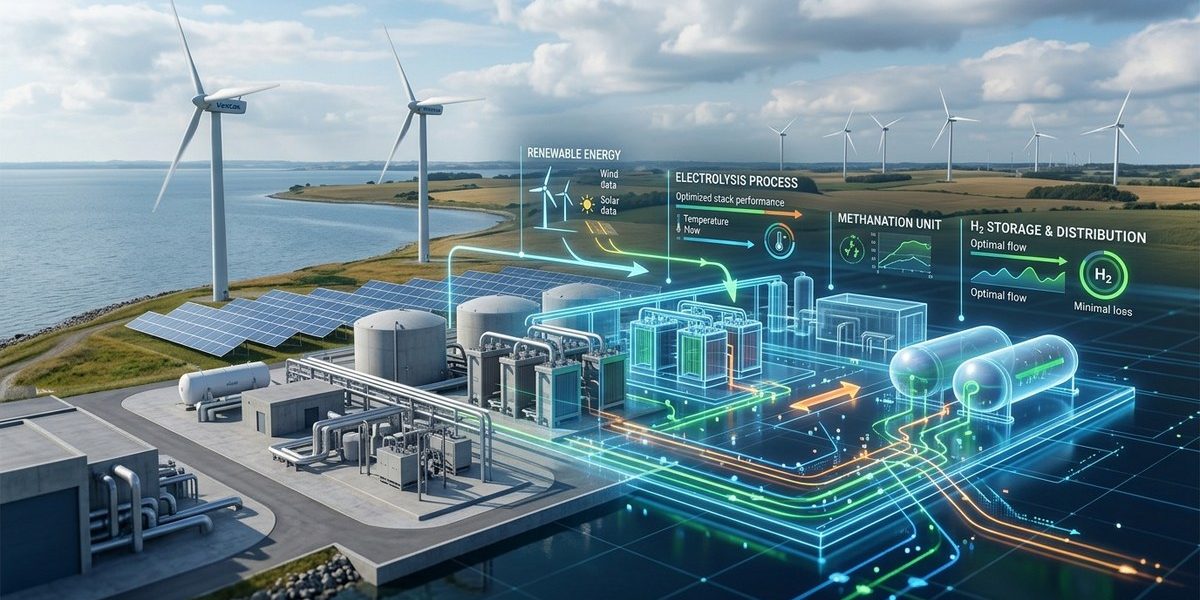
Green hydrogen production is a complex balancing act. You need to match renewable power supply with electrolyser operation, minimise energy losses, and keep maintenance costs under control. One wrong variable and your system efficiency drops. That is where digital twins come in. These virtual replicas of physical assets let you simulate, predict, and optimise every stage of the hydrogen production process. For engineers across Denmark and beyond, digital twins are becoming an essential tool for improving green hydrogen efficiency. They help you turn intermittent wind and solar power into a steady, cost effective flow of hydrogen.
Digital twins transform green hydrogen production by creating live virtual models of electrolysers and auxiliary systems. They allow you to test operating scenarios, predict faults, and optimise energy consumption without risking physical equipment. Danish projects in 2026 are proving that digital twins reduce electricity use per kilogram of hydrogen by up to 12% while boosting overall plant availability.
What Makes a Digital Twin Different from a Simulation
We often see the terms used interchangeably, but they are not the same. A simulation runs a model once with fixed inputs. A digital twin, on the other hand, stays continuously synchronised with the real world. Sensors on your electrolyser feed real time data into the twin. The twin updates its state, runs predictions, and sends recommendations back. This closed loop is what makes it powerful for dynamic environments like a wind powered hydrogen plant.
Imagine a 20 MW electrolyser farm in Jutland. The wind picks up. The digital twin sees the incoming spike in power and adjusts the stack temperature setpoints automatically to maintain optimal efficiency. You do not have to wait for a manual calculation. The twin has already run thousands of scenarios and knows the best response.
How Digital Twins Optimise Green Hydrogen Production Efficiency
The primary goal for any renewable hydrogen plant is to produce the most hydrogen per kilowatt hour of renewable electricity. Digital twins contribute in several concrete ways:
Real Time Energy Management
Electrolysers operate best within a narrow window of current density and temperature. Deviations waste energy. A digital twin monitors these parameters continuously and suggests or automates adjustments. It can also coordinate with your power purchase agreements and grid signals to throttle production when electricity prices are high, then ramp up when they drop.
Predictive Maintenance
Unplanned downtime kills efficiency. A single stack failure can halt production for days. By comparing sensor trends against the twin’s baseline model, you get early warnings about membrane degradation, pump wear, or heat exchanger fouling. You can schedule maintenance during low wind periods instead of during peak renewable generation.
Process Optimisation Experiments
Want to test a new operating pressure? Or try a different temperature ramp? Do it on the twin first. You can run what if scenarios without any risk to the physical plant. The results feed directly into your control strategy.
A Practical Five Step Process for Implementing Digital Twins
If you are an engineer looking to adopt digital twins for your green hydrogen project, follow this structured approach:
-
Instrument your asset
Install sensors for temperature, pressure, flow, voltage, current, and water quality. Without good data, the twin is just an expensive guess. Focus on the parameters that most affect efficiency: stack voltage (to detect degradation), cooling water temperature, and hydrogen purity. -
Build a baseline model
Use historical data and manufacturer specifications to create the first version of the twin. Physics based models work well for electrolysers, but you can also use machine learning to capture complex relationships. The goal is a model that predicts stack voltage with less than 1% error. -
Connect the twin to live data
Set up a data pipeline from your PLCs or SCADA system into the twin. The update frequency should be at least once per minute for electrolyser control, and once per second for transient events like start up or shutdown. -
Train the twin on normal and fault conditions
Run the twin alongside the real plant for a few weeks. Let it learn the typical operating patterns. Also inject synthetic fault data (like a blocked gas outlet) so the twin learns to recognise problems before they cause shutdowns. -
Deploy control recommendations
Start with advisory mode. The twin suggests setpoint changes, and a human operator approves them. Once trust is built, switch to closed loop control for selected variables like cooling flow or load ramp rate.
Common Pitfalls and How to Avoid Them
Even a well built digital twin can fail if you ignore certain traps. The table below outlines frequent mistakes and their solutions.
| Mistake | Why It Hurts Efficiency | Solution |
|---|---|---|
| Using stale data | Twin predictions drift away from reality | Refresh sensor data at least every 60 seconds |
| Overfitting the model | Twin performs well on past data but fails on new patterns | Use a hybrid physics ML approach and retrain monthly |
| Ignoring degradation | Stack voltage drops over time, twin thinks it is still healthy | Include a degradation parameter that updates from real voltage measurements |
| Not integrating with weather forecasts | Renewable power input is unpredictable | Pull in local wind and solar forecasts to pre condition the twin |
| Keeping the twin isolated | No feedback to plant control system | Connect the twin’s output to the DCS or PLC via an API |
Expert Insight: A Danish Perspective
“The biggest shift we have seen in 2026 is the move from one off models to live, continuously learning twins. At our demonstration site in Esbjerg, we reduced specific energy consumption from 52 kWh per kilogram of hydrogen to 46 kWh simply by letting the digital twin optimise the stack current during wind ramps. That is a 12% gain without any hardware change. The next step is fleet wide optimisation across multiple plants.”
* Senior Electrolyser Engineer, Danish Energy Innovation Hub
Tying Digital Twins to Your Broader System
Digital twins do not operate in a vacuum. They work best when integrated with other optimisation layers. For example, if you are also integrating power to gas systems, the twin can coordinate the electrolyser output with methanation or hydrogen storage units. Similarly, Danish electrolyser technologies are advancing rapidly, and digital twins help you evaluate which new stack design or balance of plant component gives you the best return.
The twin also feeds into larger economic models. You can combine its efficiency predictions with real time electricity prices to decide when to produce hydrogen, when to store it, and when to sell it to the grid through a fuel cell. This is exactly what some Danish project developers are doing in 2026 to accelerate industry decarbonisation.
What to Look for in a Digital Twin Platform
If you are selecting software or a partner for your digital twin project, consider these capabilities:
- Real time data ingestion from multiple protocols (Modbus, OPC UA, MQTT)
- Model flexibility to support physics based, data driven, or hybrid models
- Scalability from a single electrolyser to a fleet of plants
- Integration with existing control systems for closed loop optimisation
- Visualisation dashboards that are intuitive for operators and engineers
Some of the top innovations in Danish electrolyser technologies for 2026 already ship with built in digital twin capabilities. It is worth checking whether your next plant purchase includes a twin ready interface.
The Road Ahead for Digital Twins and Green Hydrogen
By 2030, digital twins will probably be standard equipment on every new green hydrogen plant, much like SCADA is today. The efficiency gains we are seeing now will double as artificial intelligence models improve and as more plants share anonymised data. For renewable energy engineers and researchers, the time to start experimenting is now.
Pick one electrolyser stack at your facility. Instrument it properly. Build a simple twin. Run it for a month alongside normal operations. You will be surprised at the opportunities you find to cut energy consumption and reduce unplanned downtime. And you will be contributing to the broader knowledge base that helps Denmark and the world produce green hydrogen more efficiently every year.