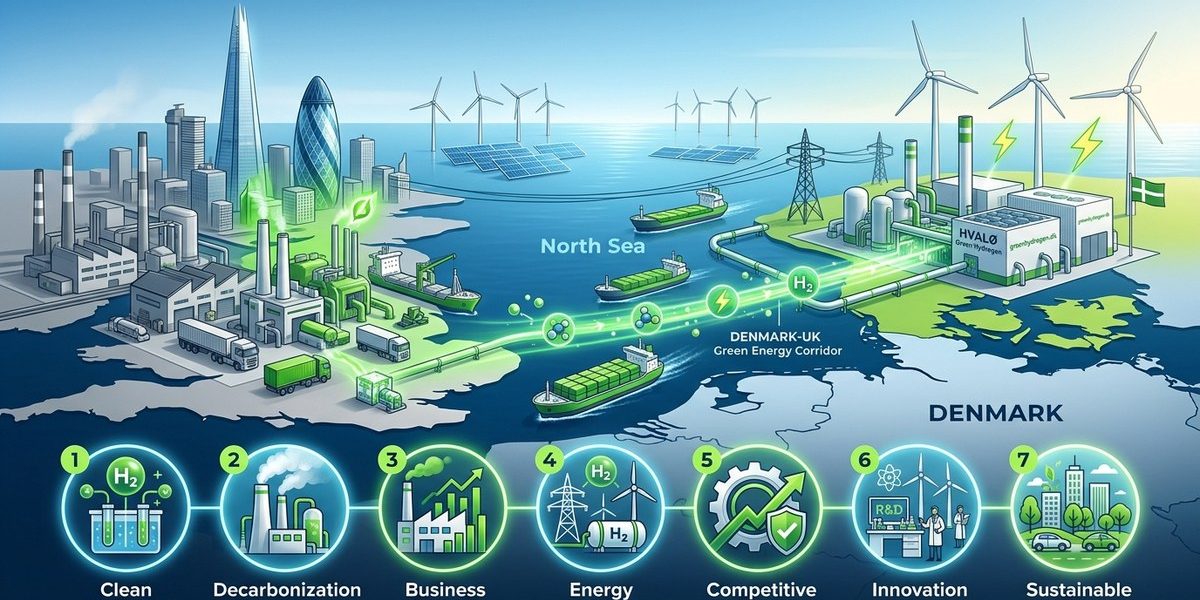
Denmark has spent the last decade turning its wind power advantage into something extraordinary. It has built a world leading Power to X ecosystem that turns renewable electricity into green hydrogen, synthetic fuels, and industrial chemicals. For UK businesses trying to decarbonise without sacrificing competitiveness, that Danish experience is pure gold.
The UK is further behind on Power to X deployment. Yet the need to act is urgent. Energy costs remain volatile. Carbon border taxes are coming. Corporate net zero targets are getting tighter every year. Instead of starting from scratch, UK businesses can tap into Danish technology, project knowledge, and supply chain partnerships. That is what makes Danish Power to X benefits for UK businesses so compelling right now.
Danish Power to X technologies offer UK businesses a proven route to affordable green hydrogen, synthetic fuels, and industrial decarbonisation. From electrolyser innovation to hydrogen valley infrastructure, Denmark has already solved many of the technical and commercial challenges the UK now faces. By partnering with Danish suppliers and project developers, UK firms can avoid costly trial and error, accelerate their net zero timelines, and strengthen energy security at the same time.
Why Danish Power to X Matters for the UK Right Now
The UK has ambitious targets for green hydrogen. The government wants 10 GW of production capacity by 2030. Yet deployment has been slower than expected. High capital costs, grid connection delays, and a lack of skilled operators have all held things back.
Denmark faced similar obstacles a few years ago. But it pushed through them with a combination of smart policy, industrial collaboration, and technical excellence. Today, Danish companies operate some of the most efficient electrolysers in Europe. They have built integrated hydrogen valleys that link production with local demand. They have also developed digital tools that optimise plant performance in real time.
These are not theoretical advances. They are running in commercial projects right now. And they are available to UK businesses through technology licences, joint ventures, and equipment supply deals.
If you want to understand how the Danes got there, read our article on It explains the infrastructure choices that made the difference.
The Seven Key Benefits for UK Businesses
Here are the specific advantages that Danish Power to X brings to UK companies. Each one addresses a real pain point that sustainability officers, energy managers, and investors are dealing with today.
-
Lower levelised cost of hydrogen. Danish electrolyser manufacturers have driven down costs through continuous innovation. Their systems achieve higher efficiency at partial load, which matters when wind power is variable. That means cheaper hydrogen for UK off takers.
-
Proven grid integration at scale. Denmark has years of experience running electrolysers alongside offshore wind farms. The technical know how for balancing supply and demand is already documented. UK project developers do not need to reinvent the grid connection playbook.
-
Access to advanced methanation technology. Danish companies have commercialised methanation processes that turn green hydrogen into renewable natural gas. This is a game changer for industries that cannot electrify, such as glass manufacturing and high temperature ceramics.
-
Digital twin optimisation. Danish engineers use digital twins to monitor electrolyser stacks, predict maintenance needs, and adjust operating parameters in real time. This reduces downtime and extends stack life. We covered this topic in detail in
-
Hydrogen valley blueprints. Denmark has established hydrogen valleys that co locate production with industrial users, transport hubs, and gas grids. The planning models, zoning rules, and stakeholder engagement templates are transferable to UK regions like Teesside, South Wales, and the Humber.
-
Cross border hydrogen trade infrastructure. Danish ports are being upgraded to handle liquid hydrogen and ammonia for export. The logistics and safety standards developed there are directly relevant to UK ports looking to become hydrogen hubs.
-
Regulatory and permitting experience. Danish authorities have streamlined permitting for electrolyser projects. UK businesses can learn from that process to avoid delays. Our piece on https://greenhydrogen.dk/what-can-the-uk-learn-from-denmark-s-green-hydrogen-pioneers/ covers the policy lessons in more depth.
How Danish Power to X Compares with Other Approaches
UK businesses evaluating Power to X have several technology options. The table below shows how the Danish approach stacks up against other common pathways.
| Factor | Danish Power to X | Alternative Approaches |
|---|---|---|
| Electrolyser efficiency at partial load | Very high due to advanced PEM and SOEC systems | Lower for traditional alkaline designs |
| Grid integration maturity | Proven across multiple GW scale projects | Still being piloted in most UK settings |
| Cost reduction trajectory | Already achieving below 4 EUR per kg | Most UK projects still above 6 GBP per kg |
| Digital operations capability | Digital twins and AI driven optimisation | Mostly manual or basic SCADA systems |
| Hydrogen valley ecosystem | Fully operational with multiple off takers | Early stage or single off taker projects |
| Port and logistics readiness | Export infrastructure under construction | Mostly feasibility studies only |
The data makes one thing clear. Danish Power to X is not just a theoretical advantage. It is a practical, de risked pathway that UK businesses can adopt today.
Lessons from Danish Hydrogen Valleys
Denmark’s hydrogen valleys are living laboratories. They show what works and what does not. One of the most instructive examples is the HyBalance project in Hobro. It has been producing green hydrogen since 2018 and supplies both industrial users and a hydrogen refuelling station.
The project proved that a single electrolyser facility can serve multiple demand streams at once. That flexibility is critical for UK businesses that want to avoid depending on one customer or one use case.
“The most important thing we learned is that you have to design for variability from day one. UK conditions are similar to Danish conditions. Wind blows when it blows. Your electrolyser must be able to ramp up and down without losing efficiency or damaging the stack. That is exactly what our technology does.”
Senior Engineer, Danish Electrolyser Manufacturer (2026)
That insight has direct commercial value. A UK chemical company planning an on site electrolyser can specify equipment that handles intermittent renewable power without degrading performance. That avoids costly oversizing or battery buffering.
For more on how hydrogen valleys are being replicated elsewhere, see
Practical Steps for UK Businesses
If you are a sustainability officer, energy procurement manager, or investor looking to act on Danish Power to X benefits for UK businesses, here is a practical checklist to get started.
- Audit your hydrogen demand. Understand which parts of your operations could use green hydrogen directly, or where synthetic fuels would be a better fit.
- Assess your renewable power position. Do you have access to PPAs for wind or solar? Electrolyser economics improve massively with low cost, direct renewable supply.
- Shortlist Danish technology partners. Look at companies with proven operating records in Denmark. Ask for reference plants and performance data.
- Evaluate hydrogen valley membership. Joining a UK hydrogen valley gives you shared infrastructure, shared risk, and faster permitting. Danish blueprints can inform the valley design.
- Plan for digital operations early. Digital twins are not an afterthought. They should be specified at the front end engineering design stage.
- Engage with UK port authorities. If you are considering hydrogen imports or exports, start talking to ports that are already planning hydrogen infrastructure.
Why 2026 Is the Year to Act
The business case for Power to X has shifted in 2026. Carbon prices are higher. The UK Emissions Trading Scheme is expanding. And the cost of electrolysers has continued to fall.
Meanwhile, Danish companies are scaling up their manufacturing capacity. They are looking for international partners. UK businesses that move now can secure preferential pricing, technical support, and project slots before the competition catches up.
Waiting another year means higher costs, longer timelines, and fewer options. The Danish model is proven. The only question is whether UK businesses will take advantage of it.
For a deeper look at how electrolyser costs are dropping, read our analysis on
A Partnership Built for the Long Term
Danish Power to X is not a product you buy off the shelf. It is a partnership model that combines technology, operational knowledge, and policy insight. UK businesses that embrace this model will decarbonise faster, spend less capital, and build energy supply chains that are resilient for decades.
The Danes have already done the hard work. They have tested the electrolysers, optimised the grids, built the valleys, and trained the workforce. Now they are ready to share that expertise with the UK.
Start with a conversation. Identify one application where green hydrogen or synthetic fuels could replace fossil fuels in your operations. Then reach out to a Danish technology partner and ask for a feasibility study. That first step is smaller than you think, and the potential payoff is enormous.
The future of clean energy is not a solo effort. It is built on collaboration between countries that share the same goals. Denmark and the UK are natural partners in that mission. It is time to make the most of it.