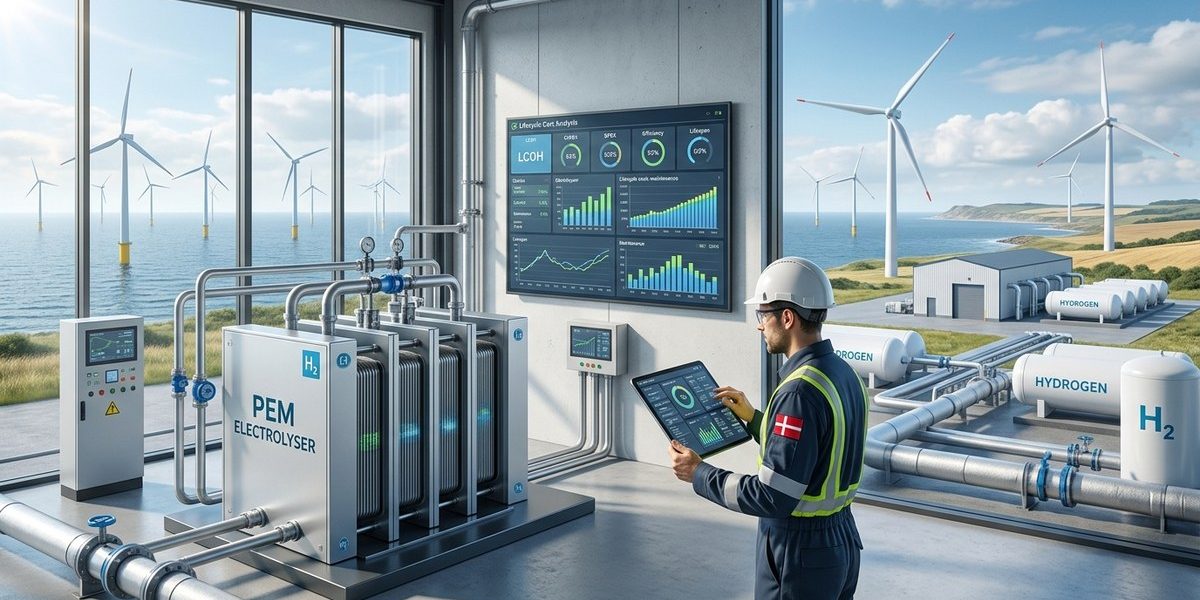
When you are planning a green hydrogen project in Denmark, the upfront price tag of an electrolyser is only the beginning. The real cost picture stretches over many years of operation, maintenance, performance degradation, and electricity consumption. Getting that full picture right can make or break your project’s financial viability. Especially in 2026, when Danish energy prices and subsidy schemes are evolving, understanding lifecycle costs is not just smart accounting. It is the foundation of a sound investment case.
Evaluating electrolyser lifecycle costs in Denmark means looking beyond capital expenditure to include operational electricity use, stack replacement intervals, degradation curves, grid charges, and available subsidies. A robust model that accounts for wind farm curtailment patterns and Power Purchase Agreement structures can lower levelised cost of hydrogen by 15-25% over a 20-year project life. Use real Danish data, not generic projections.
Why Lifecycle Costs Matter for Danish Projects
Denmark’s green hydrogen ambitions are no secret. The country aims to install several gigawatts of electrolyser capacity by 2030. But the projects being developed today will operate for at least two decades. During that time, the cost of electricity from offshore wind will fluctuate, stack components will need replacing, and efficiency will slowly drop.
A project that looks profitable based on initial capital expenditure alone can turn into a loss maker if operational costs or degradation are underestimated. That is why project developers and financial analysts are focusing more and more on the total cost of ownership. And in Denmark, where the grid is already highly renewable, the way you model your electricity supply has a direct impact on your results.
For a broader view of how Danish electrolysers are evolving, you can read about top innovations in Danish electrolyser technologies for 2026.
Breaking Down the Lifecycle Cost Components
A complete lifecycle cost model for an electrolyser includes several layers. Here are the main ones you need to capture in your spreadsheet:
- Capital expenditure (CAPEX): The purchase and installation of the electrolyser stack, balance of plant, transformer, water treatment, and grid connection.
- Operational expenditure (OPEX): Maintenance, labour, consumables (deionised water, chemicals), and insurance.
- Electricity cost: The single largest variable. In Denmark, this depends on Power Purchase Agreement (PPA) pricing, grid tariffs, and whether you run the electrolyser during hours of high wind or buy baseload.
- Stack replacement cost: PEM and alkaline stacks degrade. You will likely need one or two replacements over a 20-year period. The cost per MW and the timing matter.
- Degradation curve: Efficiency falls over time. A stack operating at 55 kWh/kg today might require 58 kWh/kg after five years. That extra energy consumption is a real cost.
- Decommissioning and recycling: At the end of life, dismantling and material recovery can be significant. Danish regulations on waste and circular economy add specific requirements.
Building a model that combines all these elements is not simple. But it is essential. If you want to see how leading Danish projects handle the integration of electrolysers with renewable power, take a look at how to integrate electrolysers with Denmark’s wind power for optimal green hydrogen production.
A Practical 5-Step Framework for Evaluating Lifecycle Costs
Follow these steps to build a solid lifecycle cost analysis for a Danish green hydrogen project.
-
Define the project baselines. Set the electrolyser technology (PEM, alkaline, or SOEC), rated power, operating hours per year, expected lifetime (usually 20 years), and location in Denmark. Location affects grid tariffs and connection costs.
-
Model the electricity supply. Use historical Danish wind and solar profiles to estimate hourly PPA prices. Factor in grid tariffs (which vary by voltage level and time of use) and any renewable energy certificates or guarantees of origin you plan to sell.
-
Calculate degradation and replacement schedules. Most manufacturers provide degradation curves. Use them to forecast annual efficiency losses. Plan stack replacements based on the manufacturer’s recommended interval or when efficiency drops below a threshold (e.g., 10% loss).
-
Add all non-energy OPEX. Include maintenance contracts, labour for a 24/7 operation, water and chemical consumption, insurance, and any royalties or licensing fees.
-
Apply Danish subsidy schemes. In 2026, the Danish state offers support through contracts for difference (CfD), investment grants, and carbon contracts. Model the impact of these on your cash flows.
“The biggest mistake we see is using generic degradation data from the manufacturer’s brochure. Real operational data from Danish projects shows that stack life is often 10-15% shorter than advertised when the electrolyser runs with variable loads from wind farms. Always apply a safety margin.”
– Senior Engineer, Green Hydrogen Denmark Advisory
After building the model, compare your levelised cost of hydrogen (LCOH) against the expected offtake price. A realistic LCOH for Danish projects in 2026 is typically in the range of EUR 4.5 to 6.5 per kg, depending on scale and electricity cost.
Common Mistakes in Cost Modelling
Even experienced analysts slip up on a few points. Here is a table of frequent errors and how to avoid them.
| Mistake | Why it hurts | How to fix it |
|---|---|---|
| Using static electricity price | Ignoring hourly wind generation patterns leads to overestimating utilisation at low prices | Model PPA with a discount factor for curtailment hours |
| Assuming full stack lifetime from datasheet | Stacks degrade faster under dynamic operation | Use Danish pilot project data for degradation |
| Forgetting grid tariff structure | Tariffs in Denmark have time-of-day and seasonal components that add 10-20% to electricity cost | Include Energinet’s tariff schedules in your model |
| Ignoring stack recycling costs | End-of-life disposal is becoming regulated; costs can be EUR 20-40 per kW | Get quotes from Danish recycling firms |
| Overlooking water treatment energy | Producing deionised water uses about 4-5 kWh per cubic metre | Add a parasitic load of 0.5-1% to total energy |
Getting these details wrong can shift your LCOH by more than 20%. If you are unsure about the Danish grid dynamics, check out the future of renewable energy integration for Danish green hydrogen infrastructure.
The Danish Context: Energy Prices and Subsidies
Denmark’s electricity market is unique. With one of the highest shares of wind power in Europe, spot prices can swing from negative to very high within hours. An electrolyser project that can run flexibly during low-price periods can achieve a much lower average electricity cost than one that runs continuously.
In 2026, the Danish government is operating a contract for difference scheme for green hydrogen. This tops up the achieved hydrogen sale price to a fixed strike price (around EUR 7 per kg for smaller projects). To qualify, your project must meet additionality criteria: the electricity must come from new renewable capacity that is not already subsidised.
Additionally, the Danish Energy Agency provides investment grants covering up to 30% of CAPEX for electrolysers above 50 MW. But these grants come with conditions on operating hours and efficiency reporting.
For a deeper look at how subsidies shape project economics, you can explore why green hydrogen is essential for Denmark’s 2026 energy goals.
How Technology Choice Affects Total Cost
The three main electrolyser technologies – PEM, alkaline, and solid oxide (SOEC) – have very different lifecycle profiles. In Denmark, PEM is currently the most popular for large projects because of its fast response and high current density. Alkaline remains cheaper upfront but has lower efficiency and slower ramping. SOEC is more efficient in electricity use but operates at high temperatures, which adds thermal integration costs.
Here is a rough comparison for a 100 MW plant in Denmark with 20-year operation:
- PEM: CAPEX EUR 800-1,000 per kW. Stack replacement every 7-10 years. Degradation around 0.5% per year. Good for flexible operation.
- Alkaline: CAPEX EUR 600-800 per kW. Stack replacement every 10-12 years. Degradation around 0.3% per year. Less responsive to load changes.
- SOEC: CAPEX EUR 1,200-1,500 per kW (including heat integration). Stack replacement every 5-7 years due to thermal cycling. Higher efficiency (40-45 kWh/kg) but more complexity.
Your choice depends on your project’s operating profile. If you are pairing with offshore wind and expect many stop-start cycles, PEM might be better despite higher stack costs. If you can run baseload using a dedicated wind farm, alkaline could give a lower LCOH.
For additional technology comparisons, read about key factors for choosing electrolyzer technology in Denmark’s green hydrogen sector.
Why Degradation Assumptions Can Break Your Model
Degradation is one of the most misunderstood variables. Many models use a linear degradation of 0.5% per year. Real data from Danish pilot projects, such as those at the GreenLab Skive facility, show that degradation is not linear. It is faster in the first two years and then stabilises. Moreover, if the electrolyser is run at partial load or with frequent starts, degradation accelerates.
A sensitivity analysis on degradation can reveal whether your project is robust. Assume a worst case of 1% per year and see if the LCOH still meets your target. If not, you might need to oversize the stack or plan an earlier replacement.
Building Your Financial Model
A proper lifecycle model for Danish projects should include at least these sheets:
- Input assumptions: Technology, size, location, PPA price curve, grid tariffs, subsidy parameters
- Cash flow projection: Year-by-year revenue from hydrogen sales, cost of electricity, OPEX, stack replacement, and decommissioning
- Sensitivity analysis: Vary electricity price, degradation rate, stack lifetime, and subsidy value to see LCOH range
- Financing structure: Debt-to-equity ratio, interest rate, tax regime (Danish corporate tax is 22%)
You do not need to build everything from scratch. Several Danish consulting firms offer standardised templates adapted to the local market. If you prefer to do it yourself, start with a proven framework from the Danish Energy Agency’s technology data catalogue.
For a step-by-step guide to performance metrics, see 5 key performance metrics for evaluating electrolyser efficiency in Danish energy projects.
Start Your Lifecycle Assessment with Real Data
You now have a solid understanding of the main components and pitfalls when evaluating electrolyser lifecycle costs in Denmark. The key is to ground every assumption in real Danish data: hourly electricity prices, local grid tariffs, actual degradation from operational projects, and current subsidy conditions. Generic numbers from international reports will lead you astray.
Begin by gathering the specific parameters for your project location. Talk to the local DSO (Energinet’s distribution arm) for grid connection costs and tariffs. Reach out to manufacturers for stack degradation data under Danish operating conditions. And use the sensitivity analysis to stress test your model.
If you want to see how Danish projects are already applying these principles, read about how Danish green hydrogen projects are accelerating industry decarbonisation by 2026.
Taking the time to build a thorough lifecycle cost model now will save you from expensive surprises later. The Danish hydrogen market is moving fast, but the fundamentals of good financial analysis remain the same. Get the numbers right, and your project will stand out to investors and partners alike.