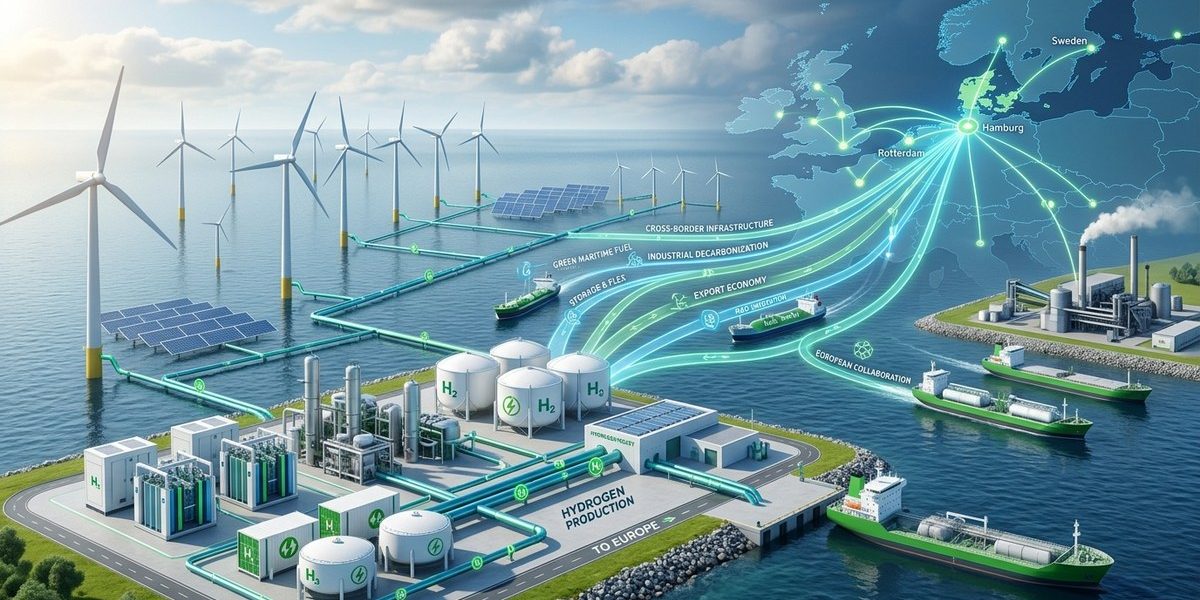
Denmark has a knack for turning wind into something you can store in a pipe. The country’s hydrogen valleys are no longer pilot projects on paper. By 2026, they are fully operational hubs that connect renewable electricity to industrial boilers, shipping fuel, and even German steel furnaces. For anyone tracking European clean energy trade, these valleys are the closest thing to a live laboratory for cross-border hydrogen economics.
Danish hydrogen valleys are not isolated experiments. They are integrated energy ecosystems that produce, store, and export green hydrogen across European borders. By 2026, these valleys have demonstrated that renewable hydrogen can compete on cost with grey hydrogen when paired with offshore wind, flexible electrolysers, and cross-border pipeline access. Policy analysts and investors should watch the Esbjerg corridor and the Bornholm Energy Island as bellwethers for EU hydrogen trade.
How hydrogen valleys rewire the energy map
A hydrogen valley is a regional cluster where production, storage, distribution, and end use of hydrogen happen in one connected system. Denmark hosts several of these valleys, and they are not just domestic showpieces. They are designed from day one to plug into European infrastructure.
The key difference between a hydrogen valley and a standalone electrolyser plant is integration. A valley connects wind farms, electrolysers, hydrogen storage caverns, pipeline networks, and industrial consumers within a defined geography. That integration drives down costs and builds the commercial confidence needed for cross-border trade.
Take the HySynergy project in Fredericia. It combines a 1 GW electrolyser capacity with underground salt cavern storage and direct pipeline links to Germany. By 2026, it is already dispatching green hydrogen to industrial users in Schleswig-Holstein. That is not a future scenario. It is happening now.
Why Danish valleys are different from other European projects
Several European countries have hydrogen strategies. What sets Denmark apart is the marriage of three factors: abundant offshore wind, existing gas infrastructure that can be repurposed, and a regulatory environment that treats hydrogen as a tradeable commodity rather than a niche experiment.
Consider the numbers. Denmark’s offshore wind capacity factor often exceeds 45 percent. That means electrolysers can run for more hours at lower electricity costs. When you combine that with the Danish Energy Agency’s certification framework for guarantees of origin, you get hydrogen that carries a verified green label. That label is what German buyers are willing to pay a premium for.
Another factor is speed. Danish projects have moved from feasibility studies to final investment decisions faster than comparable projects in other EU member states. The reason is partly cultural. Danish energy utilities, grid operators, and industrial firms have decades of experience collaborating on district heating and wind power. They apply the same cooperative muscle to hydrogen.
The numbered list: three practical steps Danish valleys use to enable trade
-
Certify every molecule. Each batch of hydrogen produced in a Danish valley is tracked with a digital guarantee of origin. This certificate proves the hydrogen was made from renewable electricity, which satisfies the EU’s delegated acts on renewable fuels of non-biological origin. Without this certification, cross-border trade would stall at customs.
-
Build flexible electrolyser stacks. Danish valleys deploy electrolysers that can ramp up and down within seconds. This flexibility allows them to soak up surplus wind power when electricity prices are low and sell hydrogen when prices rise. It is the same logic as a pumped hydro plant, but with a gas output.
-
Secure long-term offtake agreements. Valleys like Green Hydrogen Hub in Esbjerg sign 10 to 15 year contracts with industrial buyers before construction begins. These contracts de-risk the investment and prove to lenders that the hydrogen has a market. German steelmakers and Dutch refineries are among the signatories.
The technology stack inside a Danish hydrogen valley
If you want to understand what makes these valleys tick, look at the equipment choices. The table below compares the main technologies deployed across Danish valleys in 2026.
| Technology | Typical capacity per unit | Key advantage | Primary use case |
|---|---|---|---|
| PEM electrolyser | 5 to 20 MW | Fast ramping, high pressure output | Balancing wind fluctuations |
| Alkaline electrolyser | 10 to 100 MW | Lower capital cost per MW | Baseload production |
| Solid oxide electrolyser | 1 to 5 MW | High efficiency at elevated temperatures | Waste heat recovery in industrial parks |
| Underground salt cavern storage | 100 to 500 GWh | Low storage cost, large volume | Seasonal storage for winter demand |
The trend in 2026 is toward hybrid configurations. A valley might install PEM units for flexibility and alkaline units for baseload, then connect both to a shared salt cavern. This hybrid approach lowers the overall levelised cost of hydrogen by about 15 percent compared to a single technology solution.
What the UK can learn from Danish hydrogen valleys
British readers will notice parallels with the UK’s own hydrogen ambitions. The UK has excellent offshore wind resources and depleted gas fields that could store hydrogen. But the UK lags in one critical area: coordination between electricity and gas grids.
Danish valleys treat the electricity grid and the gas grid as one system. When wind power is abundant, electrolysers run and inject hydrogen into the gas network. When wind is low, stored hydrogen can be converted back to electricity or burned directly in industrial furnaces. This sector coupling is the secret sauce.
The UK’s hydrogen valleys, such as the one planned for the Humber region, could adopt a similar approach. The lesson is simple: do not build electrolysers in isolation. Build them as part of a valley that includes storage, pipeline access, and industrial customers.
“The Danish model proves that hydrogen valleys are not just about producing green molecules. They are about creating a market where those molecules can be traded across borders with trust and transparency.” — Henrik Andersen, energy policy adviser at the Danish Energy Agency
Common pitfalls when planning a hydrogen valley
Not every valley succeeds. Some European projects have stalled because they ignored basic realities. Here are the mistakes to avoid, based on what Danish developers have learned the hard way.
-
Overestimating electrolyser utilisation rates. Some project developers assume electrolysers will run at 80 percent capacity. In reality, 40 to 60 percent is more realistic when relying on variable renewables. Danish valleys plan for the lower number and treat higher utilisation as a bonus.
-
Ignoring hydrogen purity requirements. Industrial users need different purity levels. Steelmakers can tolerate lower purity, but fuel cell vehicles need 99.999 percent. Danish valleys install purification skids as standard rather than retrofitting later.
-
Underestimating grid connection costs. Connecting a 100 MW electrolyser to the grid can cost as much as the electrolyser itself. Danish valleys negotiate grid connection early and often share the cost with the transmission system operator.
The cross-border trade routes that matter
By 2026, three trade corridors have emerged from Danish hydrogen valleys.
First, the Denmark to Germany corridor via the Esbjerg to Hamburg pipeline. This route delivers hydrogen to German industrial clusters in the Ruhr and Hamburg. The pipeline is a repurposed natural gas line, which keeps infrastructure costs low.
Second, the Denmark to the Netherlands route via the North Sea. Hydrogen is shipped as ammonia from the Port of Esbjerg to Rotterdam, where it is cracked back into hydrogen for use in Dutch refineries.
Third, the Bornholm Energy Island route. This project uses offshore wind to power electrolysers on the island, then exports hydrogen by ship to Poland and the Baltic states. It is a template for how island nations can become hydrogen exporters.
Each of these routes depends on the same foundation: a hydrogen valley that produces certified green hydrogen at a competitive price. Without the valley, there is no trade.
How policy analysts should evaluate Danish hydrogen valleys
If you are a policy analyst looking at these projects, focus on three metrics.
First, the carbon intensity of the hydrogen. Danish valleys are publishing verified carbon intensity data, often below 0.5 kg CO2 per kg of hydrogen. That is far lower than the EU threshold of 3 kg CO2 per kg for renewable hydrogen.
Second, the cost trajectory. In 2026, the levelised cost of hydrogen from Danish valleys ranges from EUR 4 to EUR 6 per kg, depending on electricity prices. That is still higher than grey hydrogen at EUR 1.5 to EUR 2 per kg, but the gap is closing. With carbon pricing in the EU Emissions Trading System, green hydrogen is already cheaper than grey hydrogen in some scenarios.
Third, the scalability. Danish valleys are designed to be replicated. The same technical blueprint used in Esbjerg is being adapted for projects in Latvia, Chile, and Morocco. If you want to understand where European hydrogen trade is heading, watch the Danish valley playbook.
The investment case for energy investors
For energy investors, Danish hydrogen valleys offer a lower risk entry point than greenfield projects in less mature markets. The reasons are straightforward.
The regulatory framework is stable. Denmark has a national hydrogen strategy that aligns with the EU Hydrogen Strategy and the REPowerEU plan. There is no risk of sudden policy reversals.
The infrastructure is partially built. Repurposed gas pipelines and existing salt caverns reduce capital expenditure. Investors are not paying for new steel from scratch.
The offtake is secured. Long-term contracts with creditworthy industrial buyers provide revenue certainty. Some valleys have even signed indexation clauses that link hydrogen prices to natural gas prices, giving investors a hedge.
Of course, risks remain. Electricity price volatility can squeeze margins. Electrolyser downtime can disrupt supply. But compared to hydrogen projects in countries without a valley ecosystem, the Danish projects look like a safer bet.
A final word on what comes next
Danish hydrogen valleys are not the end of the story. They are the foundation for a European hydrogen economy that is still being built. By 2026, these valleys have proven that green hydrogen can be produced at scale, certified for cross-border trade, and delivered to industrial customers at a price that makes economic sense.
The next step is expansion. Denmark plans to double its electrolyser capacity by 2028, and new valleys are being planned in Jutland, Zealand, and on the island of Lolland. Each new valley will strengthen the trade corridors that connect Northern Europe.
For policy analysts, the takeaway is clear. The Danish model works because it treats hydrogen as an energy system, not a single technology. For investors, the opportunity lies in backing valleys that have already demonstrated commercial viability. And for clean tech professionals, the Danish hydrogen valley is the best classroom in Europe.
If you want to see the future of European clean energy trade, book a ticket to Esbjerg. The hydrogen is already flowing.