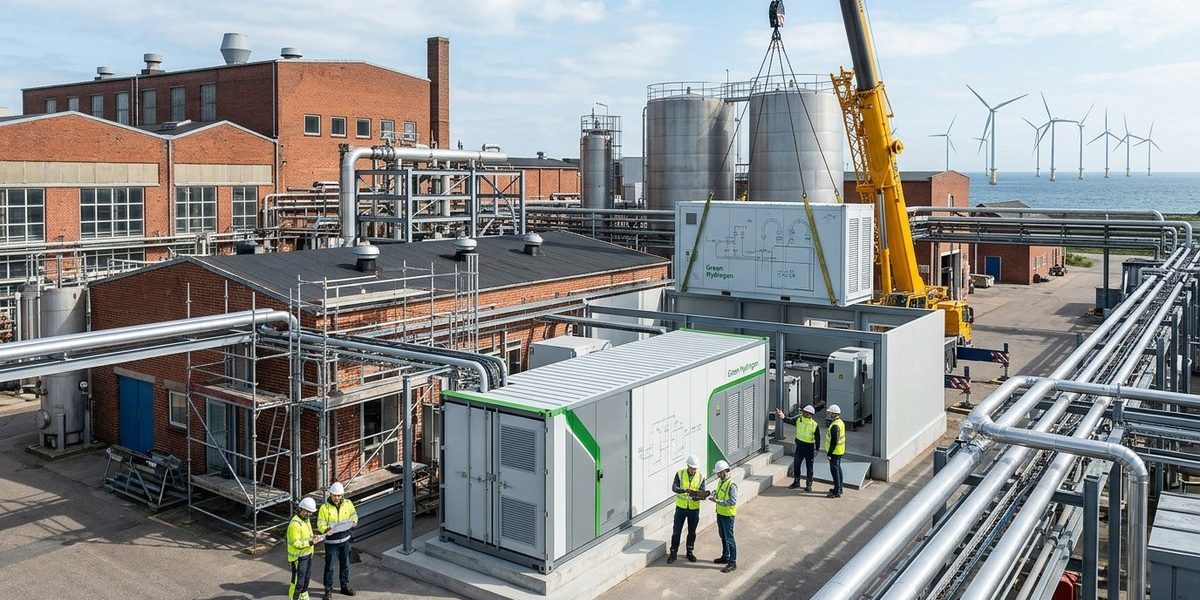
Converting an existing industrial facility to produce green hydrogen is a complex but rewarding challenge. You are not starting from a blank sheet of paper. Instead, you are working with existing power infrastructure, water supply, and spatial constraints. This electrolyser retrofit guide Denmark is written for the engineers and project managers on the ground who need practical steps, not theory. We will look at how to assess your site, choose the right technology, and avoid the common pitfalls that can delay a project.
Retrofitting an industrial site for green hydrogen in Denmark requires a methodical assessment of existing electrical capacity, water treatment capabilities, and spatial layout. By prioritising modular PEM systems and planning for future hydrogen backbone connections, you can reduce capital costs and accelerate your project timeline. This guide covers the five critical stages of a successful retrofit.
Assessing Your Existing Site Infrastructure
Before you order any equipment, you need a clear picture of what your site already offers. A retrofit is only cost effective if you can reuse major assets.
Start with your electrical supply. Green hydrogen production via electrolysis is energy intensive. You need to know the maximum import capacity of your grid connection. Many Danish industrial sites built in the 1990s or earlier have transformers rated for 10 to 20 megawatts. That might be enough for a pilot scale unit, but not for a commercial 50 MW plant. You will likely need to upgrade your transformer and switchgear. Contact your local grid operator (like Cerius or N1) early to understand lead times for a new connection or upgrade. A six month wait for a transformer is not unusual.
Water is the next big item. Electrolysers need high purity deionised water. Your existing process water system might be suitable for cooling or washing, but it is unlikely to meet the conductivity standards required for a PEM or alkaline stack. You will need a reverse osmosis unit and a deionisation skid. Check your existing water intake capacity. A 10 MW electrolyser consumes roughly 10 cubic metres of deionised water per day. That is a small amount for a large chemical plant, but a significant draw for a small manufacturing site.
Finally, look at your available floor space. Electrolysers are tall, heavy pieces of equipment. They need good ventilation because hydrogen is light and flammable. You cannot squeeze a 20 MW stack into a room designed for a boiler. You need a dedicated area with a fire rated separation, hydrogen detection, and a clear path for maintenance access.
Choosing the Right Electrolyser Technology for a Retrofit
Not every electrolyser technology suits a retrofit project. You have three main options, and each has trade offs.
- Alkaline electrolysers are mature and lower cost per megawatt. They work well for steady state operation. But they are large and need a liquid electrolyte (potassium hydroxide). Retrofitting them into an existing building is often impossible because of their size and the need for chemical handling.
- PEM (Proton Exchange Membrane) electrolysers are more compact. They respond faster to variable power, which is ideal if you are pairing with wind or solar. They produce hydrogen at higher pressure, reducing the need for additional compression. The downside is that they use iridium and platinum catalysts, making them more expensive per unit.
- Solid oxide electrolysers are still emerging. They operate at high temperatures and can use heat from industrial processes. For a retrofit in 2026, they are not yet a mainstream choice for most Danish sites.
For most Danish industrial retrofits, a modular PEM system is the practical choice. You can install one module at a time, which helps with phased budgeting and grid connection limits. You can also place them in smaller footprints than alkaline stacks.
Here is a comparison of the two main technologies for a retrofit:
| Feature | Alkaline Electrolyser | PEM Electrolyser |
|---|---|---|
| Footprint per MW | Large (needs separate building) | Compact (fits inside existing structure) |
| Startup time | 15 to 60 minutes | 1 to 5 minutes |
| Load range | 20% to 100% | 0% to 100% |
| Output pressure | Atmospheric to 10 bar | 30 to 50 bar |
| Water quality needed | Moderate | Very high (needs good pretreatment) |
| Best use case | Baseload, steady operation | Variable renewable pairing, retrofit |
The Retrofit Process in Five Steps
Here is a numbered list of the stages you will go through when planning your retrofit.
- Site audit and feasibility study. Hire a consultant to measure your electrical capacity, water quality, and structural load limits. This study should also check for hazardous area zoning. A zone 1 or zone 2 area around the electrolyser will affect where you can place other equipment.
- Technology selection and vendor engagement. Send your site data to three vendors. Ask them for a proposal that includes the balance of plant (pumps, dryers, transformers). Do not just price the stack. The balance of plant can be 40% of the total cost.
- Detailed engineering and permitting. You need a building permit from your kommune. You also need environmental approval if your hydrogen output exceeds certain thresholds. In Denmark, the Energistyrelsen (Danish Energy Agency) provides guidance on safety and reporting. Plan for 4 to 6 months for permitting.
- Construction and integration. This is where you install the electrolyser, connect it to your high voltage supply, and tie it into your water treatment loop. You will need a period of commissioning where you run the system at partial load and verify purity.
- Commissioning and grid connection. Your grid operator will want to see a power quality study. Electrolysers can cause harmonics if not paired with the right filters. Once the grid connection is signed off, you can ramp up to full production.
Common Mistakes to Avoid
A retrofit is not a greenfield project. You are working with constraints that can trip you up.
“The biggest mistake I see is assuming the existing electrical infrastructure can handle the transient loads from a PEM electrolyser. A 10 MW stack can draw 15 MW for a few seconds during startup. That can trip your main breaker if you have not modelled the inrush current.”
Senior project engineer, Danish hydrogen project, 2025
Here are other mistakes to watch for:
- Ignoring cooling capacity. Electrolysers are about 70% efficient. The other 30% becomes heat. You need a cooling loop that can reject 3 MW of heat for every 10 MW of input. Air cooled chillers are noisy and expensive. If you have access to seawater or a river, consider once through cooling.
- Underestimating hydrogen drying. Hydrogen leaves the electrolyser saturated with water vapour. You need a drying system to remove moisture before compression or storage. A simple pressure swing adsorption (PSA) dryer works well, but it adds cost and footprint.
- Forgetting about nitrogen purging. You need a nitrogen supply to purge the system during shutdown. Many sites do not have a nitrogen line. Installing a nitrogen generator or a liquid nitrogen tank is an extra cost that surprises project budgets.
- Not planning for future expansion. Denmark is building a hydrogen backbone that will connect to Germany. If your site is near the planned pipeline route, you should install a larger outlet flange now. It is cheaper than cutting into the pipe later.
Making the Financial Case for a Retrofit
A retrofit can be cheaper than a greenfield build because you reuse land, buildings, and grid connection capacity. But you need to be honest about the costs.
The table below shows typical cost ranges for a 20 MW retrofit in Denmark in 2026.
| Cost item | Estimate (EUR) |
|---|---|
| Electrolyser stack (PEM) | 6 to 8 million |
| Balance of plant (cooling, drying, water treatment) | 3 to 4 million |
| Electrical upgrade (transformer, switchgear) | 1 to 2 million |
| Civil works and building modifications | 1 to 2 million |
| Engineering, permitting, project management | 1 million |
| Total | 12 to 17 million |
You can offset these costs through the Danish Hydrogen Innovation Fund and the EU Innovation Fund. Some Danish regions also offer grants for industrial decarbonisation. Check with your local erhvervshus (business centre) for current schemes.
For a deeper look at how to evaluate the total cost of ownership, read our guide on how to evaluate electrolyser lifecycle costs for Danish green hydrogen projects. It covers maintenance intervals, stack replacement costs, and electricity price assumptions.
Planning for the Danish Hydrogen Backbone
By 2028, Energinet plans to have a hydrogen pipeline running from western Denmark to the German border. If your site is in Esbjerg, Fredericia, or the Greater Copenhagen area, you are likely within reach of this backbone.
Connecting to the pipeline changes the economics of your retrofit. You can sell hydrogen at a higher price because you access the German industrial market. You also avoid the cost of on site compression and tube trailer logistics. If you are within 10 kilometres of the planned pipeline route, it is worth installing a larger diameter outlet now. The extra pipe cost is small compared to the future value of pipeline access.
For more on how Denmark is building this infrastructure, read about how Denmark is leading the transition to green hydrogen infrastructure. It explains the timeline and the connection requirements.
Safety Standards and Operational Permits
Hydrogen is a hazardous gas. You need to follow the Danish ATEX regulations for explosive atmospheres. The electrolyser area will likely be classified as Zone 1 or Zone 2. That means all electrical equipment in that zone must be certified for explosive environments. You also need hydrogen detectors linked to an automatic shutoff system.
The Danish Working Environment Authority (Arbejdstilsynet) will inspect your site before you start production. They will look for:
- Adequate ventilation (natural or forced)
- Hydrogen detection with alarms
- Emergency stop buttons at all exits
- A clear safety zone around the electrolyser
- Documentation of risk assessments (a HAZOP study is standard)
For a full checklist, see our article on 5 critical safety standards for operating electrolysers in Denmark’s industrial zones. It includes the specific ATEX classifications and the required documentation for Arbejdstilsynet.
Putting the Plan into Action
A successful electrolyser retrofit in Denmark comes down to preparation. You need to know your site limits, choose a modular technology, and plan for future pipeline connections. The work is detailed, but the payoff is real. You turn an existing industrial site into a producer of green hydrogen, supporting Denmark’s 2026 energy goals and creating a new revenue stream.
Start with a simple site audit. Walk your electrical room. Check your water meter. Measure the floor space. Then call a consultant who has done this before. With the right team and a clear plan, your retrofit can be operational within 18 months. That timeline is achievable if you start the grid connection process and the permitting work in parallel.
For a broader view of how Danish projects are scaling up, take a look at how Danish green hydrogen projects are accelerating industry decarbonisation by 2026. It shows real world examples of retrofits that are already running.
Good luck with your project. The work you do today will shape Denmark’s energy future for decades.