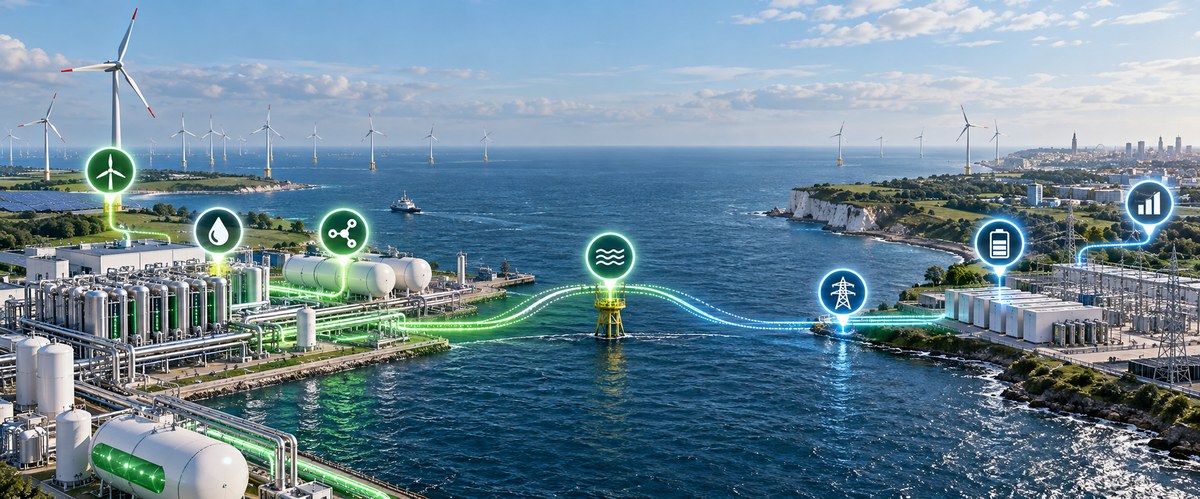
Denmark has been running power-to-gas projects for over a decade. The UK is now playing catch up. That is not a criticism. It is an opportunity. Danish engineers have already made the mistakes, fixed the bugs, and found what works. For energy policy analysts, grid operators, and renewable energy consultants in the UK, those lessons are pure gold. The big question is: how do we apply them to UK grid balancing without starting from scratch?
Danish power-to-gas projects show that green hydrogen can solve UK grid balancing challenges today, not in ten years. By using electrolysers as flexible demand, storing excess wind power as hydrogen, and co-locating with renewables, the UK can stabilise its grid. The seven lessons from Denmark offer a practical roadmap for 2026 and beyond.
Why the UK grid needs Danish thinking
The UK electricity grid faces a growing problem. Wind and solar generation can surge to 80% of supply on a breezy, sunny afternoon. On a still, grey winter evening, that share can drop below 10%. National Grid ESO has to balance these swings with gas plants, interconnectors, and demand-side response. But gas is expensive and dirty. Interconnectors rely on our neighbours having spare power. Demand response works, but only up to a point.
Denmark faced the same challenge earlier. Their wind penetration regularly exceeds 50% of annual consumption. They solved part of the puzzle with power-to-gas. Instead of curtailing wind turbines when supply exceeds demand, they run electrolysers to make green hydrogen. That hydrogen becomes stored energy for later use. It is a giant, flexible battery that can hold weeks of supply.
The seven lessons from Danish power-to-gas projects
Here are the seven practical takeaways from Denmark’s real-world installations, from the HyBalance plant in Hobro to the BioCat project in Avedøre.
1. Electrolysers work best as flexible demand, not baseload
Many UK planners assume electrolysers should run 24/7 to maximise output. Danish data says the opposite. The most profitable projects run electrolysers only when electricity prices are low or negative. In 2024, Danish wind farms experienced negative prices for over 300 hours. Electrolysers soaked up that cheap power and turned it into valuable hydrogen.
The UK lesson: Build electrolysers that can ramp from 10% to 100% in under two minutes. Proton exchange membrane (PEM) electrolysers do this well. Alkaline units are cheaper but slower. For grid balancing, speed matters more than raw efficiency.
2. Hydrogen storage is the missing link for seasonal balancing
Lithium batteries handle intraday swings. They cannot store energy for weeks. Danish projects like the one at Stenlille store hydrogen in salt caverns. That hydrogen sits there until winter, when wind generation drops and heating demand rises. The stored hydrogen then runs through a combined heat and power plant or a fuel cell.
The UK lesson: The UK has salt caverns under the North Sea and onshore in Cheshire. Repurposing these for hydrogen storage could solve the winter wind drought problem. Without storage, power-to-gas is just an expensive way to make fertiliser.
3. Co-location with renewables cuts costs dramatically
Danish developers learned early that building an electrolyser next to a wind farm saves on grid connection fees and reduces transmission losses. The Westküste 100 project in Germany, near the Danish border, takes this further by placing electrolysers inside the wind farm substation.
The UK lesson: When planning offshore wind farms in the Dogger Bank or Hornsea zones, include a platform for electrolysis. Pipe the hydrogen ashore instead of electricity. This reduces the need for expensive high-voltage cables and avoids grid congestion.
4. Heat integration improves overall system efficiency
Electrolysers generate waste heat. A 10 MW electrolyser produces roughly 8 MW of heat. Danish projects capture this heat for district heating networks. In Esbjerg, the local heating utility uses electrolyser heat to warm homes, boosting total system efficiency to over 90%.
The UK lesson: Map your local heat networks. If an electrolyser site is near a district heating scheme, the heat is a revenue stream, not a waste problem. This changes the business case significantly.
5. Methanation adds value but adds complexity
Some Danish projects convert hydrogen and CO2 into synthetic methane. This methane can be injected directly into the existing gas grid without blending limits. The BioCat project near Copenhagen does exactly this, using CO2 from a wastewater treatment plant.
The UK lesson: Methanation makes sense where CO2 is available cheaply. Biogas plants, cement factories, and breweries are good candidates. For pure grid balancing, plain hydrogen storage is simpler and cheaper. Do not add methanation unless you have a guaranteed CO2 source.
6. Regulatory sandboxes accelerate deployment
Denmark created special regulatory zones where grid connection rules, hydrogen purity standards, and market access rules were relaxed for pilot projects. This allowed developers to test new configurations without waiting years for regulatory changes.
The UK lesson: Ofgem and DESNZ should create similar sandboxes for power-to-gas projects in Scotland and the North of England. The current regulatory framework was designed for electricity, not hydrogen. Sandboxes let you test before you legislate.
7. System operators need new market signals
Danish grid operator Energinet discovered that existing electricity markets did not reward the flexibility that electrolysers provide. They introduced a new balancing product called “hydrogen flexibility service” that pays electrolysers to adjust consumption in real time.
The UK lesson: National Grid ESO should develop a similar product. The existing Firm Frequency Response and Demand Turn Up services are close, but they do not account for the unique ramp rates and energy storage capabilities of electrolysers.
A comparison of Danish project approaches
| Project | Electrolyser type | Storage method | Primary grid service | Key innovation |
|---|---|---|---|---|
| HyBalance, Hobro | PEM | Hydrogen cylinders | Frequency response | Fast ramping in under 1 minute |
| BioCat, Avedøre | Alkaline | Methane injection | Seasonal storage | CO2 from biogas |
| Westküste 100 | PEM | Salt cavern | Wind firming | Co-location with offshore wind |
| Stenlille | Alkaline | Salt cavern | Winter peak shaving | Long duration storage |
How to apply these lessons in the UK today
The seven lessons translate into a practical process for UK projects. Here is a numbered sequence that any project developer can follow.
- Site selection first. Choose a location within 5 km of a renewable energy source (wind farm or solar array) and within 10 km of a hydrogen off-taker or a salt cavern.
- Choose the right electrolyser. For grid balancing, specify PEM with a ramp rate of at least 10% per second. Accept slightly lower efficiency for faster response.
- Design for heat recovery. Include a heat exchanger and a connection to a district heating network or an industrial heat user.
- Plan storage capacity. For daily balancing, use compressed hydrogen tanks. For seasonal balancing, secure a salt cavern or lined rock cavern.
- Register for balancing services. Apply to National Grid ESO for Dynamic Containment or Demand Turn Up. The revenue from these services often makes the project viable.
- Build in stages. Start with a 5 MW pilot. Prove the ramp rates, the heat recovery, and the market revenue. Then scale to 50 MW or 100 MW.
- Share data openly. Danish projects publish performance data. UK projects should do the same. This builds confidence among investors, regulators, and the public.
Common mistakes and how to avoid them
Based on Danish experience, here are the pitfalls that UK projects should watch for.
- Oversizing the electrolyser for the available renewable energy. If the wind farm averages 50 MW but peaks at 100 MW, do not install a 100 MW electrolyser. Install 30 MW and run it at high utilisation.
- Ignoring water treatment. Electrolysers need deionised water. Danish projects underestimated water treatment costs. Budget for reverse osmosis and polishing.
- Forgetting grid connection lead times. A new grid connection can take 18 months. Start the application before you order the electrolyser.
- Assuming hydrogen will be cheap. Green hydrogen costs GBP 5 to GBP 8 per kg in Denmark. UK costs will be similar. Do not build a business case on unrealistic hydrogen prices.
What can the UK learn from Denmark’s hydrogen pioneers?
Denmark’s power-to-gas projects are not perfect. Some have struggled with low utilisation rates and high maintenance costs. But they have generated real data that the UK can use today. The key insight is that electrolysers are not just hydrogen factories. They are grid assets. When you treat them as flexible demand, they become a tool for balancing the grid, storing excess renewables, and reducing curtailment.
For a deeper look at how Danish electrolyser technologies are being optimised for production, see our guide on maximizing green hydrogen production with Danish electrolyser technologies. If you are interested in how these systems integrate with wider industrial needs, our article on integrating power-to-gas systems for sustainable Danish industry provides more context.
“Danish power-to-gas projects have shown that the real value is not in the hydrogen itself. It is in the flexibility that the electrolyser provides to the electricity system. That is the lesson the UK needs to learn.” — Senior analyst, Danish Energy Agency
A practical roadmap for UK grid balancing in 2026
The seven lessons from Denmark point to a clear path for the UK. Start with small, flexible electrolysers co-located with wind farms. Use them to provide grid balancing services first, hydrogen production second. Capture the waste heat. Store the hydrogen for winter. Share the data.
The UK does not need to invent anything new. It needs to adapt what Denmark has already proven. The technology works. The market signals are emerging. The regulatory framework is catching up. 2026 is the year to move from pilot projects to deployment.
What Danish power-to-gas projects mean for your next project
If you are an energy policy analyst, grid operator, or renewable energy consultant, the message is straightforward. Danish power-to-gas projects are not a theoretical case study. They are a working template. Use the seven lessons to shape your next business case, your next regulatory proposal, or your next grid connection application. The Danish experience is there for the taking. Apply it, adapt it, and make UK grid balancing a reality with green hydrogen.