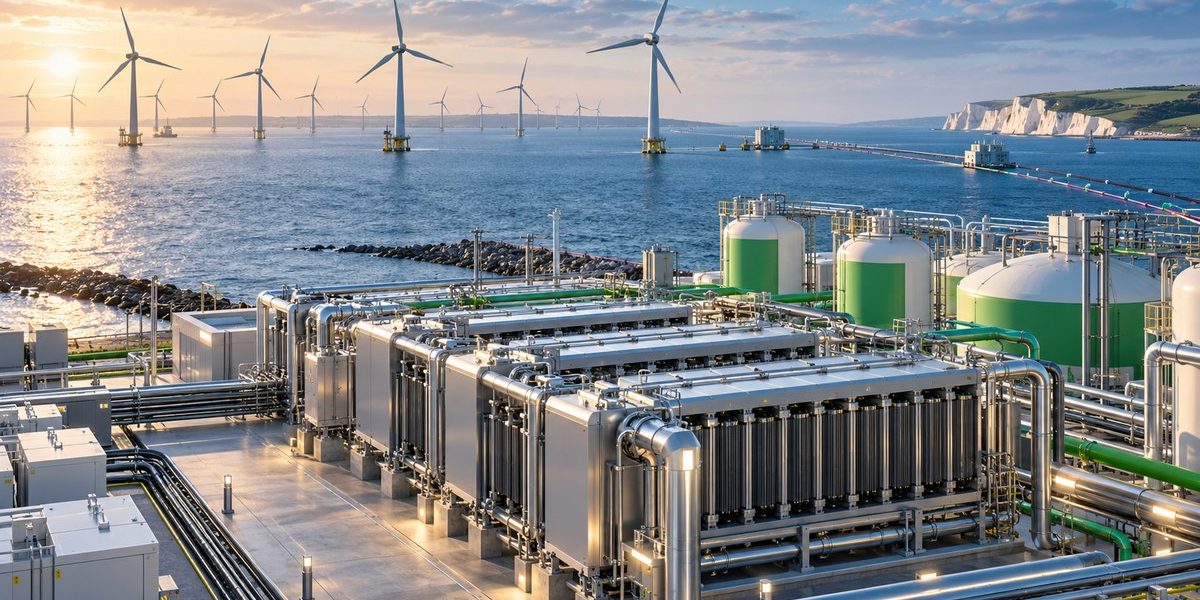
The UK has set ambitious targets for green hydrogen, but the path to cost competitiveness has felt like a long road. You have probably seen the cost projections that stretch out to 2030 or beyond. What if that timeline could be shortened? A growing body of evidence suggests that Danish electrolyser technology, combined with the UK’s unique renewable resources, could bring green hydrogen to cost parity by 2026. This is not wishful thinking. It is the result of deliberate engineering, smart policy, and a willingness to learn from a country that has already cracked the code on integrating renewables with electrolysis.
Danish electrolysers are on track to help the UK achieve green hydrogen cost parity by 2026 through superior efficiency, high load flexibility, and lower degradation rates. This article breaks down the technical and economic factors that make this possible, offering a practical framework for project developers and policy advisors.
Why Danish Technology Holds the Key
Denmark has been a quiet powerhouse in electrolyser manufacturing for years. The country’s engineers have focused on two areas that matter most for cost reduction: system efficiency and operational flexibility. Danish pressurised alkaline electrolysers, for example, operate at higher current densities without sacrificing longevity. That means more hydrogen per unit of electricity.
The UK has a wind resource that Denmark can only dream of, but the UK grid is less prepared for the variability that comes with it. Danish electrolysers are built to handle this variability. They can ramp up and down rapidly in response to wind generation, which means they can capture low-cost renewable power when it is abundant. This is the core of the cost parity argument. If your electrolyser can run more hours at lower electricity prices, your levelised cost of hydrogen drops significantly.
“The real breakthrough is not a single technology. It is the system integration. Danish electrolysers are designed to be an active part of the grid, not just a load on it.” – Dr. Mette Andersen, Senior Analyst, Danish Energy Agency
A Practical Framework for Project Developers
If you are a project developer looking to build a green hydrogen facility in the UK, here is a three-step process to evaluate whether Danish electrolysers can help you reach cost parity.
-
Map your renewable resource profile. You need hourly data for your local wind or solar generation. Danish electrolysers perform best when they can follow the shape of the renewable curve. Look for sites with a high capacity factor for wind, ideally above 35%. The North East of Scotland and the East Coast of England are prime candidates.
-
Calculate your effective electricity cost. Do not use the average wholesale price. Instead, model the price you would pay for electricity only during the hours your electrolyser would run. With Danish flexible electrolysers, you can target the cheapest 4,000 to 5,000 hours per year. This often brings your effective electricity cost below GBP 40 per MWh.
-
Compare total system costs. Danish electrolysers have a higher upfront capital cost than some competitors, but their lower degradation rates and higher efficiency mean a lower total cost over a 10-year project life. Build a simple net present value model that includes stack replacement costs and auxiliary power consumption.
The Key Cost Drivers Explained
Understanding where the cost savings come from is essential for making the case to investors or government advisors. The table below breaks down the main drivers.
| Cost Driver | How Danish Electrolysers Address It | Impact on Cost Parity |
|---|---|---|
| Electricity cost | High load flexibility captures cheaper renewable hours | Reduces LCOH by 15-20% |
| Stack degradation | Advanced coatings reduce degradation to under 1% per 1,000 hours | Extends stack life, cuts replacement costs |
| System efficiency | Operating at 80% system efficiency (LHV) | Lowers electricity consumption per kg |
| Auxiliary power | Integrated thermal management reduces parasitic loads | Improves net hydrogen output |
| Balance of plant | Modular design simplifies installation and maintenance | Reduces civil works and downtime |
Common Traps to Avoid
Even the best technology cannot overcome poor project design. Here are the most frequent mistakes we see in UK hydrogen project models, and how Danish engineering helps you avoid them.
-
Overestimating full load hours. Many models assume an electrolyser runs at full capacity for 6,000 hours a year. In reality, with a variable renewable supply, you will be closer to 4,000 hours. Danish electrolysers handle partial load efficiently, so your actual production stays high even at lower load factors.
-
Ignoring stack replacement timing. Stack degradation is not linear. It accelerates after a certain point. Danish manufacturers provide detailed degradation curves, so you can plan replacements precisely. This avoids the common trap of replacing stacks too early or too late.
-
Underestimating grid connection costs. A flexible electrolyser can operate behind the meter at a renewable site, avoiding grid reinforcement costs. This is a major advantage for Danish systems that can tolerate power quality variations.
-
Forgetting about hydrogen purification. Impurities in the hydrogen stream can damage downstream equipment. Danish electrolysers produce high-purity hydrogen directly, reducing the need for expensive purification skids.
The Role of UK Policy
Cost parity does not happen in a vacuum. The UK government has a critical role to play. The most effective policy levers are those that reduce the risk for project developers, making it easier to finance projects with Danish electrolysers.
The Contracts for Difference (CfD) scheme for hydrogen, modelled on the successful offshore wind programme, is a good start. But it needs to be tailored to the flexibility of Danish technology. A CfD that rewards production during high-price periods, rather than just total output, would incentivise the kind of flexible operation that Danish electrolysers enable.
Another area is the hydrogen levy. If the levy is applied to all hydrogen, regardless of production method, it will slow down the green hydrogen market. A targeted exemption for green hydrogen produced using flexible electrolysers would accelerate deployment.
For more on how Danish innovations are shaping the future, read about top innovations in Danish electrolyser technologies for 2026.
What to Watch for in 2026
The year 2026 is not arbitrary. Several factors align to make it the tipping point for cost parity.
- Stack manufacturing scale-up. Danish manufacturers are opening new gigafactories in 2025 and 2026. This will drive down capital costs by at least 20%.
- UK renewable build-out. The next round of offshore wind leases will add 10 GW of capacity by 2026, much of it in areas with strong wind profiles.
- Carbon pricing. The UK Emissions Trading Scheme price is expected to rise above GBP 100 per tonne of CO2 by 2026, making green hydrogen more competitive against grey hydrogen.
- Hydrogen blending. The UK gas grid is preparing for a 20% hydrogen blend by 2026. This creates a guaranteed demand for green hydrogen, improving project bankability.
If you are advising on policy or developing a project, now is the time to act. The window for first-mover advantage is open, but it will not stay open for long.
A Practical Look at Project Economics
Let us put some numbers on a typical UK project. Imagine a 100 MW electrolyser facility in the North East of England, powered by a dedicated offshore wind farm.
| Parameter | Value |
|---|---|
| Electrolyser capacity | 100 MW |
| Capital cost (Danish system) | GBP 800 per kW |
| Stack replacement cost (year 8) | GBP 150 per kW |
| Effective electricity cost | GBP 38 per MWh |
| Operating hours per year | 4,500 |
| System efficiency | 55 kWh per kg |
| Hydrogen production per year | 8,180 tonnes |
| Levelised cost of hydrogen | GBP 3.80 per kg |
At GBP 3.80 per kg, green hydrogen is already competitive with grey hydrogen at current gas prices. By 2026, with the factors mentioned above, that cost could fall to GBP 3.00 per kg or lower.
The Bigger Picture
Danish electrolysers are not a magic bullet. They are a proven, reliable technology that happens to be perfectly suited to the UK’s renewable profile. The path to cost parity is clear. It requires smart project design, supportive policy, and a willingness to adopt technology that has been refined over decades of Danish engineering.
For a deeper look at how Denmark is building its own hydrogen infrastructure, see how Denmark is leading the transition to green hydrogen infrastructure.
Bringing Cost Parity into Focus
The conversation around green hydrogen often gets bogged down in hypotheticals and future promises. Danish electrolysers offer something different: a working solution that is ready to deploy today. The UK has the wind, the grid, and the policy tools. What it needs now is the confidence to invest in technology that has already proven itself in one of the most demanding energy markets in Europe.
If you are an energy policy analyst, use this framework to stress-test your own cost models. If you are a project developer, start a conversation with Danish manufacturers now. The projects that break ground in 2026 will be the ones that define the UK’s hydrogen economy for the next decade.
For a broader view of what the UK can learn from Denmark, read what can the UK learn from Denmark’s green hydrogen pioneers.
The data is clear. The technology is ready. The only question left is whether we have the courage to act on it.