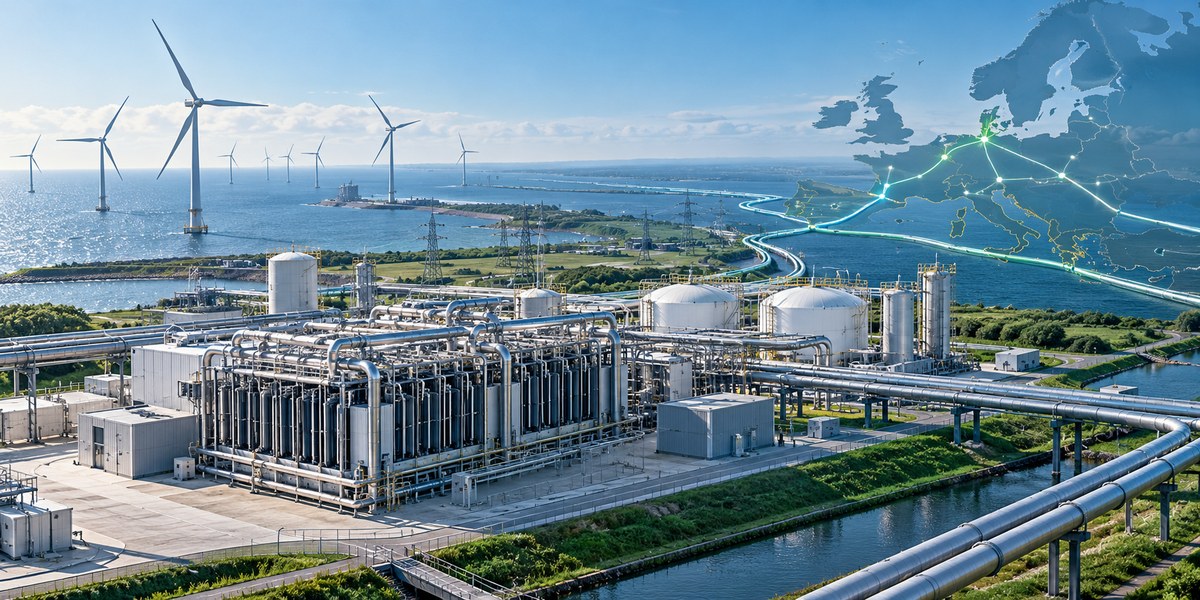
Europe is waking up to a reality that Denmark has been quietly preparing for over a decade. The continent’s ambition to build a green hydrogen economy now rests on the machines that split water into hydrogen and oxygen. And when you look at where those machines are being designed, tested, and scaled, one country keeps appearing at the top of the list. Danish electrolysers are not just a national success story. They are becoming the structural spine of Europe’s green hydrogen supply chain in 2026.
Danish electrolysers are critical to Europe’s 2026 green hydrogen supply because of their high efficiency, integration with offshore wind, and advanced manufacturing scale. Policy analysts and investors should focus on Denmark’s PEM and alkaline systems, which offer the best balance of cost, durability, and renewable compatibility for cross-border hydrogen trade.
Why Danish technology leads the European electrolyser market
Denmark’s position did not happen by accident. The country has spent years building a cluster of engineering talent, testing facilities, and industrial partnerships that other European nations are now trying to replicate. The result is a set of electrolyser technologies that work reliably at scale and integrate naturally with the renewable energy sources that power them.
Three factors explain why Danish electrolysers are so central to Europe’s plans in 2026:
- Direct integration with offshore wind. Danish electrolysers are designed to handle the variable output from wind turbines. They can ramp up and down without degrading performance, which is essential when your electricity comes from the North Sea.
- Manufacturing scale and cost reduction. Danish factories have moved beyond pilot production. They are now building megawatt-scale stacks at costs that are starting to compete with grey hydrogen, especially when carbon pricing is factored in.
- Cross-border infrastructure readiness. The planned Danish Hydrogen Backbone pipeline to Germany means that hydrogen produced in Denmark can reach industrial customers in Central Europe. This is a logistical advantage that no other Nordic country can match.
For a deeper look at how these systems are being deployed, read our guide on maximizing green hydrogen production with Danish electrolyser technologies.
The two main electrolyser types powering Europe’s supply chain
When energy strategists talk about Danish electrolysers, they usually mean one of two technologies. Both have their place in the 2026 supply chain, but they serve different roles.
| Technology | Efficiency (kWh/kg H2) | Ramp rate | Best use case | Danish leadership |
|---|---|---|---|---|
| PEM (Proton Exchange Membrane) | 50-55 | <10 seconds | Pairing with wind and solar | Topolyte, Danish Power Systems |
| Alkaline (Pressurised) | 45-50 | 20-30 seconds | Continuous industrial hydrogen | Green Hydrogen Systems, Stiesdal |
PEM electrolysers are the stars of the show when it comes to flexibility. They can respond to changes in wind power almost instantly, which makes them ideal for projects where the electricity supply is variable. Alkaline electrolysers are more efficient in steady-state operation and are often chosen for industrial facilities that need a constant hydrogen supply.
Denmark leads in both categories. The technical expertise in PEM membranes comes from decades of work in fuel cells and specialty coatings. The alkaline side benefits from Denmark’s long history with wind energy and the engineering culture that comes with it.
If you are comparing these two options for a project, our article on comparing PEM and alkaline electrolysers for Denmark’s green hydrogen projects covers the trade-offs in detail.
How Danish electrolysers integrate with Europe’s existing energy system
One of the most common questions from policy analysts is how electrolysers fit into the current grid. The answer is that Danish technology is designed to be a bridge between renewable generation and industrial demand.
Here is how the integration typically works in practice:
- A 100 MW offshore wind farm in the Danish North Sea sends power to an onshore electrolyser facility near Esbjerg.
- The electrolyser uses PEM stacks to convert that variable electricity into hydrogen, which is then compressed and stored in salt caverns nearby.
- From storage, the hydrogen flows into the Danish Hydrogen Backbone pipeline, which connects to the German network at the border.
- German steel plants, refineries, and chemical facilities use that hydrogen to replace natural gas in their processes.
This is not a theoretical model. It is happening in 2026. The pipeline is under development, the electrolysers are being installed, and the offtake agreements are being signed.
For more on how this integration works at the system level, see integrating power-to-gas systems for sustainable Danish industry.
What the numbers say about Danish electrolyser deployment in 2026
Let us look at the data that investors and strategists care about. The numbers for 2026 tell a clear story about Denmark’s role in Europe’s hydrogen supply.
- Denmark is on track to have over 1.5 GW of installed electrolyser capacity by the end of 2026.
- The average cost of hydrogen from Danish electrolysers has fallen to around 4.50 EUR per kilogram, down from over 6 EUR in 2023.
- Danish manufacturers now supply approximately 30% of all electrolyser stacks installed in Europe.
- The Danish Hydrogen Backbone project has secured state backing of 16.5 billion DKK (around 2.2 billion EUR) to connect Esbjerg to the German border.
These figures matter because they show that Danish electrolysers are not just a research curiosity. They are a commercial reality that is already displacing fossil hydrogen in industrial supply chains.
“The Danish approach to electrolyser deployment is methodical. They do not announce projects they cannot build. That reliability is why German industrial customers are signing long-term contracts with Danish producers.” — European Hydrogen Infrastructure Analyst, 2026
Key challenges that Danish electrolysers help solve
Europe’s green hydrogen supply chain faces several structural problems. Danish technology addresses each of them in specific ways.
Matching supply with variable renewable generation
The biggest technical challenge is that wind and solar power do not produce electricity on demand. Electrolysers must be able to follow the renewable output without wasting energy or damaging the equipment.
Danish PEM electrolysers solve this by using advanced membrane materials that tolerate rapid current changes. The stacks can go from idle to full load in under ten seconds, which means they can capture every kilowatt-hour of wind energy without needing battery buffering.
Reducing the cost of hydrogen production
Cost remains the main barrier to green hydrogen adoption. Danish manufacturers have tackled this by standardising stack designs and automating assembly lines.
The result is that capital costs for Danish electrolysers have dropped by nearly 40% since 2022. Operating costs have also fallen because the systems require less maintenance and have longer stack lifetimes.
Building the infrastructure for cross-border trade
Hydrogen is hard to transport. It leaks through small gaps, embrittles steel, and requires high compression. Danish engineers have decades of experience with natural gas pipelines, and they are applying that knowledge to hydrogen.
The Danish Hydrogen Backbone is designed to handle pure hydrogen at pressures that match the German distribution network. This avoids the need for costly recompression at the border.
For a broader view of these challenges, read 5 challenges facing electrolyser deployment in Denmark and how to overcome them.
What supply chain strategists should watch in 2026
If you are developing a strategy for green hydrogen procurement or investment, there are several developments to track.
- The final investment decision on the Danish Hydrogen Backbone. This will determine the timeline for hydrogen flows to Germany. The current target is commissioning by 2030, but partial capacity could come online earlier.
- Scale-up of Green Hydrogen Systems’ alkaline stacks. The company is building a new factory that will double its production capacity by late 2026.
- Partnerships between Danish electrolyser firms and German industrial gas companies. These deals are the real signal of market confidence, because they involve long-term offtake commitments.
- The role of hydrogen valleys in southern Denmark. These regional hubs are testing how electrolysers, storage, and end-use can work together at scale.
Our analysis of how hydrogen valleys in Denmark are creating a blueprint for regional green hydrogen hubs by 2026 provides more detail on these projects.
A practical process for evaluating Danish electrolyser suppliers
If you are an investor or strategist looking at Danish electrolyser technology, follow this process to make an informed decision.
- Assess the technology type. Decide whether your project needs PEM or alkaline electrolysers. PEM is better for flexible, wind-linked production. Alkaline is better for steady, baseload industrial use.
- Check the manufacturer’s track record. Look at how many stacks they have deployed in commercial projects, not just pilot plants. Ask for performance data over at least 5,000 operating hours.
- Evaluate the service and maintenance network. Electrolysers need regular maintenance. Danish suppliers typically offer remote monitoring and local service teams across Europe.
- Model the total cost of ownership. Include the cost of electricity, stack replacement, water treatment, and compression. Danish systems often have higher upfront costs but lower lifetime costs.
- Verify the renewable energy source. Green hydrogen must come from additional renewable capacity. Make sure the electrolyser is paired with a dedicated wind or solar farm that would not otherwise be built.
For a more detailed look at these factors, see key factors for choosing electrolyzer technology in Denmark’s green hydrogen sector.
The role of Danish electrolysers in Europe’s energy security
Beyond the technical and economic arguments, there is a geopolitical dimension. Europe wants to reduce its dependence on imported fossil fuels. Green hydrogen produced with Danish electrolysers offers a way to replace natural gas in industrial processes using domestic renewable energy.
The Danish model is particularly attractive because it does not rely on imports of rare earth metals or complex supply chains. The key materials for PEM and alkaline electrolysers are widely available, and the manufacturing capacity is being built within Europe.
This is why European energy policy analysts are paying close attention to Denmark. The country’s electrolyser industry is not just a supplier. It is a template for how other nations can build their own clean energy supply chains.
Why Denmark’s electrolyser push is accelerating in 2026
The acceleration in 2026 comes down to three things: policy certainty, falling costs, and industrial demand. The Danish government has committed to supporting hydrogen infrastructure through state guarantees and direct investment. The cost of electrolysers has fallen to the point where green hydrogen is competitive in several industrial applications. And European manufacturers are desperate for a clean alternative to natural gas.
Danish electrolysers are the backbone of this transition because they combine technical excellence with practical deployment. They work in the real world, not just in laboratory conditions. They are being built at scale, not in small batches. And they are connected to the infrastructure that Europe needs to move hydrogen from where it is produced to where it is consumed.
For a comprehensive overview of the latest developments, read top innovations in Danish electrolyser technologies for 2026.
What this means for your strategy in 2026 and beyond
If you are reading this as a policy analyst, investor, or supply chain strategist, the message is straightforward. Danish electrolysers are not a niche technology. They are a central pillar of Europe’s green hydrogen supply chain. The technology is proven, the costs are falling, and the infrastructure is being built.
The smart move is to start engaging with Danish suppliers now. The capacity that will be available in 2027 and 2028 is being contracted in 2026. Waiting will mean higher prices and fewer options.
Take a look at why cross-border hydrogen trade from Denmark to Germany is pivotal for 2026 to understand the infrastructure that makes this possible. And if you want to see how the UK can learn from this model, read what can the UK learn from Denmark’s green hydrogen pioneers.
The pieces are in place. Danish electrolysers are ready to supply Europe’s green hydrogen future. The only question is whether the rest of the continent is ready to use them.