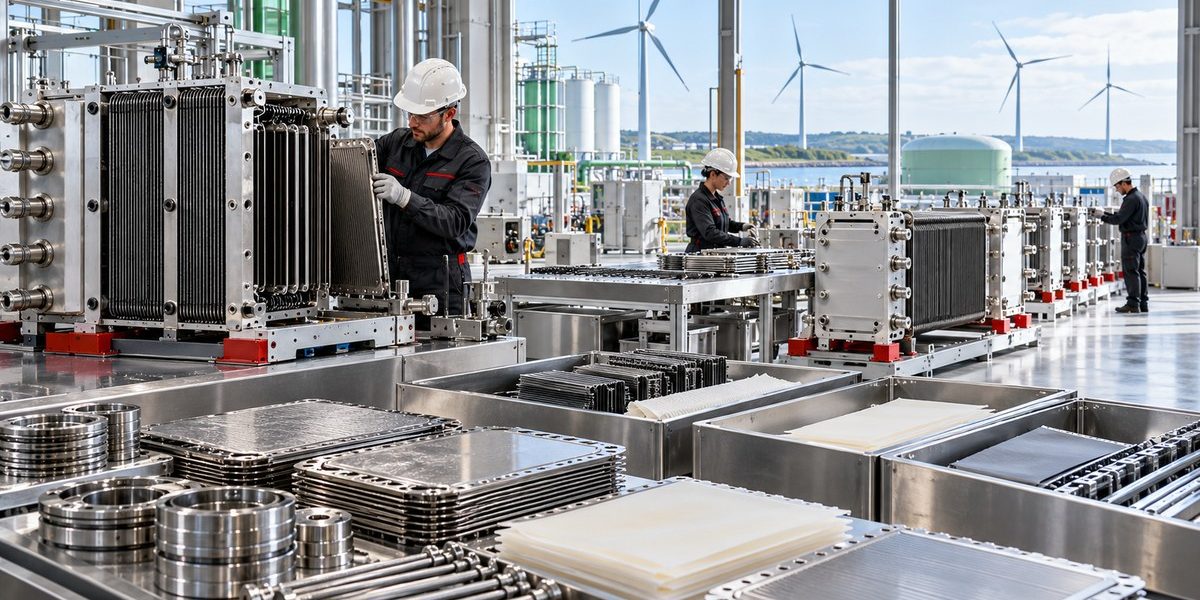
Denmark has a habit of turning problems into opportunities. With wind turbines spinning off the coast and a national grid that already runs on a high share of renewables, you might think the hard part was done. But the green hydrogen sector faced a stubborn issue: what happens to an electrolyser stack after 60,000 hours of splitting water? In 2026, the answer is no longer a question mark. Denmark’s electrolyser recycling strategy has become a blueprint for cutting costs and waste at the same time.
Denmark’s electrolyser recycling strategy recovers up to 95% of critical materials like iridium and nickel from old stacks. This cuts the cost of new electrolysers by nearly a third and diverts thousands of tonnes of waste from landfill. For investors and policy analysts, it is a circular economy model that lowers risk and improves project economics.
Why Recycling Electrolysers Changes the Economics
When you build a green hydrogen plant, the electrolyser is the biggest capital expense. For years, the industry focused on making those stacks cheaper to manufacture. But the real breakthrough in 2026 is realising that a stack is not a one-time purchase. It is a resource bank.
The Danish approach treats end-of-life electrolysers as urban mines. A single large-scale PEM electrolyser contains kilograms of precious metals. Those materials have volatile prices and are often sourced from geopolitically sensitive regions. By keeping them in circulation, Denmark reduces exposure to supply chain shocks and lowers the levelised cost of hydrogen (LCOH).
For a policy analyst looking at national energy security, this is a direct win. For an investor, it turns a depreciating asset into a circular revenue stream.
The Three Pillars of the Danish Strategy
Denmark’s recycling strategy does not rely on a single magic solution. It rests on three interconnected processes that work together.
-
Standardised stack design for disassembly. Manufacturers now build stacks that can be taken apart in under four hours. That might sound simple, but it required a shift in thinking. Bolts replace welded joints. Membrane assemblies slide out on rails. This design choice makes recycling economically viable because labour time drops sharply.
-
Hydrometallurgical recovery of catalysts. Instead of burning off components, Danish recyclers use a wet chemical process to dissolve and separate iridium, ruthenium, and nickel. The recovery rate for iridium now sits above 92% in commercial operations. That metal alone can account for 15% of a PEM stack’s original cost.
-
Closed-loop remanufacturing of bipolar plates. Stainless steel bipolar plates are cleaned, inspected, and recoated. Plates that pass a thickness test go straight back into new stacks. The Danish Energy Agency estimates this alone saves 40% of the embodied carbon compared to making plates from virgin steel.
These three steps form the backbone of what industry insiders now call the “Aalborg Protocol”, named after the city where the first commercial-scale recycling line opened in early 2026.
A Practical Look at the Numbers
Let us put some figures on the table. The table below compares the old linear model with the new circular model for a typical 10 MW PEM electrolyser project in Denmark.
| Component | Linear Model (No Recycling) | Circular Model (Danish Strategy) | Cost Saving |
|---|---|---|---|
| Iridium catalyst | 100% virgin, market price | 92% recovered, 8% top-up | 44% |
| Nickel mesh | 100% virgin | 85% recovered | 38% |
| Bipolar plates | 100% virgin steel | 70% reused, 30% new | 35% |
| End plates and frames | Landfill | 95% recycled as raw material | 50% |
| Total stack replacement cost | Full price | 68% of original | 32% |
That 32% saving on stack replacement ripples through the entire project life cycle. For a 50 MW facility operating for twenty years, it can mean millions of euros in avoided capital expenditure.
What Industry Experts Are Saying
“We used to think of an electrolyser stack as a consumable. After 60,000 hours, you pull it out and throw it away. The Danish strategy proves that is not just wasteful, it is financially negligent. A recycled stack is cheaper than a new one, and it performs within 3% of original efficiency.”
Dr. Mette Frandsen, Head of Circular Economy at the Danish Hydrogen Innovation Hub
That 3% efficiency gap is closing. Some recycled stacks in pilot projects are now matching original performance. The technology is moving faster than anyone predicted.
Common Mistakes in Electrolyser Recycling (and How Denmark Avoids Them)
Not every recycling effort succeeds. Here are the pitfalls that other regions have stumbled into, and how Denmark sidesteps them.
- Mixing stack types in a single recycling stream. PEM and alkaline stacks need different chemical baths. Denmark keeps them separate from the factory floor.
- Shredding before sorting. Shredding a complete stack makes metal recovery harder. Danish lines disassemble first, then process each material stream independently.
- Ignoring the balance of plant. Pumps, valves, and piping contain copper and stainless steel. Denmark’s strategy includes a separate recovery line for these components.
- Assuming recycling is always cheaper. It is not. Transporting a spent stack from Germany to Denmark can eat into savings. That is why Denmark is building regional hubs in Jutland and Zealand to minimise logistics costs.
How This Strategy Lowers Investment Risk
For investors, the biggest headache in green hydrogen has always been uncertainty. Will metal prices spike? Will regulations force costly decommissioning? Will the electrolyser manufacturer still exist in ten years to supply spare parts?
Denmark’s recycling strategy answers all three.
- Metal price volatility is hedged because you are not buying virgin material every cycle.
- Decommissioning becomes a revenue event instead of a cost line.
- Standardised stack design means you are not locked into a single supplier. Any recycler certified under the Danish standard can process your stacks.
This de-risking is already attracting institutional capital. Pension funds that previously stayed on the sidelines are now looking at Danish hydrogen projects with a keener eye.
The Role of Policy in Making It Work
None of this happened by accident. The Danish government introduced a series of measures that created the conditions for a recycling ecosystem.
- Extended producer responsibility (EPR) for electrolysers. Manufacturers must finance the take-back and recycling of stacks sold after 2024. This gave them a direct financial incentive to design for disassembly.
- A material passport system. Every new electrolyser installed in Denmark carries a digital passport listing the materials and their quantities. Recyclers scan this passport to plan the recovery process before the stack even arrives.
- Tax credits for recycled content. Stacks that contain at least 30% recycled material qualify for a reduced VAT rate on the purchase price.
These policies do not pick winners. They set the rules of the game and let the market find the most efficient solutions.
What the UK Can Take From This
The UK has its own hydrogen ambitions, with clusters planned in Teesside, Humber, and Aberdeen. The Danish example offers a concrete lesson: do not wait until the first stacks fail to think about recycling.
British policymakers could adopt a similar material passport system. UK electrolyser manufacturers could start designing for disassembly today. The cost of retrofitting recycling capability later is far higher than building it in from the start.
For UK investors, the message is simpler. A project that includes a recycling plan is a lower-risk project. Factor that into your due diligence.
The Path Forward for Electrolyser Recycling in 2026 and Beyond
Denmark is not stopping at the current recovery rates. Research labs in Aarhus and Copenhagen are working on direct membrane reuse, where the entire membrane electrode assembly is cleaned and reinstalled without breaking it down into individual metals. Early results suggest this could push total material recovery above 97% by 2028.
There is also work on robotic disassembly lines. A prototype at the Danish Technological Institute can now strip a 5 MW stack in 90 minutes with no human intervention. That will drive labour costs down further and make recycling viable for smaller stacks that are currently uneconomical to process.
The strategy is also expanding to include offshore electrolysers. As Denmark deploys more subsea hydrogen production units on North Sea platforms, a floating recycling service is being developed. A barge with a mobile processing unit can travel to the platform, strip the stack, and return the recovered metals to shore. That avoids the cost and risk of transporting heavy equipment across the North Sea.
A Practical Checklist for Evaluating a Recycling Strategy
If you are assessing a Danish hydrogen project or planning one of your own, here is what to look for.
- Does the electrolyser supplier have a certified take-back programme?
- Are the stacks designed for disassembly in under four hours?
- Is there a material passport for the stack?
- What is the guaranteed recovery rate for iridium and nickel?
- Does the recycling partner use hydrometallurgical or pyrometallurgical methods? (Hydrometallurgical is preferred for precious metals.)
- Are the recycled materials fed back into Danish manufacturing or sold on the open market?
These questions will tell you whether the project is truly circular or just greenwashing a linear model.
Why This Matters for the Nordic Circular Economy
Denmark’s electrolyser recycling strategy is not an isolated initiative. It fits into a broader Nordic push for industrial symbiosis, where waste from one process becomes feedstock for another. The Kalundborg eco-industrial park is the most famous example, but the electrolyser recycling network is creating similar links between hydrogen plants, metal refineries, and manufacturing facilities across the country.
This interconnectedness makes the entire system more resilient. If one recycling line goes down, another can take the load. If iridium prices spike, the closed loop buffers the impact. For a small country with big ambitions, that resilience is worth its weight in rare earth metals.
A Final Thought on Cost and Waste
Denmark’s electrolyser recycling strategy proves that cutting costs and cutting waste are not trade-offs. They are the same thing. When you recover 92% of a precious metal, you do not just save the environment. You save the money that would have gone to a mining company on the other side of the world.
For policy analysts, this is a case study in smart regulation. For investors, it is a risk reduction tool. For the hydrogen industry, it is the missing piece that makes green hydrogen economically sustainable over the long term.
The next time someone tells you that green hydrogen is too expensive, ask them about the recycling plan. If they do not have one, they are not looking at the full picture.
Denmark is. And in 2026, that is making all the difference.