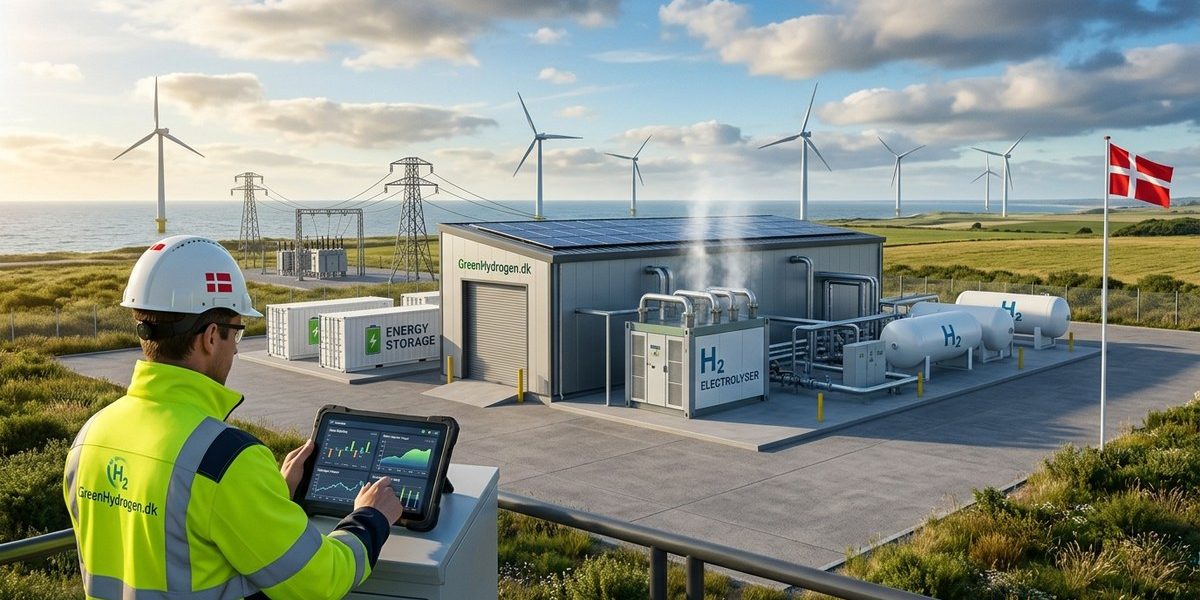
You have decided to invest in a green hydrogen project in Denmark. The wind blows, the sun shines, and your electrolyser hums along, turning electrons into molecules. Then the sky goes grey and still. Your power input drops. The grid sends a spike. Your system trips, or worse, it degrades. This is the reality of a Danish electrolyser investment in a world of grid fluctuations.
Grid fluctuations are the single biggest threat to the return on a Danish electrolyser investment. By combining advanced power electronics, smart hydrogen storage, and flexible operational protocols, you can turn volatility from a liability into a competitive advantage. The goal is not to avoid fluctuations, but to profit from them.
Why grid fluctuations matter for your electrolyser
Denmark’s power grid is one of the most renewable in Europe. By 2026, wind and solar account for over 70% of electricity generation. That is brilliant for decarbonisation, but it creates a problem for industrial users. The supply of power is no longer steady. It varies by the minute.
An electrolyser is a sensitive piece of equipment. It needs a stable voltage and a consistent current to operate efficiently. When the grid fluctuates, your electrolyser faces two risks. The first is operational. Rapid changes in power can trip protection systems, causing unplanned downtime. The second is financial. If you have signed a fixed-price power purchase agreement (PPA) but cannot run your plant when the sun is not shining, your production costs rise and your revenues fall.
To protect your Danish electrolyser investment, you need a strategy that addresses both the technical and the financial sides of the problem.
The three layers of protection
Think of your protection strategy as three layers. Each layer handles a different type of fluctuation.
Layer one: Power electronics and controls. This is the hardware that sits between the grid and your electrolyser stack. Modern power converters can smooth out voltage sags and swells in milliseconds. They can also ramp production up and down in response to price signals.
Layer two: Hydrogen storage and buffering. You cannot control when the wind blows, but you can control when you sell your hydrogen. By adding a storage buffer, you decouple production from demand. You run your electrolyser when power is cheap and abundant, and you feed hydrogen to your offtaker when they need it.
Layer three: Market and financial hedging. This is the business side of the equation. You use financial instruments to lock in a minimum revenue, even when the grid is unstable. This layer includes contracts for difference, flexibility payments from the grid operator, and long-term offtake agreements.
A practical process to future-proof your investment
Here is a step-by-step process that works for projects in Denmark right now.
-
Audit your grid connection point. Talk to Energinet, the Danish transmission system operator. Ask for the historical data on voltage variations and frequency deviations at your specific connection point. This data is free and it tells you what your electrolyser will actually face.
-
Choose the right electrolyser technology. Proton exchange membrane (PEM) electrolysers handle load changes better than alkaline systems. They can ramp from 10% to 100% in a few seconds. If your site is prone to sudden drops in power, PEM is the safer choice. For a detailed comparison, see our guide on comparing PEM and alkaline electrolysers for Denmark’s green hydrogen projects.
-
Size your power electronics for overload. Do not spec your rectifier and transformer for the average power. Spec them for 120% of the peak. This headroom absorbs spikes without tripping your breakers.
-
Install a battery buffer. A small battery (around 10% of your electrolyser capacity) can smooth out the worst of the fluctuations. It costs money, but it saves you from stack degradation. The battery charges when the grid is stable and discharges to protect the electrolyser during a transient event.
-
Set up a flexible hydrogen storage system. You do not need a massive underground cavern. A set of pressurised tanks sized for 12 hours of production is enough to decouple your output from the grid. This lets you run your plant at full power during the cheap hours and idle during the expensive ones.
Common mistakes and how to avoid them
| Mistake | Why it hurts | Better approach |
|---|---|---|
| Sizing the electrolyser for the PPA, not the grid | You cannot run at full capacity during low-wind periods. | Size for the 10th percentile of renewable generation, not the average. |
| Ignoring harmonic distortion | Harmonics from nearby wind farms can overheat your stack. | Specify a power quality study before you order the rectifier. |
| Signing a fixed-price PPA without a curtailment clause | You pay for power you cannot use. | Include a force majeure or grid curtailment clause in your PPA. |
| Using an alkaline electrolyser on a highly variable grid | Alkaline stacks degrade faster with rapid cycling. | Use PEM or add a large battery to buffer the ramps. |
| Forgetting about reactive power charges | The grid operator may charge you for poor power factor. | Install active power factor correction in your converter design. |
How to finance the buffer
Adding a battery and a hydrogen storage tank increases your capital expenditure. You need to justify that cost to your investors. The good news is that these buffers create new revenue streams.
“In Denmark, the grid operator pays for flexibility. If you can prove that your electrolyser can respond to a grid signal within two seconds, you can sell that response to the balancing market. The payments are small per event, but they add up over a year. In 2025, we saw projects earn between 5% and 8% of their revenue from grid services alone.” – Energy analyst, Danish Energy Agency
You can also use your buffer to participate in the frequency containment reserve (FCR) market. This is a premium service that pays well for fast response. Your battery handles the response, while your electrolyser runs at base load.
The must-have components for a resilient system
If you are building a new project in 2026, include these items in your specifications:
- A grid-tied inverter with a ride-through capability for 500-millisecond dips.
- A programmable logic controller (PLC) that can throttle the electrolyser based on a real-time price signal from Nord Pool.
- A hydrogen compressor that can handle variable inlet pressure from the storage tanks.
- A remote monitoring system that alerts you to grid events before they cause a trip.
For more on the hardware side, read our piece on top innovations in Danish electrolyser technologies for 2026.
Operational tactics for daily management
Your hardware is only half the story. How you operate the plant matters just as much.
- Run a predictive schedule. Use weather forecasts to plan your production windows. If a storm is coming, run your electrolyser hard the day before. If a calm period is forecast, idle the plant and draw from storage.
- Monitor stack health. Track the voltage decay of each cell. A sudden change in voltage indicates that a fluctuation has damaged the membrane. Catch it early and replace the cell before the whole stack fails.
- Train your operators. Your team needs to understand the grid signals. They should know when to override the automatic controls and when to let the system ride through a fluctuation.
Putting it all together
A future-proof Danish electrolyser investment is not about buying the cheapest equipment. It is about designing a system that treats grid fluctuations as a feature, not a bug. You build in buffers. You choose technology that can flex. You sign contracts that share the risk.
Start with the audit. Talk to Energinet. Get the data on your specific connection point. Then design your system around that data, not around a brochure.
The Danish grid is not going to get more stable. As more offshore wind comes online, the fluctuations will increase. But the opportunities will increase too. The projects that survive and thrive will be the ones that planned for volatility from day one.
Take a look at our guide on how to integrate electrolysers with Denmark’s wind power for optimal green hydrogen production for a deeper look at the operational side of this equation.
Your next three steps
You now have the framework. Here is what to do next.
- Step one: Run the numbers. Model your project with and without a battery buffer. Use real grid data from your connection point. See how much the buffer improves your uptime and your stack lifetime.
- Step two: Talk to a power electronics supplier. Ask them for a guarantee on ride-through performance. If they cannot give you a written specification, find another supplier.
- Step three: Review your PPA. If your contract does not include a flexibility clause, renegotiate it. You need the freedom to idle your plant when power prices spike.
Denmark is the best place in Europe to build a green hydrogen project. The renewable resources are world class. The grid is modern. The regulatory framework is supportive. But the grid is also volatile. That is a fact you cannot change. What you can change is how your project responds to that volatility. Build the buffers. Choose the right technology. Sign smart contracts. Then watch your electrolyser run reliably, year after year, no matter what the wind does.