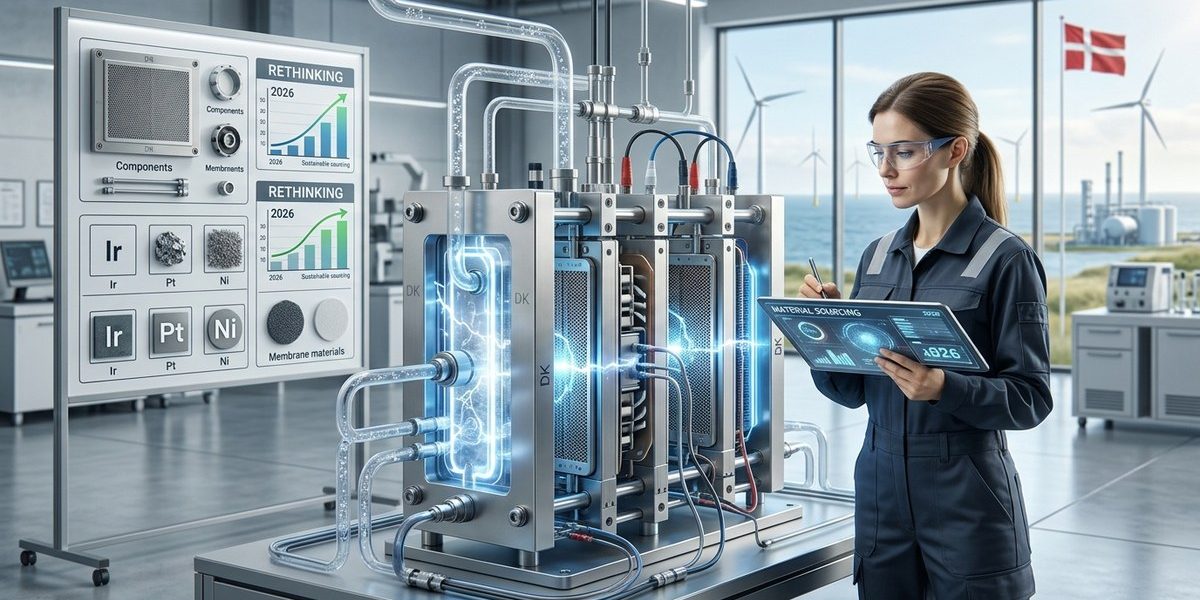
Denmark has long been a quiet powerhouse in the green hydrogen world. But in 2026, something has shifted. The suppliers who build the electrolyser stacks at the heart of this industry are no longer just competing on efficiency or cost. They are scrambling to secure the raw materials that make those stacks work. Iridium, platinum, rare earth elements, and even specific grades of steel have become strategic assets. Geopolitical tensions and supply chain bottlenecks have turned material sourcing into the defining challenge for Danish electrolyser makers.
In 2026, Denmark’s electrolyser stack suppliers are moving away from single-source, high-risk materials like iridium. They are investing in alternative chemistries, recycling programmes, and localised supply chains. This shift is driven by price volatility, EU regulations on critical raw materials, and the need to scale production without being held hostage by a handful of global suppliers.
A Perfect Storm for Material Sourcing
Think about what goes into a modern PEM electrolyser stack. The catalyst layers often rely on iridium and platinum. These are platinum group metals, and they come from a very small number of mines, mostly in South Africa and Russia. In 2026, relying on those sources feels like a gamble.
The war in Ukraine disrupted Russian metal supply. Trade disputes have made South African exports less predictable. At the same time, demand for electrolysers is soaring. Every new green hydrogen project in Denmark, from the Hydrogen Valleys in Jutland to the offshore wind-to-hydrogen pipelines in the North Sea, needs stacks. The result is a classic supply crunch.
Danish suppliers are not waiting for the market to stabilise. They are actively rethinking their material strategies. This is not a theoretical exercise. It is happening on factory floors in Kolding, Herning, and Copenhagen right now.
The Three Big Material Problems
There are three main headaches that supply chain managers are trying to solve in 2026.
1. Iridium Dependency
Iridium is the most critical material for PEM electrolysers. It is scarce, expensive, and almost entirely sourced from South African platinum mines as a by-product. The price has swung wildly. In 2025, it hit peaks that made stack production economically unviable at scale. Suppliers are now racing to reduce iridium loading in their catalysts. Some have cut it by 80% compared to designs from 2023.
2. PFAS Phase-Out
Per- and polyfluoroalkyl substances (PFAS) are used in membranes and gaskets. The EU is moving to restrict them under new chemical regulations. Danish suppliers are switching to PFAS-free alternatives, but those new materials have their own supply chains. Sourcing them reliably is a new challenge.
3. Steel and Titanium Grades
The bipolar plates in a stack need to resist corrosion and handle high pressure. High-grade titanium and specialised stainless steel are not always easy to get in the volumes needed. European steel mills are prioritising other industries, and lead times have stretched.
How Danish Suppliers Are Responding
The response has been practical and multi-layered. Here is a numbered list of the main strategies being adopted by Danish electrolyser stack suppliers in 2026.
-
Switch to low-iridium and non-iridium catalysts. Several Danish R&D teams are now testing catalysts based on nickel, cobalt, and manganese. These are far more abundant. The trade-off is slightly lower efficiency, but the supply security is worth it.
-
Build domestic recycling loops. Instead of shipping scrap stacks abroad, suppliers are setting up their own recovery facilities. They reclaim iridium, platinum, and titanium from end-of-life stacks. This cuts dependency on virgin mining.
-
Sign long-term offtake agreements with European mines. New mining projects in Finland, Sweden, and Portugal are being developed. Danish suppliers are locking in contracts now to secure supply for the next decade.
A Practical Guide to Rethinking Your Material Strategy
If you are a supply chain manager or investor looking at the Danish electrolyser market, here is a bulleted list of actions to consider.
- Audit your current material sources. Map every critical material back to its country of origin.
- Set a target for reducing iridium loading per megawatt by at least 50% by 2027.
- Start a pilot programme for catalyst recycling with a Danish partner.
- Engage with EU policy discussions on Critical Raw Materials. The rules are still being shaped.
- Diversify your supplier base for titanium and specialty steels. Do not rely on a single mill.
Comparing Sourcing Approaches in 2026
The table below shows how different sourcing strategies stack up against each other for Danish electrolyser makers.
| Strategy | Cost per MW | Supply Risk | Maturity |
|---|---|---|---|
| High-iridium PEM (traditional) | High | Very High | Mature |
| Low-iridium PEM | Medium | Medium | Emerging |
| Nickel-based catalyst (new) | Low | Low | Early stage |
| Full recycling loop | Medium (initial) | Very Low | Pilot scale |
| European mine offtake | Medium | Low | Growing |
Expert Advice: Why This Shift Matters Now
“The days of assuming you can buy iridium on the spot market are over. We are seeing lead times stretch from weeks to months. If you are not already testing low-iridium stacks or securing recycling partnerships, you are already behind.” — Senior supply chain analyst at a Danish electrolyser manufacturer, speaking at a hydrogen conference in Aarhus, March 2026.
This is not just about cost. It is about being able to deliver on the contracts you have signed. Several Danish projects have already faced delays because stack deliveries were held up by material shortages.
The Role of PFAS-Free Membranes
The SUPREME project, led by the University of Southern Denmark, is a good example of the kind of innovation happening right now. They are developing PEM stacks that use no PFAS and dramatically less iridium. This is not a lab experiment. It is being scaled for commercial trials in 2026. If it works, it could remove two of the biggest sourcing bottlenecks at once.
You can read more about how Danish innovations are shaping the future of green hydrogen infrastructure and how these material changes fit into the bigger picture.
What This Means for Investors
If you are an investor tracking the Danish hydrogen sector, here is what to watch.
- Who is investing in recycling capacity? The suppliers that build their own material loops will have a structural cost advantage by 2028.
- Who is signing European mine deals? Those contracts are a sign of long-term thinking.
- Who is still using old stack designs with high iridium loads? They may struggle to scale.
The financial incentives supporting electrolyser projects in Denmark for 2026 are generous, but they come with delivery deadlines. Material strategy will determine who meets those deadlines.
A New Mindset for Supply Chains
The shift in Denmark’s electrolyser stack material sourcing is not a temporary fix. It represents a permanent change in how the industry thinks about supply chains. Instead of treating materials as commodities to be bought at the lowest price, suppliers are treating them as strategic assets. They are investing in relationships, recycling, and research all at once.
This is a more complex way of operating. But it is also more resilient. And in a world where the next geopolitical shock could come at any moment, resilience is worth more than a marginal cost saving.
Looking Ahead to 2027 and Beyond
The changes happening in 2026 will set the pattern for the rest of the decade. Danish suppliers that move early on low-iridium stacks and closed-loop recycling will be the ones that dominate the European export market. Those that hesitate will find themselves locked out of key supply chains.
If you want to understand how this fits into the broader picture of why Danish electrolysers are the backbone of Europe’s green hydrogen supply chain in 2026, the message is clear. Material sourcing is no longer a footnote in the engineering manual. It is the headline.
A Final Thought
The next time you look at an electrolyser stack, think about where every atom in it came from. That iridium might have been mined in South Africa, shipped to a refinery in Belgium, processed in Germany, and assembled in Denmark. The whole chain is fragile. The smartest suppliers are the ones building shorter, stronger chains. If you are involved in this industry, now is the time to ask your own suppliers the hard questions about where their materials come from. The answers will tell you everything about whether they can deliver in 2027 and beyond.