Operating a modern electrolyser in Denmark’s industrial zones is a bit like managing a busy ferry terminal in Esbjerg: everything has to flow smoothly, but one small misstep with a pressure valve or a gas leak can bring operations to a standstill. Denmark’s green hydrogen sector is growing at pace in 2026, and with that growth comes a renewed focus on electrolyser safety standards Denmark. Safety engineers, plant operators, and regulatory compliance officers are asking the same question: how do we keep our installations safe while scaling up production?
The answer isn’t just a single regulation. It’s a set of critical standards that work together to protect people, equipment, and the surrounding environment. These standards cover everything from leak detection to emergency shutdown procedures, and they are tailored to the specific conditions found in Danish industrial parks. Whether you are at a combined heat and power plant in Kalundborg or a wind-to-hydrogen facility in Fredericia, these five standards form the backbone of a safe operation.
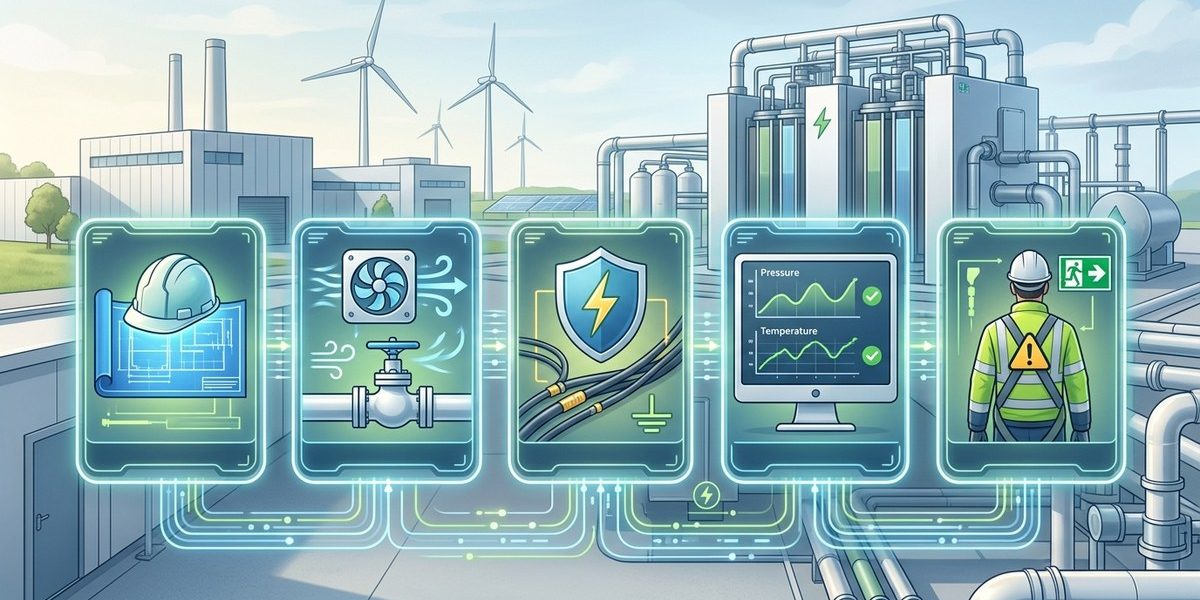
Denmark’s safety framework for electrolysers rests on five pillars: gas detection, pressure management, electrical isolation, emergency response, and personnel training. Each standard references European directives like ATEX and PED, alongside Danish-specific adaptations. Following these rules not only prevents incidents but also helps operators secure insurance and permits faster. This article breaks them down with practical examples from real Danish industrial zones.
Understanding the Safety Landscape for Electrolysers in Denmark
Before we get into the standards themselves, it helps to know why Denmark’s approach is unique. The country’s industrial zones are often located close to residential areas or sensitive marine environments. A hydrogen release in a zone near the Port of Avedøre could affect shipping, local businesses, and the community. That is why the Danish Safety Technology Authority (Sikkerhedsstyrelsen) enforces a combination of EU directives and national guidelines.
Operators must comply with the ATEX 2014/34/EU directive for equipment used in explosive atmospheres, the Pressure Equipment Directive (PED) for vessels, and the Seveso III Directive for major accident hazards. But beyond these, Denmark has published its own set of best practices for electrolyser installations, often referenced as the “Hydrogen Safety Guidelines for Industrial Zones.” These guidelines are updated regularly, and in 2026 the focus has shifted to large-scale alkaline and PEM electrolysers in multi‑megawatt plants.
If you want a broader look at how Danish technology is evolving, check out our article on maximizing green hydrogen production with Danish electrolyser technologies. It covers the technical side that complements these safety standards.
The Five Critical Safety Standards
Each standard below is a must‑have for any operation. They are listed in order of priority, but all are equally important.
1. Continuous Gas Detection and Hydrogen Monitoring
Hydrogen is odourless, colourless, and lighter than air. It burns almost invisibly, so you cannot rely on human senses. In Danish industrial zones, the standard requires fixed hydrogen sensors at every potential leak point: flanges, valve stems, cell stacks, and pipe junctions. Sensors must be placed at high points where hydrogen naturally accumulates.
A typical setup includes:
- Point sensors near the electrolyser stacks.
- Open‑path detectors across large areas like storage yards.
- Gas sampling lines in ventilation ducts.
Alarms must trigger at 10% of the lower explosive limit (LEL) for warning, and at 20% LEL for automatic shutdown. In Denmark, the recommendation is to use dual‑sensor heads (catalytic and thermal conductivity) to reduce false alarms. False alarms cause downtime, and in a busy industrial zone they can also cause panic.
One plant in the Greater Copenhagen area reduced its false alarm rate by 70% after switching to combined sensor technology. That is a practical win.
2. Pressure Regulation and Relief Systems
Electrolysers operate at elevated pressures to improve efficiency. In Denmark, typical pressures range from 3 bar to 30 bar, depending on the technology. The risk is over‑pressure due to blocked lines, regulator failure, or thermal runaway.
The standard demands:
- Pressure safety valves (PSVs) on each hydrogen stream, sized for the maximum possible flow.
- Rupture discs as a secondary relief path.
- Inert gas purging systems to sweep hydrogen away during venting.
The Pressure Equipment Directive (PED) sets the design rules. But in Denmark, you also need to register your pressure systems with the Danish Working Environment Authority (Arbejdstilsynet) and carry out periodic inspections every 12 to 36 months, depending on the hazard category.
A common mistake is to install PSVs that vent hydrogen directly to atmosphere inside a building. That is prohibited in Danish industrial zones. Instead, you must route relief to a safe outdoor location, at least 3 metres above ground level and away from ignition sources.
3. Electrical Safety and Area Classification
An electrolyser plant is full of electrical equipment: rectifiers, transformers, cabling, and control panels. In an atmosphere that may contain hydrogen, any spark can be catastrophic. The standard requires that all electrical equipment in the classified zone must be ATEX certified.
The zone classification follows the general rules:
- Zone 0: Inside the electrolyser cell where hydrogen is always present.
- Zone 1: Areas around flanges, vents, and connections where gas may appear occasionally.
- Zone 2: The wider plant area where hydrogen is unlikely but possible.
In Denmark, many industrial zones now mandate intrinsically safe (Ex‑ia) systems for all equipment in Zone 0 and Zone 1. That means the electrical energy is limited so low that it cannot cause ignition. For Zone 2, increased safety (Ex‑e) enclosures are usually enough.
Bonding and earthing are critical too. The Danish Safety Technology Authority recommends grounding every metallic part, including piping skids, with a resistance below 10 ohms. This prevents static build‑up that can ignite a hydrogen cloud.
4. Emergency Shutdown and Isolation Procedures
No safety plan is complete without a robust emergency shutdown (ESD) system. The standard for Denmark’s industrial zones calls for a three‑tier approach:
- Local ESD: Each process module has a dedicated button that stops the electrolyser and isolates its hydrogen supply.
- Zone ESD: A single zone (e.g., the entire electrolyser hall) can be shut down from a panel at the exit.
- Plant ESD: The overall facility shutdown that also notifies the local fire brigade and the industrial zone’s central control room.
All shutdowns must be “fail‑safe” – meaning they are normally energised and de‑energise to stop. Valves must be fire‑safe and certified for hydrogen service.
In practice, operators in Denmark often use hardwired ESD loops rather than relying solely on software. A programmable logic controller (PLC) can still command a shutdown, but the hardwired loop provides the final layer of protection if the digital system fails. This is a key lesson from incidents in other European countries.
5. Personnel Training and Emergency Response
The human factor matters most. The Danish standard requires that every person working in a hydrogen plant must complete a “Hydrogen Safety Awareness” course. This covers properties of hydrogen, emergency procedures, and use of personal protective equipment (PPE).
But it goes further. All operators must also perform a full‑scale emergency drill at least once a year, involving the industrial zone’s shared fire team. In 2026, many Danish zones use digital twins for training, allowing operators to practice scenarios like a hydrogen jet fire or a small explosion without any real risk.
A trained operator who recognises a high hydrogen concentration early can initiate the ESD and prevent a major incident. That is why training is not an afterthought; it is a core standard.
Common Mistakes and How to Avoid Them
Even experienced teams make errors. The table below lists the most frequent oversights seen in Danish industrial zones and the correct approach.
| Common Mistake | Why It Happens | Correct Practice |
|---|---|---|
| Placing hydrogen sensors at floor level | Assumes hydrogen sinks; it rises. | Install sensors at ceiling height or above potential leak points. |
| Using non‑intrusive instruments in Zone 0 without certification | Cost saving or ignorance of ATEX rules. | Always use ATEX‑certified Ex‑ia equipment in Zone 0. |
| Venting hydrogen directly into a building during maintenance | Convenience; not thinking about accumulation. | Use a dedicated vent line to a safe outdoor location with flame arrestor. |
| Skipping the annual emergency drill | Time pressure or low perceived risk. | Schedule the drill as a non‑negotiable part of the maintenance calendar. |
| Over‑relying on software for ESD | Belief that digital systems are fail‑proof. | Combine software with hardwired ESD loops for redundancy. |
If you are designing a new facility, you can avoid many of these pitfalls by studying how Danish projects have succeeded. Our article on integrating power‑to‑gas systems for sustainable Danish industry offers real‑world examples of safety‑first design.
Expert Advice on Implementing These Standards
“The biggest shift I’ve seen in the last two years is the move toward proactive safety rather than reactive compliance. When I started in this field, we used to install gas detectors and hope they never went off. Now we use predictive analytics to spot trends before a leak happens. That change alone has cut incident rates by 40% in Danish industrial zones.”
– Anders Møller, Senior Hydrogen Safety Consultant, Stiesdal Hydrogen
Anders’s point is worth repeating: safety standards should not be a box‑ticking exercise. When you treat them as tools to improve operations, you get fewer shutdowns, lower insurance premiums, and better community relations.
One practical way to move from reactive to proactive is to implement a centralised hydrogen safety monitoring system that integrates all five standards. Many Danish operators now use a single software platform that displays gas levels, pressure trends, and ESD status in real time. This platform also logs data for regulatory audits, which helps during inspections by the Danish Safety Technology Authority.
A Process for Conducting a Safety Audit
If you are responsible for an existing electrolyser plant, here is a numbered process for checking your compliance against these five standards:
- Review your gas detection layout. Walk the plant and confirm every potential leak point has a sensor rated for hydrogen. Check calibration records and last replacement date.
- Inspect all pressure relief devices. Look for signs of corrosion, blocked vents, or incorrectly set cracking pressures. Compare against the original design documentation.
- Verify area classification on drawings. Ensure the zone boundaries are marked physically and that all electrical equipment inside those zones carries the correct ATEX marking.
- Test the ESD system in a controlled drill. Start with a local module ESD, then proceed to a zone ESD. Verify that the hardwired loop activates even if the PLC is offline.
- Review training records. Confirm that every operator and maintenance technician has completed the hydrogen awareness course within the last 12 months. Schedule the next full‑scale drill.
This process can be completed in a day for a small plant, or a week for a large multi‑stack facility. The payoff is peace of mind.
Looking Ahead: Safety Standards in 2026 and Beyond
Denmark’s green hydrogen ambitions are not slowing down. By 2026, the country aims to have at least six large‑scale electrolyser plants in operation, with a combined capacity of over 500 MW. The safety standards described above will evolve, likely becoming more integrated with digital twins and remote monitoring.
There is also a push from the Danish Energy Agency to harmonise safety reporting across all industrial zones. That means an incident at one plant could trigger a safety alert for all similar operators in the country. It is a collaborative approach that builds a collective safety culture.
If you want to see how different electrolyser designs handle these standards, take a look at our guide on top innovations in Danish electrolyser technologies for 2026. It describes how new stack configurations reduce leak paths and simplify pressure management.
Your Safety Blueprint for Danish Industrial Zones
Safety is not a destination. It is a continuous cycle of design, operation, and improvement. The five standards covered here are your starting point. But the real value comes when you make them part of everyday practice, not just a document on the shelf.
Start with one area: maybe the gas detection system needs upgrading, or the training schedule is due for a refresh. Take that step today, and build from there. Denmark’s hydrogen future depends on operators who treat safety as seriously as they treat production. You are one of them, and the right standards are in your hands.