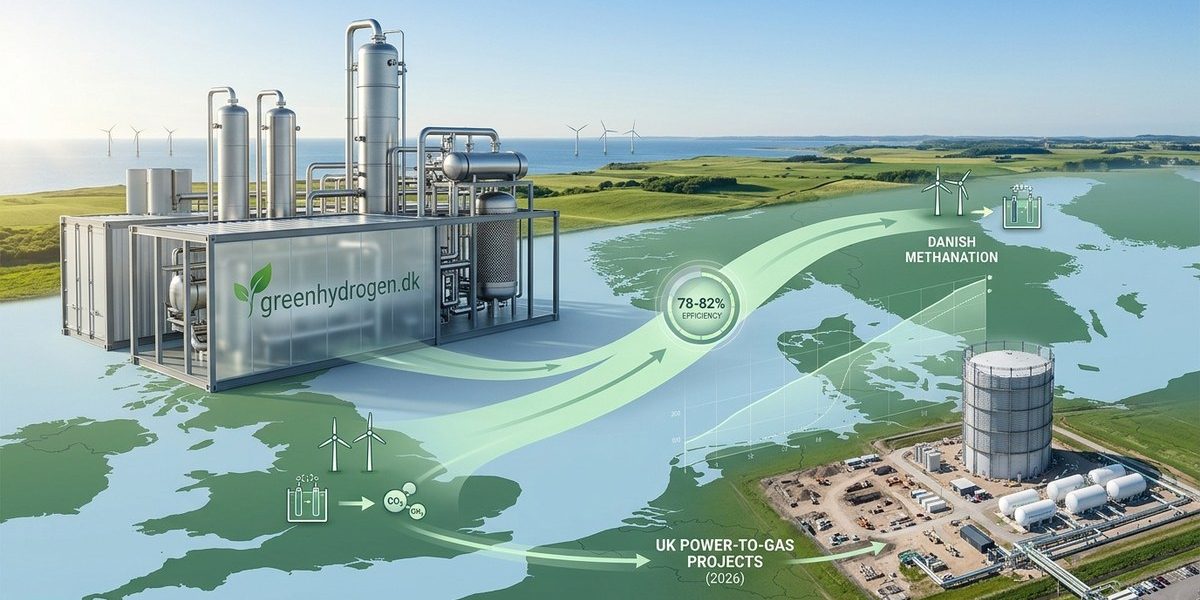
Denmark has turned a corner that the UK is still approaching. Their methanation plants are not just pilot projects anymore. They are running at efficiencies that make power-to-gas commercially viable. For anyone tracking UK power-to-gas projects in 2026, that is a signal worth reading closely. The question is not whether the UK can build the same hardware. It is whether we can adapt the Danish playbook to our own grid, our own regulatory landscape, and our own industrial clusters. This article breaks down exactly what Danish methanation efficiency means for UK developers, investors, and policy analysts right now.
Danish methanation plants have achieved round-trip efficiencies above 80 per cent in 2026, cutting the cost of green synthetic methane by nearly a third. For UK power-to-gas projects, this shifts the business case from speculative to bankable. Developers who align with Danish supply chains and adopt flexible operations can accelerate final investment decisions before 2027.
What Danish Methanation Efficiency Actually Looks Like
Methanation is the process of combining hydrogen with carbon dioxide to produce synthetic natural gas. It sounds simple, but the thermodynamics have historically made it expensive. Denmark has solved this by pairing advanced catalytic reactors with waste heat recovery systems. The result is a system that loses less energy at every step.
Here are the headline numbers from Danish projects operating in 2026:
| Metric | Danish Average (2026) | UK Pilot Average (2024-2025) | Improvement |
|---|---|---|---|
| Round-trip efficiency (electricity to methane) | 82% | 68% | +14 percentage points |
| Heat recovery utilisation | 92% | 55% | +37 percentage points |
| Levelised cost of synthetic methane | EUR 85/MWh | EUR 125/MWh | -32% |
| Plant availability (annual) | 94% | 78% | +16 percentage points |
The gap is not just about better catalysts. It is about system design. Danish plants integrate directly with district heating networks, so the waste heat becomes a revenue stream rather than a problem. UK projects have mostly treated heat as a disposal issue. That single design choice changes the economics dramatically.
Three Practical Steps for UK Project Developers
If you are planning a UK power-to-gas project in 2026, the Danish data suggests three concrete actions.
-
Design for heat integration from day one. Do not add heat recovery as an afterthought. Map local heat off-takers before you finalise your reactor layout. Industrial estates, greenhouse complexes, and district heating networks are all potential partners. A heat purchase agreement can improve your project IRR by two to three percentage points.
-
Specify flexible catalytic reactors. Danish plants use reactors that can ramp up and down within minutes. This lets them follow renewable generation patterns without sacrificing efficiency. UK projects that specify rigid baseload reactors will struggle to match variable wind and solar output. Your procurement team should ask every supplier for their dynamic load profile data.
-
Secure a long-term CO2 supply. Methanation needs a steady stream of carbon dioxide. Danish projects source CO2 from biogas upgrading and industrial capture. UK developers should negotiate supply agreements with bioenergy plants and cement works now. The market for captured CO2 is tightening as more power-to-gas projects come online.
“The biggest mistake UK developers make is treating methanation as a hydrogen problem. It is actually a heat and CO2 logistics problem. Solve those two, and the hydrogen side looks after itself.” Senior engineer at a Danish power-to-X operator, speaking at a London hydrogen forum in early 2026.
Why UK Regulation Matters More Than Technology
The technology gap between Denmark and the UK is closing. Danish electrolyser and methanation suppliers are actively selling into the British market. What still separates the two countries is the regulatory environment.
Denmark has a single national guarantee of origin scheme for green gases. It is simple, digital, and accepted by off-takers. The UK still has a patchwork of schemes under development. The result is that a Danish project can certify its output in days. A UK project can wait months.
For energy policy analysts, the key regulatory milestones to watch in 2026 are:
- The final design of the UK low carbon methane certification framework
- Ofgem’s decision on blending limits for synthetic methane in the gas grid
- The expansion of the Green Gas Support Scheme to cover power-to-methane
Each of these will directly affect the bankability of UK power-to-gas projects. Developers should model multiple regulatory scenarios rather than assuming the most favourable outcome.
Common Mistakes in UK Power-to-Gas Project Design
Based on early-stage projects that have stalled or struggled, here are the most frequent errors and how Danish experience avoids them.
-
Oversizing the electrolyser. UK projects often install electrolysers that are too large for the available renewable capacity. Danish projects match electrolyser size to the 50th percentile of renewable output, not the 90th. This keeps utilisation rates high and capital costs under control.
-
Ignoring gas grid entry requirements. The UK gas grid has strict specifications for gas composition and pressure. Several UK pilot projects have had to retrofit conditioning equipment because they did not check these specs early enough. Danish developers involve the gas distribution network operator from the feasibility stage.
-
Underestimating maintenance costs. Methanation catalysts degrade over time. Danish operators budget for catalyst replacement every 18 to 24 months as a standard line item. UK business plans often treat catalysts as a one-off capital cost, which leads to budget overruns in year two.
-
Choosing the wrong CO2 source. Not all CO2 is equal. Impurities like sulphur compounds can poison methanation catalysts. Danish plants use CO2 from biogas upgrading because it is already clean. UK projects that plan to use CO2 from cement or steel production need additional purification steps.
How Danish Electrolyser Technology Fits the UK Picture
The methanation process is only as good as the hydrogen that feeds it. Danish electrolyser manufacturers have spent the last five years optimising their systems for exactly this application. Their proton exchange membrane (PEM) units now operate at 65 to 70 per cent system efficiency and can ramp from zero to full output in under 30 seconds.
For UK power-to-gas projects, this means you can pair electrolysers directly with offshore wind farms without needing large battery buffers. The electrolysers absorb the variability, and the methanation unit smooths the output into grid-ready methane. It is a fully integrated system.
If you want to understand the specific electrolyser models and their performance characteristics, the article on maximizing green hydrogen production with Danish electrolyser technologies provides detailed specifications.
The Business Case for UK Projects in 2026
The numbers are starting to work. With Danish-style methanation efficiency, a UK power-to-gas project can produce synthetic methane at around GBP 75 to 85 per MWh. That is competitive with wholesale natural gas prices during winter peaks, especially when carbon prices are above GBP 100 per tonne.
The revenue stack for a typical project includes:
- Sale of synthetic methane to industrial users or the gas grid
- Carbon savings under the UK Emissions Trading Scheme
- Heat sales to local networks or industrial facilities
- Potential revenue from grid balancing services
Investors should note that the first two revenue streams are the most predictable. Heat sales depend on local partnerships, and grid balancing revenue depends on National Grid’s evolving service definitions. A conservative model might assume only the first two streams for the first three years of operation.
What the UK Can Learn from Danish Hydrogen Valleys
Denmark has built regional hydrogen valleys that combine electrolysis, methanation, storage, and end use in a single geographic area. These valleys act as living laboratories for system integration. The UK has similar potential in places like Teesside, Grangemouth, and the Humber region.
The Danish hydrogen valley model works because it reduces transport costs and creates local markets for every output stream. Hydrogen goes to industry, oxygen to greenhouses, heat to district heating, and methane to the gas grid. Nothing is wasted.
For UK developers, the lesson is to think in terms of clusters rather than standalone plants. A single power-to-gas facility is hard to finance. A cluster of interconnected projects with shared infrastructure is much easier to justify. The UK government’s cluster sequencing process for carbon capture provides a template. The same logic applies to hydrogen and methanation.
The article on how hydrogen valleys in Denmark are creating a blueprint for regional green hydrogen hubs by 2026 goes deeper into the cluster economics and the partnership models that work.
A Realistic Timeline for UK Power-to-Gas Projects
If you are planning a project today, here is what a realistic timeline looks like based on Danish and UK experience.
- Months 1 to 6: Feasibility study, site selection, and preliminary engineering. Identify CO2 sources and heat off-takers. Engage with the local gas network operator.
- Months 7 to 12: Front-end engineering design (FEED). Secure planning permission. Apply for regulatory approvals and grid connection.
- Months 13 to 18: Final investment decision. Order long-lead items like electrolysers and methanation reactors. Finalise CO2 supply and heat offtake agreements.
- Months 19 to 30: Construction and commissioning. Expect a 12 month build phase for a 50 MW facility.
- Month 31 onwards: Commercial operation. Ramp up to full capacity over three to six months.
This timeline assumes no major regulatory delays. If the UK certification scheme for synthetic methane is not finalised by mid 2026, expect slippage of six to twelve months.
Why 2026 Is the Pivot Year
Several factors align in 2026 to make it the decisive year for UK power-to-gas.
The first UK hydrogen allocation rounds have awarded contracts to electrolytic hydrogen projects. Some of those projects are now looking at methanation as a route to market for hydrogen that cannot be used locally. The carbon price trajectory is strong enough to support synthetic methane economics. And Danish suppliers are actively seeking UK partners to deploy their proven technology.
If the UK does not move now, the risk is that Danish and German projects capture the early market for synthetic methane, locking UK industry into import dependence. That would repeat the pattern of the last decade with natural gas.
Practical Tools for Evaluating Efficiency
When you are comparing different methanation technologies for your project, use these four metrics as your baseline.
- Cold gas efficiency: The percentage of hydrogen’s energy content that ends up in the methane. Danish systems achieve 80 to 83 per cent.
- Waste heat recovery rate: The proportion of heat that is captured for productive use. Look for systems above 85 per cent.
- Load following capability: How fast the reactor can change output. A good system can go from 20 per cent to 100 per cent load in under five minutes.
- Catalyst lifetime: The number of operating hours before replacement is needed. Danish catalysts typically last 18,000 to 22,000 hours.
These metrics give you a common language when talking to suppliers. Do not accept claims without third party verification. Danish operators publish their performance data openly. Ask your supplier to do the same.
The Role of Digital Twins in Optimising Operations
Danish methanation plants now use digital twins to simulate performance in real time. These virtual models predict catalyst degradation, optimise heat recovery, and adjust operating parameters based on electricity prices and gas demand.
For UK projects, digital twins are not a luxury. They are a tool for reducing operational risk. A well calibrated digital twin can help you avoid unplanned downtime and extend catalyst life by 10 to 15 per cent. The upfront investment is modest compared to the savings.
If you want to see how Danish operators implement this technology, the article on how digital twins are optimising Danish green hydrogen production efficiency walks through the specific software platforms and data integration methods.
What Investors Should Look For
If you are evaluating a UK power-to-gas project for investment, focus on these five factors.
- The quality of the CO2 supply agreement. Is it long term? Is the price fixed or indexed? Is the CO2 purity guaranteed?
- The heat offtake arrangement. Has the project secured a binding agreement with a heat customer? Or is it relying on merchant heat sales?
- The technology supplier’s track record. Have they built a commercial scale methanation plant before? Ask for references and performance data.
- The regulatory pathway. Does the project have a clear route to certification and grid injection? Or is it waiting for policy decisions?
- The team’s experience. Have the project developers worked on integrated energy systems before? Methanation is different from standalone hydrogen production.
Projects that score well on all five factors are likely to reach financial close. Projects that are weak on two or more factors will struggle.
Bringing the Danish Model Home
Danish methanation efficiency is not a secret. The technical data is published. The plant designs are replicable. The supply chains are open for business. What the UK needs now is the confidence to commit.
The best time to start a UK power-to-gas project was two years ago. The second best time is now. The technology works. The business case is solid. The regulatory framework is nearly complete. And the Danish example proves that it can be done at scale.
If you are a hydrogen project developer, start your feasibility study this quarter. If you are an energy policy analyst, push for the final certification rules to be published before the autumn. If you are a clean energy investor, look for projects that have already secured their CO2 and heat agreements.
The UK has the renewable resources, the industrial demand, and the engineering talent to make power-to-gas a success. What we have lacked is a working example to follow. Denmark has given us that example. Now it is our turn to build.
For a deeper look at the electrolyser technologies that make this possible, the article on why Danish electrolysers are the backbone of Europe’s green hydrogen supply chain in 2026 explains the manufacturing capacity and quality standards that UK projects can rely on.