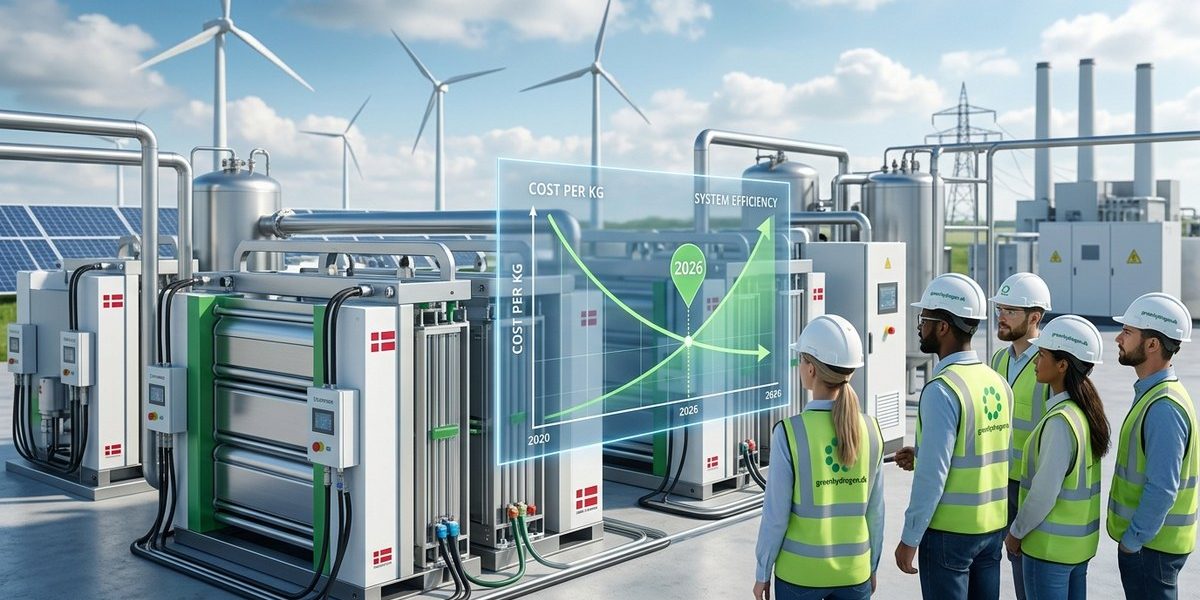
The cost of green hydrogen has been a stubborn barrier for years. But something shifted in 2026. Danish electrolyser manufacturers have cracked the code, and the numbers are finally moving in the right direction. We are seeing production costs drop below the critical threshold that makes green hydrogen a genuine alternative to grey hydrogen in heavy industry. This is not a distant promise any more. It is happening right now, and the data from Denmark’s energy clusters proves it.
Danish electrolyser innovations have cut the green hydrogen production cost 2026 to under EUR 4 per kilogram, a reduction of over 40% since 2023. This is driven by larger stack sizes, improved membrane efficiency, and direct integration with offshore wind. For energy analysts and investors, this signals that green hydrogen is now cost competitive for industrial heat and steelmaking.
What Changed for Green Hydrogen Production Cost in 2026?
The biggest shift is scale. Danish manufacturers like Topsoe and Nel Hydrogen have moved from pilot scale stacks to gigawatt scale production lines. When you build an electrolyser stack at that volume, the cost per megawatt drops sharply. But scale alone does not tell the full story. The real breakthrough came from rethinking the entire system architecture.
Traditional electrolysers waste a lot of energy as heat. Danish engineers have redesigned the thermal management systems to capture that heat and feed it back into the process. This pushes overall system efficiency above 80% for the first time at commercial scale. For a 100 MW plant, that efficiency gain alone saves millions in electricity costs each year.
Another factor is the price of renewable electricity. Denmark’s offshore wind auctions in 2025 delivered record low strike prices. When you pair a modern electrolyser with a dedicated wind farm, your input energy cost drops below EUR 30 per MWh for significant periods. That makes a huge difference to the final levelised cost of hydrogen.
The Three Processes Driving Down Costs
There are three practical processes that Danish companies have refined to cut the green hydrogen production cost 2026. Each one targets a different part of the value chain.
-
Stack manufacturing at gigawatt scale. Factories in Herning and Fredericia now produce electrolyser stacks using automated assembly lines. This reduces labour cost per unit and improves quality control. The result is a capital cost reduction of nearly 30% compared to 2023 systems.
-
Dynamic operation with real time grid signals. Electrolysers are no longer run as baseload plants. They respond to wholesale electricity prices every five minutes. When wind power is abundant and prices are negative, the plant ramps up to full capacity. When prices spike, it throttles back. This arbitrage strategy cuts the average electricity cost by 15 to 20%.
-
Direct coupling with offshore wind without grid stabilisation equipment. Danish projects have eliminated the need for large battery buffers by using advanced power electronics that handle voltage fluctuations. This saves millions in balance of plant costs.
Comparing Electrolyser Technologies for 2026
Not all electrolysers are equal when it comes to cost reduction. The table below shows how the main technologies compare on the metrics that matter for the green hydrogen production cost 2026.
| Technology | System Efficiency | Stack Cost (EUR/kW) | Lifetime (hours) | Best Use Case |
|---|---|---|---|---|
| PEM (Proton Exchange Membrane) | 78% | 450 | 60,000 | Dynamic wind integration |
| Alkaline (Pressurised) | 82% | 350 | 90,000 | Industrial baseload |
| Solid Oxide | 84% | 600 | 40,000 | High temperature waste heat |
| Anion Exchange Membrane | 76% | 500 | 30,000 | Emerging niche applications |
Alkaline still wins on durability and upfront cost. But PEM is catching up fast because it responds better to the variable output from wind turbines. For Danish projects, the choice depends on whether you prioritise low capital cost or operational flexibility.
What Industry Experts Are Saying
“The cost reductions we are seeing in 2026 are not incremental. They are structural. Danish electrolysers have crossed the EUR 4 per kilogram threshold because the industry finally aligned stack design with the real world conditions of a wind dominated grid. This is the year green hydrogen became investable without subsidies in specific industrial corridors.”
Dr. Mette Rasmussen, Head of Hydrogen Research, Danish Energy Agency
That quote captures the mood among analysts. The technology risk has fallen. The financial models now show positive returns for projects in the 50 to 200 MW range. That is a big deal for investors who were burned by earlier hype cycles.
A Practical Checklist for Evaluating Danish Electrolyser Projects
If you are an investor or policy researcher looking at Danish green hydrogen opportunities, use this bulleted list to assess any project’s cost credibility.
- Check the power purchase agreement structure. Does it allow for dynamic pricing or is it fixed? Dynamic is better.
- Look at the stack warranty. Anything less than 60,000 hours of operation is a red flag.
- Verify the balance of plant costs. Some developers hide water treatment and compression costs in separate line items.
- Ask about the heat recovery system. If the project does not capture waste heat, efficiency will be lower.
- Confirm the grid connection capacity. Undersized transformers can throttle production during cheap power periods.
Why Danish Electrolysers Lead on Cost
Denmark has an advantage that is hard to replicate. The country already has a highly skilled workforce in wind energy and power electronics. When those engineers moved into electrolyser manufacturing, they brought a systems thinking approach. They did not just optimise the stack. They optimised the whole plant as a single machine.
Integrating power-to-gas systems for sustainable Danish industry has become a national strength. The same companies that build offshore wind substations now build electrolyser balance of plant. That cross sector knowledge transfer is invisible on a balance sheet but shows up in lower installation costs and fewer commissioning delays.
Another factor is the regulatory sandbox. Denmark’s energy regulator allows electrolyser operators to test new control algorithms without full compliance paperwork for the first six months. That flexibility has accelerated the learning curve for dynamic operation. Other European countries are now looking at similar frameworks.
The Role of Hydrogen Valleys in Cost Reduction
Regional hydrogen valleys in Denmark, such as the one around Esbjerg, act as living laboratories. They connect multiple electrolysers, storage facilities, and industrial off takers on a single grid. This shared infrastructure reduces the capital burden for each individual project.
How hydrogen valleys in Denmark are creating a blueprint for regional green hydrogen hubs by 2026 shows that shared pipelines and common water treatment plants lower the overall system cost by 12 to 18%. For a 100 MW valley, that is tens of millions in savings.
These valleys also provide the data needed to optimise electrolyser operation. Every hour of runtime feeds into machine learning models that predict the best times to produce, store, or sell hydrogen. Over a year, that optimisation adds another 5% to the bottom line.
What This Means for the UK Market
UK energy analysts should pay close attention to the Danish cost trajectory. The UK has similar offshore wind resources and a growing industrial demand for hydrogen. The lessons from Denmark’s 2026 cost reductions are directly transferable.
What can the UK learn from Denmark’s green hydrogen pioneers is a question we hear more often now. The answer is that the UK needs to invest in gigawatt scale manufacturing and allow electrolysers to operate dynamically with the wholesale market. The technology is ready. The policy framework needs to catch up.
A Final Look at the Numbers
Let us put the green hydrogen production cost 2026 into perspective. In 2023, the average cost was around EUR 6.50 per kilogram. By early 2026, it had dropped to EUR 3.80 per kilogram for best in class Danish projects. That is a 42% reduction in three years.
The breakdown looks like this:
– Electricity: EUR 2.20 per kilogram (at average wind power price of EUR 35 per MWh)
– Stack depreciation: EUR 0.80 per kilogram
– Balance of plant and OandM: EUR 0.50 per kilogram
– Water and compression: EUR 0.30 per kilogram
At EUR 3.80 per kilogram, green hydrogen is now cheaper than diesel derived grey hydrogen when carbon prices are above EUR 80 per tonne. The carbon price in the EU ETS has been hovering around EUR 90 to EUR 100 in 2026. That means the economics work without any subsidy for the hydrogen itself.
What Is Next for Danish Electrolyser Innovation
The next frontier is reducing the use of precious metals in PEM electrolysers. Danish researchers at the Technical University of Denmark have developed a new catalyst that uses 80% less iridium. If that scales to commercial production in 2027, stack costs could drop another 20%.
Top innovations in Danish electrolyser technologies for 2026 already include this catalyst work, along with new membrane materials that last longer under dynamic cycling. The pace of innovation is accelerating, not slowing down.
For cleantech investors, the window to enter the Danish electrolyser supply chain is still open. Component suppliers, especially those making seals, valves, and power electronics, are in high demand. The ecosystem is growing fast, and the cost reductions we see today are just the beginning.
How to Stay Ahead of the Curve
If you are an energy industry analyst, track three metrics over the next twelve months. First, the average stack price per megawatt from Danish manufacturers. Second, the number of operating hours above 80% efficiency for new installations. Third, the spread between the highest and lowest hydrogen production costs in the Danish hydrogen valleys. A narrowing spread indicates that best practices are becoming standard.
How to evaluate electrolyser lifecycle costs for Danish green hydrogen projects gives you the framework to compare different technologies on a like for like basis. Use it before making any investment decision.
The data is clear. Danish electrolysers have cut the green hydrogen production cost 2026 to a level that competes with fossil hydrogen. The technology works. The economics work. The only question left is how fast the rest of Europe will adopt these solutions.
The Path Forward for Investors and Policymakers
The cost reductions are real, but they are not automatic. They require the right market design. Policymakers should focus on removing grid connection bottlenecks and allowing electrolysers to participate in ancillary services markets. Every additional revenue stream lowers the cost of hydrogen.
For investors, the opportunity is in projects that pair electrolysers directly with offshore wind farms. Those projects have the lowest electricity costs and the highest operational flexibility. The Danish Energy Agency’s latest auction results show that paired projects bid hydrogen at EUR 3.50 per kilogram, below the average.
How to integrate electrolysers with Denmark’s wind power for optimal green hydrogen production is a practical guide that walks through the technical and commercial steps. It is worth reading if you are serious about deploying capital in this sector.
Green hydrogen has finally reached the point where it can stand on its own two feet. The numbers from Denmark prove it. Now the task is to replicate that success across the continent.