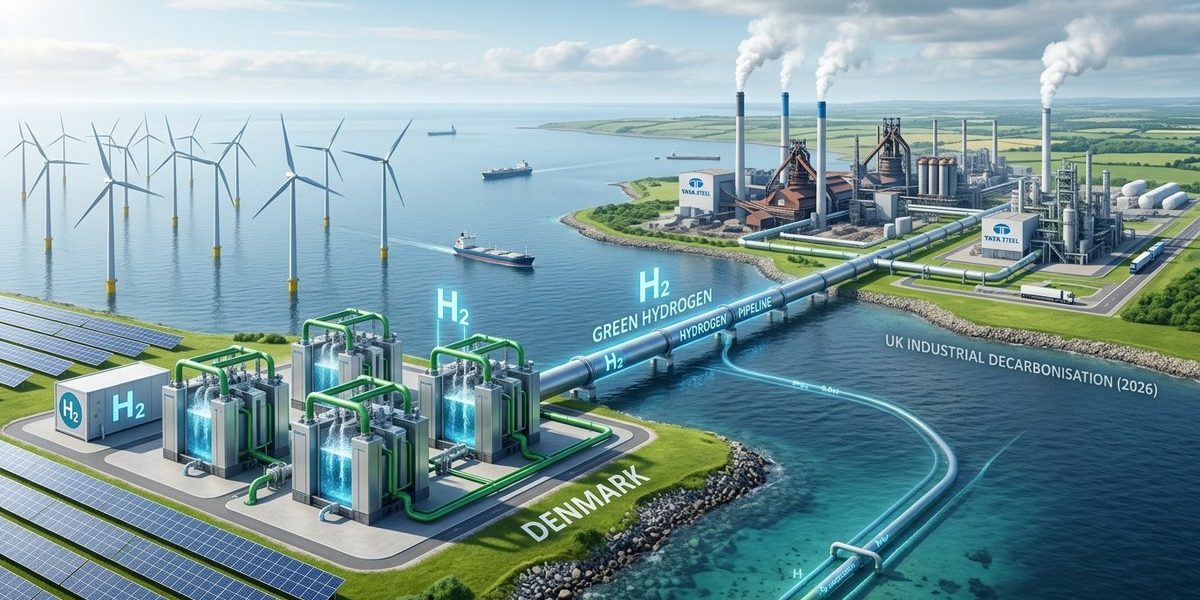
Picture a blustery morning on the Danish coast. Offshore wind turbines spin at full tilt, sending power to a cluster of electrolysers that quietly split water into green hydrogen. That hydrogen then flows through a pipeline, destined for a steel plant in the UK. This is not a distant fantasy. By 2026, this cross-border energy relationship is reshaping how British industry thinks about decarbonisation. Denmark has moved from being a renewable energy pioneer to becoming a practical blueprint for the UK. The question is no longer whether green hydrogen works. The question is how UK industrial strategists can adopt the Danish model to meet their own net-zero targets.
Denmark’s green hydrogen economy offers UK industrial decarbonisation a proven pathway. By 2026, Danish electrolyser technology, offshore wind integration, and hydrogen valley clustering provide concrete strategies for UK energy policy analysts and corporate managers. The key is adopting Denmark’s coordinated approach to infrastructure, regulation, and cross-sector demand aggregation.
Why Denmark matters for UK industrial decarbonisation
The UK has set ambitious targets. The Industrial Decarbonisation Strategy aims to cut emissions from heavy industry by two-thirds by 2035. But the gap between ambition and delivery remains wide. Denmark, by contrast, has already operationalised its green hydrogen supply chain. The country’s green hydrogen projects are accelerating industry decarbonisation at a pace that the UK can learn from.
Denmark’s advantage is not just wind. It is integration. Danish planners have linked electrolyser deployment directly to industrial demand. They have built hydrogen valleys that connect producers with users. And they have created a regulatory environment that rewards early movers. For UK analysts looking at 2026, the Danish experience offers three specific lessons.
Lesson 1: Build hydrogen valleys, not isolated projects
Denmark has established several hydrogen valleys. These are regional clusters where production, storage, and consumption happen in close proximity. The hydrogen valleys in Denmark are creating a blueprint that the UK can replicate in places like Teesside, the Humber estuary, or South Wales.
A hydrogen valley typically includes:
- A large-scale electrolyser farm powered by offshore wind
- Local storage facilities for buffering supply
- Pipeline connections to nearby industrial users
- A shared logistics hub for transport and refuelling
The result is lower infrastructure costs and higher utilisation rates. UK regions with existing industrial clusters are natural candidates for this model.
Lesson 2: Match electrolyser technology to industrial need
Not all electrolysers are the same. Denmark has deployed a mix of Proton Exchange Membrane (PEM) and alkaline electrolysers depending on the application. The comparison between PEM and alkaline electrolysers shows that each technology suits different operating conditions.
Here is a simple breakdown of how Danish projects match technology to use case:
| Technology | Best for | Danish example |
|---|---|---|
| PEM electrolyser | Quick ramping, variable renewable input | Offshore wind-to-hydrogen in Esbjerg |
| Alkaline electrolyser | Steady state, baseload operation | Industrial cluster near Copenhagen |
| Solid oxide electrolyser | High temperature, waste heat recovery | Demonstration plant in Aalborg |
For UK managers, the lesson is clear. Do not default to one technology. Assess your renewable profile, your demand pattern, and your grid connection before choosing.
How Danish electrolyser innovations cut costs
Cost remains the biggest barrier for UK industrial users. Green hydrogen is still more expensive than grey hydrogen from natural gas. But Denmark has been cutting green hydrogen production costs through a combination of technology improvements and scale.
Three factors drive cost reduction in Danish projects:
- Higher efficiency membranes. New PEM designs achieve over 65% system efficiency, up from 55% in 2020.
- Series production. Danish manufacturers have automated electrolyser assembly, cutting unit costs by 30% since 2023.
- Waste heat recovery. Industrial clusters capture heat from electrolysis and use it for district heating, creating an additional revenue stream.
These innovations bring the levelised cost of hydrogen closer to parity with fossil-based alternatives. UK projects that adopt similar approaches can accelerate their own cost curves.
A practical roadmap for UK adoption
For UK energy policy analysts and corporate decarbonisation managers, the path forward involves four steps. This is not theoretical. It is based on what has worked in Denmark.
-
Map your industrial hydrogen demand. Aggregate demand from multiple users in a single region. This creates the volume needed to justify pipeline investment.
-
Secure a renewable energy anchor. Partner with an offshore wind developer to guarantee low-cost power for electrolysis. Denmark’s integration of electrolysers with wind power shows how to match production with generation profiles.
-
Choose the right electrolyser technology. Use the table above to match technology to your operating conditions. Consider future scalability.
-
Build a hydrogen valley governance model. Establish a legal entity that manages shared infrastructure, offtake agreements, and risk allocation. Danish hydrogen valleys use special purpose vehicles for this.
Common mistakes to avoid
Based on early Danish pilot projects, here are pitfalls that UK projects should avoid:
- Overbuilding electrolyser capacity without securing firm offtake agreements
- Ignoring the cost of hydrogen storage for seasonal balancing
- Underestimating grid connection costs for large-scale electrolysers
- Failing to engage local communities early in the planning process
“The biggest mistake UK projects make is treating hydrogen as a standalone technology. It is a system. You need to design the whole chain from wind turbine to factory burner tip.” – Anders Madsen, former project director at Hydrogen Valley Denmark
Regulatory lessons from Copenhagen to London
Denmark’s regulatory approach has been deliberately pragmatic. The government introduced a carbon contract for difference scheme in 2024 that guarantees a minimum price for green hydrogen. This gives producers the confidence to invest. The UK has a similar scheme in the Hydrogen Production Business Model, but the Danish version is simpler and faster to access.
Denmark also streamlined permitting for electrolyser installations. Projects that meet environmental standards can get approval within six months. In the UK, planning delays remain a major bottleneck. The Danish electrolyser deployment model suggests that the UK could benefit from a national hydrogen planning framework that overrides local objections for nationally significant projects.
Another regulatory insight involves hydrogen blending. Denmark allows up to 20% hydrogen in the natural gas grid for industrial users. This creates an immediate demand source while dedicated hydrogen pipelines are built. UK gas networks are testing similar blends, but adoption has been slower.
The role of digital tools in scaling up
Denmark has also used digital twins to optimise hydrogen production. Digital twins are optimising Danish green hydrogen production by simulating electrolyser performance under different wind conditions. This allows operators to adjust production schedules in real time, reducing energy costs by up to 12%.
For UK industrial managers, investing in digital infrastructure early makes sense. A digital twin of your hydrogen system can model scenarios, predict maintenance needs, and optimise dispatch. It is not an extra cost. It is a tool that pays for itself within the first year of operation.
What UK industry can start doing today
You do not need to wait for national policy to catch up. Here are actions that UK companies can take now, based on Danish experience:
- Join a hydrogen cluster group. The UK Hydrogen and Fuel Cell Association runs regional networks. Participation costs little and gives you access to shared learning.
- Conduct a hydrogen readiness assessment. Map which of your processes could switch to hydrogen and what the conversion cost would be.
- Talk to your local grid operator. Understand the capacity and connection timeline for large-scale electrolysis.
- Visit a Danish hydrogen valley. Seeing the system in person is worth more than any report. Several Danish operators offer site tours for international delegations.
Why the UK cannot afford to wait
The global hydrogen economy is moving fast. Germany has signed import agreements with Denmark and Norway. The Netherlands is building a national hydrogen backbone. If the UK delays, it risks losing access to the best technology, the most experienced suppliers, and the most favourable financing terms.
Denmark’s green hydrogen sector is not just a model for UK energy security. It is a practical partner. The cross-border hydrogen trade from Denmark to Germany shows that infrastructure can connect countries. The UK could be the next destination for Danish hydrogen, either as direct imports or through technology transfer.
The window of opportunity is open now. Danish electrolyser manufacturers are scaling production. Their costs are falling. Their technology is proven. UK industrial decarbonisation managers who act in 2026 will be ahead of the curve. Those who wait will play catch-up.
Learning from Denmark’s 2026 hydrogen targets
Denmark aims to have 6 GW of electrolyser capacity installed by 2030. The country is on track to reach 2 GW by the end of 2026. That scale is already creating a domestic supply chain for components, maintenance, and engineering services. UK firms can participate in that supply chain, either as buyers of Danish electrolysers or as partners in joint ventures.
The key performance metrics for evaluating electrolyser efficiency are well established. UK buyers should demand data on system efficiency, degradation rate, and stack lifetime before signing contracts. Danish suppliers are transparent with these numbers because they know their products perform well.
For UK policy analysts, the most important metric is the carbon intensity of the hydrogen. Denmark uses a rigorous lifecycle assessment that includes embedded emissions from electrolyser manufacturing. This sets a high standard that the UK should adopt in its own certification schemes.
A shared North Sea hydrogen future
The North Sea has been the site of oil and gas extraction for decades. By 2026, it is becoming a renewable energy powerhouse. Denmark is repurposing North Sea oil platforms for electrolyser deployment, turning old infrastructure into green hydrogen production hubs. The UK has similar platforms that could follow the same path.
A shared North Sea hydrogen grid is technically feasible. Pipelines that once carried natural gas can be converted to hydrogen. The UK and Denmark already have strong energy trading relationships. Extending that to hydrogen is a natural next step.
The Danish government has been clear. It wants to export hydrogen to neighbouring countries. The UK should be at the front of the queue. That requires regulatory alignment, common standards, and a willingness to invest in interconnection infrastructure.
Putting Danish lessons into practice
The evidence is clear. Denmark green hydrogen UK industrial decarbonisation is not just a slogan. It is a working relationship that is delivering results. Danish electrolysers are producing hydrogen at scale. Danish hydrogen valleys are connecting supply with demand. Danish regulators have created a framework that encourages investment.
For UK energy policy analysts, the task is to adapt these lessons to the British context. That means building hydrogen valleys in our industrial heartlands. It means choosing the right technology for each application. It means streamlining regulation and investing in digital tools.
For corporate decarbonisation managers, the task is more immediate. Start your hydrogen journey now. Conduct the assessments. Join the clusters. Visit the Danish sites. The technology is ready. The costs are falling. The demand is there.
The only missing ingredient is action. And 2026 is the year to take it.