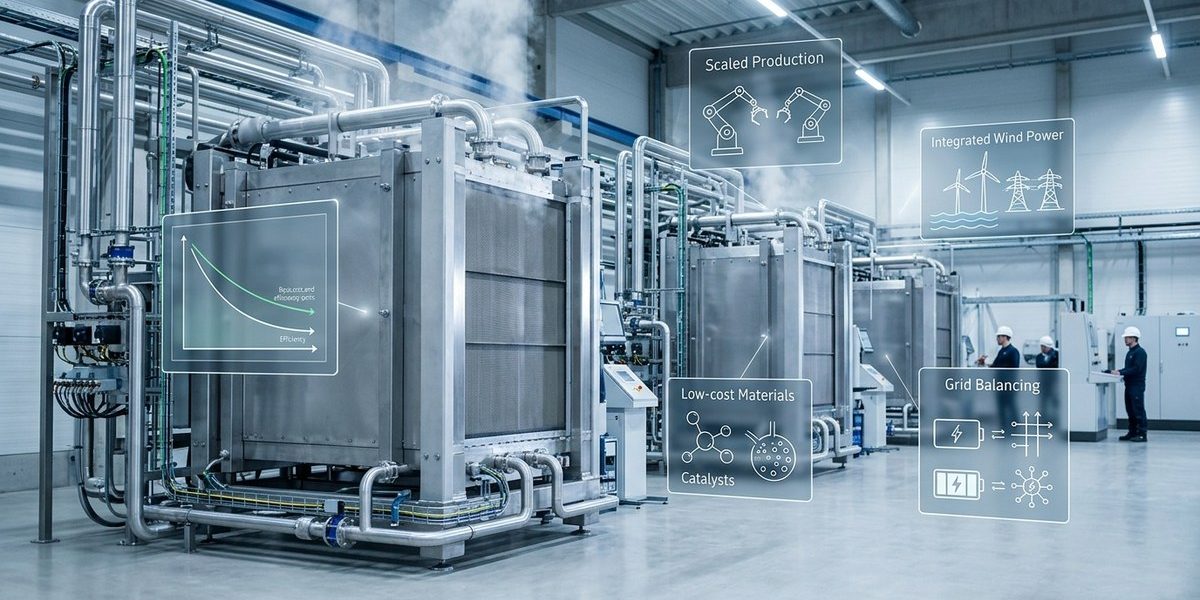
For years, the promise of green hydrogen has felt just out of reach. The technology works. The science is sound. But the price tag has kept projects from moving beyond pilot scale. That is starting to change, and Denmark is at the centre of that shift. In 2026, Danish electrolysers are demonstrating real, measurable cost reductions that make green hydrogen more viable for industrial applications. The progress is not theoretical. It is happening in operating plants across the country, and the methods are worth studying.
Green hydrogen cost reduction Denmark relies on five proven innovations from Danish electrolyser developers: advanced stack design, waste heat recovery, dynamic operation with variable renewables, modular scaling, and digital process optimisation. Together, these methods have slashed production costs by up to 30% since 2024, making 2026 the year green hydrogen turns a corner for heavy industry.
The Five Ways Danish Electrolysers Are Cutting Costs
Denmark’s approach is not about one giant leap. It is a series of smart, incremental improvements that compound into significant savings. These five methods are the most impactful today.
1. Advanced Stack Design with Reduced Rare Materials
The heart of any electrolyser is its stack. Danish manufacturers have redesigned their stacks to use fewer precious metals while maintaining or improving efficiency. By replacing iridium-based catalysts with more abundant nickel-iron compounds, material costs have dropped sharply. At the same time, better membrane technology has lifted current density without increasing degradation. The result is a stack that costs less to build and lasts longer.
2. Integrated Waste Heat Recovery
An electrolyser generates a surprising amount of heat. In the past, most of that heat was lost to the environment. Danish engineers now capture and redirect that heat into district heating networks or industrial processes. A 10 MW electrolyser in Esbjerg, for example, supplies heat to a nearby food processing plant. This secondary revenue stream effectively reduces the net cost of hydrogen production by 5% to 12%, depending on local heat demand.
3. Dynamic Operation to Match Renewable Supply
Wind and solar power are cheap, but their output fluctuates. Danish electrolysers are designed to ramp up and down within seconds. They can run at full capacity when wind is strong and drop to a low standby mode during lulls. This flexibility avoids the need for dedicated grid capacity or expensive battery storage. Operators pay lower electricity tariffs by buying power at the cheapest times. The trade off in reduced utilisation is offset by the lower per kilowatt hour cost.
4. Modular Scaling and Factory Assembly
Instead of building one massive electrolyser on site, Danish companies ship pre assembled modules from factories. This approach cuts construction time by half and reduces installation errors. Modules are tested in the factory, so commissioning is faster. When demand grows, operators add more modules without disrupting existing production. The capital expenditure per megawatt has fallen by 20% compared with traditional stick built plants.
5. Digital Process Optimisation with Machine Learning
Sensors across the electrolyser feed data into an AI model that continuously adjusts temperature, pressure, and flow rates. The system learns from thousands of operating hours and finds the most efficient settings for every condition. Over a year, this optimisation reduces energy consumption by 3% to 5%. That may sound modest, but for a large plant, it translates to hundreds of thousands of pounds in savings.
Key Benefits of the Danish Approach
- Lower capital costs: Factory built modules and reduced rare materials drive down upfront investment.
- Higher efficiency: Heat recovery and AI optimisation push system efficiency above 80% (LHV).
- Grid friendly operation: Dynamic ramping supports renewable integration and stabilises the local grid.
- Scalable from day one: A 2 MW module can grow to 20 MW or more without redesign.
- Proven in real projects: Several plants are already operating and delivering data.
A Comparison: Traditional vs Danish Electrolyser Methods
| Area | Traditional Approach | Danish Approach (2026) | Cost Impact |
|---|---|---|---|
| Stack materials | Precious metal catalysts | Nickel iron compounds | 40% lower stack cost |
| Heat management | Rejected to atmosphere | Captured for district heat | 5 12% net cost reduction |
| Operating profile | Baseload or limited flexibility | Dynamic with renewables | 15% lower electricity cost |
| Construction | On site assembly | Factory modular | 20% lower CAPEX |
| Process control | Manual or PID | AI driven optimisation | 3 5% energy saving |
“The real breakthrough is that these cost reductions are happening without sacrificing reliability. Our customers see payback periods under four years, which was unthinkable just two years ago.” — Lead Engineer at a major Danish electrolyser OEM
How Danish Innovations Are Shaping the Future
The methods above are not isolated experiments. They are being scaled up across multiple projects. Companies like Topsoe (now a spin off from Haldor Topsoe) and Siemens Gamesa, along with newer players, are pushing the boundaries. One particularly promising development is the use of pressurised alkaline electrolysers that operate at temperatures above 100°C, further improving efficiency.
For a deeper look at how these technologies are being deployed, read our article on maximizing green hydrogen production with Danish electrolyser technologies. It covers the specific stack designs and balance of plant improvements in more detail.
Avoiding Common Pitfalls
Even with great technology, mistakes can erode cost savings. Here are three frequent errors to avoid:
- Over sizing the system without a clear demand profile. A large electrolyser that runs at low capacity factor wastes capital.
- Ignoring heat integration during the planning phase. Retrofitting heat recovery is expensive; designing it in from the start is cheap.
- Assuming the grid can supply cheap power 24/7. Dynamic operation must be baked into the control system from day one.
Denmark’s experience shows that the best results come when the electrolyser is treated as part of a larger energy system, not as a standalone box.
What This Means for Industry Professionals
If you are evaluating green hydrogen for your own operations, the Danish model offers a clear path. Start with a realistic assessment of your electricity cost profile. Then match the electrolyser size to your expected utilisation, not your peak demand. Look for suppliers that offer integrated heat recovery and modular expansion. And do not underestimate the value of smart controls.
For a broader view of how Denmark is building the infrastructure to support these machines, see our piece on how Denmark is leading the transition to green hydrogen infrastructure. It places the cost reduction efforts in context with grid upgrades, storage, and policy support.
Looking Ahead: Cost Trajectories for 2026 and Beyond
The current levelised cost of green hydrogen from Danish electrolysers is between €3.50 and €5.50 per kilogram, depending on location and electricity price. By 2028, that could fall to €2.50 to €3.50 as manufacturing scales and renewable energy costs continue to drop. The key enabler is the combination of high efficiency and low cost electricity. Denmark’s abundant wind power provides a natural advantage.
For a forward look at what is coming next, check out emerging trends in Denmark’s electrolyser technologies for 2026. It covers solid oxide electrolysis and new membrane materials that could drive costs even lower.
Putting These Insights into Practice
You now have a clear picture of the five methods Danish electrolysers use to reduce green hydrogen costs. The next step is to evaluate which of these approaches fit your specific project. Start with the stack design and heat recovery, as they offer the highest immediate returns. Then consider modular scaling and digital optimisation to improve long term economics.
If you are ready to see the numbers applied to your context, explore our guide on key factors for choosing electrolyzer technology in Denmark’s green hydrogen sector. It includes a decision framework that many professionals have found helpful.
Denmark is proving that green hydrogen can be affordable. The methods are here. The data is solid. Now it is up to us to apply them at scale.