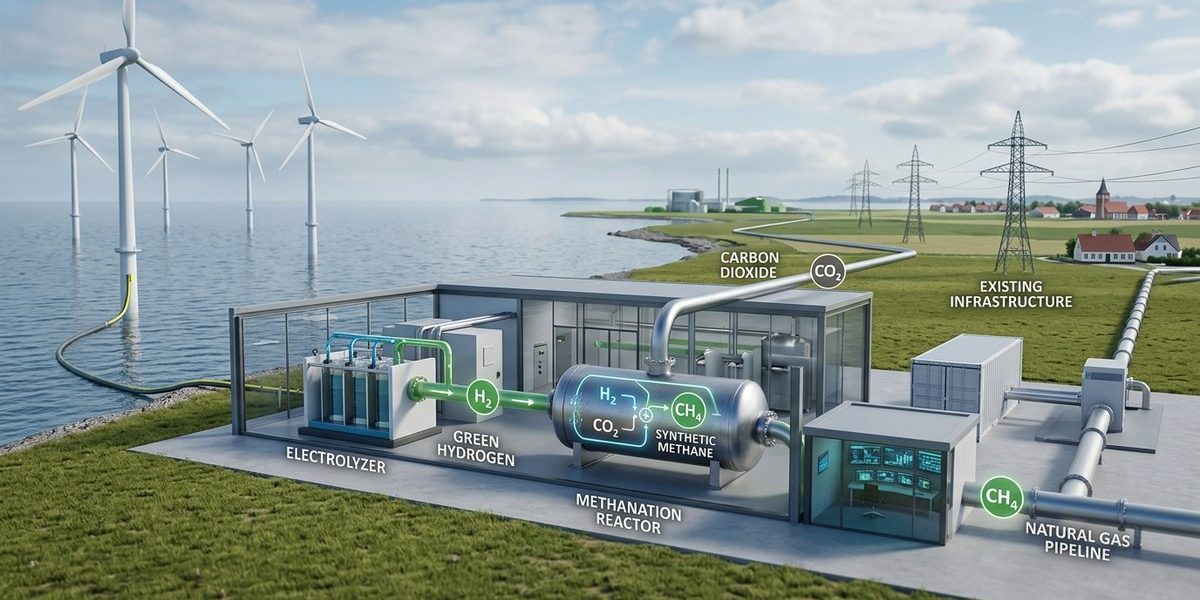
Denmark runs on wind. And soon, it might run on methane made from that wind. As the country pushes towards a fully decarbonised energy system by 2045, green hydrogen sits at the centre of the plan. But hydrogen has a problem: storing it at scale is tricky, and moving it through existing gas infrastructure requires expensive retrofits. That is where methanation comes in. By combining green hydrogen with captured carbon dioxide, we can create synthetic methane – a drop‑in fuel that works in today’s pipelines, boilers and even ships. For a nation that already has a robust gas grid and a world‑class wind fleet, methanation is not just a sideline. It is a strategic bridge between renewable electricity and the hard‑to‑electrify sectors of industry, heating and transport.
Methanation converts green hydrogen and CO₂ into synthetic methane, enabling long‑duration energy storage and direct use in existing gas networks. Denmark’s Power‑to‑X strategy leverages this technology to decarbonise industry, heating and heavy transport, while also providing a flexible outlet for surplus wind power. It is a critical step towards a fully renewable energy system.
Why Methanation Matters for Danish Power‑to‑X
Denmark has ambitious targets: 4–6 GW of electrolysis capacity by 2030, scaling up to 10 GW by 2050. That is a lot of green hydrogen. But hydrogen alone cannot solve every challenge. It is difficult to store for months, and only a fraction of the gas grid can handle pure hydrogen without upgrading. Synthetic methane, by contrast, is chemically identical to natural gas. It can be stored in existing salt caverns, injected into the distribution network and used in conventional appliances without modification.
For a country that already boasts one of the most advanced gas grids in Europe, this is a huge advantage. Methanation effectively turns the gas network into a giant battery. Surplus wind power is turned into hydrogen, then into methane, and stored until winter demand peaks. The same gas that once came from the North Sea can now be produced from Danish wind turbines and Danish CO₂ – often from biogas or industrial sources.
How Methanation Works: A Step‑by‑Step Process
The technology itself is well understood. It is the Sabatier reaction, named after the French chemist who discovered it over a century ago. The difference today is that both the hydrogen and the CO₂ come from renewable or recycled sources. Here is how it plays out in a typical Danish PtX facility:
-
Electrolysis: Wind or solar power splits water into green hydrogen and oxygen. This is the energy‑intensive first step, and it is where efficiency improvements in electrolysers directly affect the final cost of synthetic methane.
-
CO₂ capture: Carbon dioxide is captured from a nearby source – a biogas plant, a cement factory or even directly from the air (direct air capture). Denmark has several biogas upgrading plants that produce a pure stream of CO₂ as a by‑product.
-
Methanation reaction: Hydrogen and CO₂ are fed into a reactor at temperatures between 200 °C and 550 °C, depending on the catalyst. The reaction produces methane (CH₄) and water. Catalytic methanation uses a metal catalyst (nickel, ruthenium); biological methanation uses micro‑organisms called archaea.
-
Gas conditioning: The raw methane stream is dried, compressed and cleaned to meet grid specifications. It is then injected into the natural gas network or stored for later use.
-
Use or storage: The synthetic methane can be burned in a power plant for electricity, used for district heating, fuelled into a ship engine or supplied to a chemical plant as a feedstock.
What Makes Denmark a Natural Home for Methanation
Denmark’s energy system is uniquely suited to methanation for three reasons: abundant renewable electricity, a mature gas grid and a strong biogas sector.
-
Abundant wind power: Denmark regularly produces more wind energy than it can use. In 2025, curtailment of wind power reached record levels. Methanation provides a valley for that excess electricity, converting what would be wasted into a storable fuel.
-
Existing gas infrastructure: The Danish gas network connects to Germany and Sweden, and the country has large underground storage facilities in salt caverns. These caverns can store synthetic methane for months, balancing seasonal supply and demand.
-
Biogas CO₂: Denmark is a leader in biogas production. Many biogas plants already upgrade their gas to biomethane, leaving a stream of nearly pure CO₂. That CO₂ is currently vented. Capturing it and combining it with green hydrogen to produce more methane is a closed‑loop, circular process that maximises the use of every molecule.
Catalytic Versus Biological Methanation: A Comparison
Two main methanation routes are being deployed in Danish projects. Each has its strengths and ideal use case.
| Aspect | Catalytic Methanation | Biological Methanation |
|---|---|---|
| Temperature | 200–550 °C | 30–70 °C |
| Catalyst | Nickel or ruthenium | Micro‑organisms (archaea) |
| Tolerance to impurities | Low – requires clean CO₂ and H₂ | High – works with biogas directly |
| Reaction rate | Fast | Slower, but steadier |
| Typical scale | 10–100 MW | 1–10 MW |
| Danish example | BioCat Roslev (Electrochaea) | Biogas plant integration projects |
Both technologies are being tested and scaled in Denmark. The choice depends on the quality of the CO₂ source and the desired output pressure. Biological methanation, for instance, can handle the CO₂ stream straight from a biogas plant without pre‑treatment, which simplifies the process for smaller, decentralised units.
“Methanation is not just a storage solution – it is a sector coupling technology. It links the electricity grid, the gas grid and the transport sector in a way that pure hydrogen cannot easily achieve. Denmark’s existing gas infrastructure is a national asset, and synthetic methane allows us to keep using it without emissions.” – Dr. Mette Halskov, Senior Researcher at the Danish Energy Agency (illustrative quote)
Real‑World Projects Putting Methanation into Practice
Denmark already hosts several flagship methanation projects that demonstrate the technology’s maturity.
The BioCat Roslev plant, operated by Electrochaea, is one of the world’s largest biological methanation facilities. It uses surplus wind power to produce hydrogen, then feeds that hydrogen together with CO₂ from a neighbouring biogas plant into a reactor filled with archaea. The resulting methane is injected into the Danish gas grid. The plant has been running since 2023 and provides valuable operational data for scaling up.
Another major initiative is the Green Methane for Industry project in Esbjerg, which aims to supply synthetic methane to local industries that currently rely on natural gas. The project combines a 100 MW electrolyser with a catalytic methanation unit, using CO₂ captured from a nearby waste‑to‑energy plant.
These projects show that methanation is not a theoretical concept. It is being built, tested and integrated into the real‑world energy system – and the lessons from Denmark are being watched closely by the UK and other European countries.
Challenges That Still Need Solving
No technology is without hurdles, and methanation faces a few that Danish researchers and companies are actively addressing.
-
Efficiency losses: Each conversion step loses energy. Going from electricity to hydrogen (70–80% efficiency) and then to methane (70–80%) results in a round‑trip efficiency of around 50–60%. That is fine for seasonal storage, but for short‑term balancing, batteries or direct hydrogen injection are more efficient.
-
CO₂ availability: Sourcing enough biogenic or captured CO₂ at scale is a constraint. Denmark’s biogas sector can provide some, but if methanation is to reach the terawatt‑hour scale, direct air capture or carbon capture from large point sources will be needed.
-
Cost competitiveness: Synthetic methane currently costs more than fossil natural gas. Carbon pricing and green gas certificates are helping to close the gap, but large‑scale deployment will require continued policy support and technology cost reductions.
How Policy and Innovation Are Driving Methanation Forward
Denmark’s Power‑to‑X strategy, published in 2021 and updated in 2024, explicitly supports methanation through targeted subsidies, tax exemptions for green hydrogen and a mandate for green gas certificates. The Danish Energy Agency has allocated over DKK 1.5 billion for PtX demonstration projects, with several focused on methanation.
The country is also investing in research. The Danish Methanation Hub, a collaboration between universities, utilities and technology providers, accelerates the development of new catalysts, reactor designs and process control systems. Their work aims to push the efficiency of catalytic methanation above 90% and reduce the capital cost of biological methanation units.
The Role of Methanation in Denmark’s 2026 Hydrogen Roadmap
By 2026, Denmark expects to have at least 1 GW of electrolyser capacity installed, with a significant portion of the hydrogen used directly for industry and transport. But the surplus hydrogen – especially during summer when wind output peaks – will be directed to methanation. Several large‑scale methanation plants are in the planning or construction phase, including a 200 MW facility in Western Jutland that will supply methane to the regional gas grid.
The integration between electrolysers and methanation is also a key design consideration. For instance, top innovations in Danish electrolyser technologies for 2026 are improving the ability of electrolysers to ramp up and down in response to wind variability, which directly benefits the downstream methanation process by providing a steadier hydrogen supply.
Meanwhile, the expansion of green hydrogen infrastructure creates the backbone for these methanation plants, enabling them to access both renewable electricity and hydrogen storage close to the point of use.
What Methanation Means for Denmark’s Energy Transition
Methanation is not a silver bullet. It is one tool in a larger kit, alongside direct electrification, battery storage and hydrogen use. But for the parts of the energy system that cannot be easily electrified – industrial heating, long‑distance shipping, seasonal gas storage – it is arguably the most practical solution we have today.
Denmark’s early leadership in this field gives it a chance to export both the technology and the knowledge. The UK, Germany and the Netherlands are all looking at methanation as part of their own energy transitions. The projects running in Denmark today are generating the data, the costs and the operational experience that the rest of the world will need tomorrow.
If you are involved in energy policy, research or investment, now is the time to watch what happens in Denmark. The country is building the blueprint for a renewable gas system – and methanation is the tool that makes it possible. The next few years will tell us whether this blueprint can be scaled, but the foundations are already being laid. Keep an eye on the Danish gas grid. It is quietly turning green.