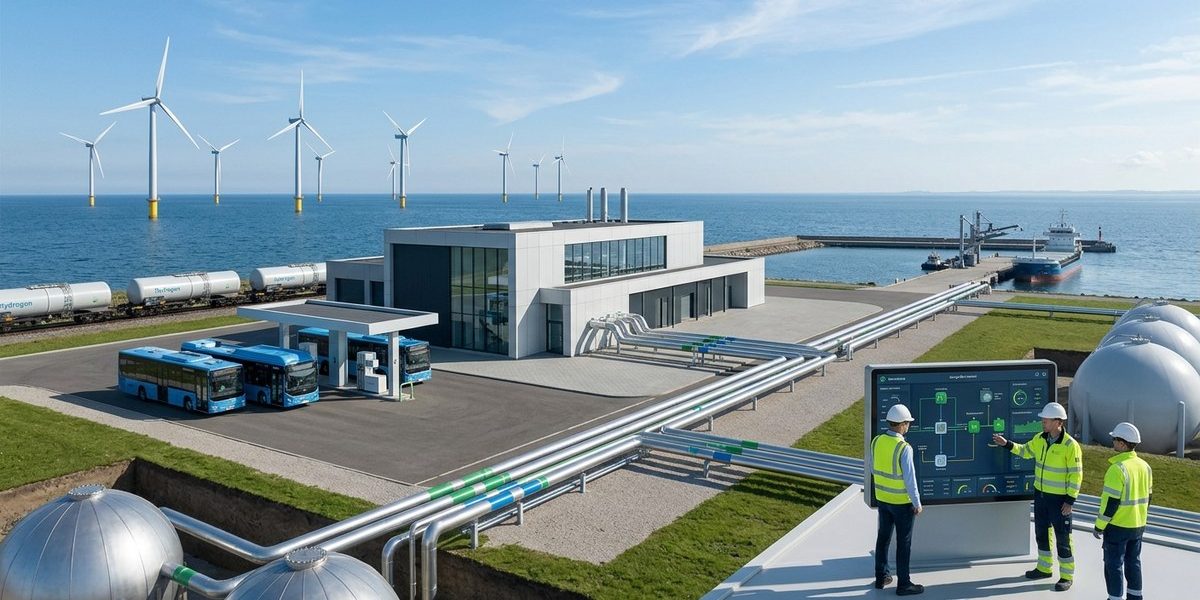
Denmark has long been known for its wind turbines and ambitious climate targets. But in the past few years, a quieter revolution has been taking shape. Small scale green hydrogen pilot projects, dotted across the country, have been generating something more valuable than just hydrogen. They are producing real world data about what a full scale hydrogen infrastructure will actually need to look like. And the findings are already reshaping plans for the 2030s.
Denmark’s green hydrogen pilot projects show that future infrastructure must prioritise flexible electrolysers that can ramp up and down with wind supply, integrated grid connections to avoid curtailment, and shared storage buffers to manage daily and seasonal mismatches. Pipeline planning must account for both local distribution and cross border exports, especially to Germany. Early coordination between power, gas and industrial sectors is essential to avoid costly retrofits later.
Why Denmark’s pilot projects matter
Pilot projects aren’t just proof of concept. They are the closest thing we have to a laboratory for future infrastructure. In Denmark, projects like the H2RES facility at Copenhagen Malmö Port, the GreenHyScale demonstration in Fredericia, and the PtX plant in Esbjerg have all been running for two to four years. They have faced real constraints: variable wind output, grid congestion, local hydrogen demand that doesn’t always line up with production.
The data from these pilots is now feeding into national planning. The Danish Energy Agency and Energinet are using it to refine their hydrogen infrastructure roadmap. For anyone involved in policy or investment, understanding what these pilots have revealed is essential. Because the same challenges will appear in every country that tries to scale up green hydrogen.
Three critical infrastructure lessons from the pilots
1. Electrolysers must be flexible, not just efficient
One of the earliest lessons from the pilots is that an electrolyser that can run at 100% load for 8,000 hours a year is not the same as one that can respond to 15 minute changes in wind power. In Denmark, wind generation can swing from 6 GW to 2 GW within an hour. The pilots showed that inflexible electrolysers cause either wasted energy (if they can’t turn down) or expensive grid upgrades (if they draw too much during low wind).
The most successful pilots used proton exchange membrane (PEM) electrolysers with a dynamic range of 10% to 120% of rated capacity. This allowed them to follow the wind profile without stressing the local grid. Alkaline electrolysers, while cheaper per unit of hydrogen, struggled with rapid cycling and had higher maintenance costs.
“The pilot projects made it clear that flexibility is the single most important feature for grid integrated electrolysis. A 70% efficient electrolyser that can follow the wind is more valuable than an 80% efficient one that cannot.” – Lead engineer at the H2RES facility, 2025 annual report
2. Grid connection design matters as much as the electrolyser
Many pilots connected directly to the local distribution network, but that created problems. When wind was abundant and power prices low, the electrolyser wanted to run at full capacity. That often exceeded the transformer capacity, causing curtailment. Other pilots connected at higher voltage levels, but that added cost and complexity.
The clearest finding: future infrastructure must include dedicated hydrogen grid connections, not just electrical ones. The pilots showed that if you have a hydrogen pipeline to a nearby industrial user, you can store hydrogen temporarily in a buffer tank and smooth out production peaks. That reduces the need for electrical grid reinforcement.
3. Seasonal storage is non negotiable for hydrogen security
A hydrogen system that only runs when the wind blows cannot supply a steel plant or a chemical factory that needs continuous operation. Every pilot tested some form of storage. The most effective solutions were salt cavern storage for seasonal balancing, and smaller pressurised tanks for daily smoothing.
The pilot data revealed that for a 100 MW electrolyser cluster, you need about 100 tonnes of hydrogen storage to cover a three day wind lull. That translates to roughly 10 to 15 GWh of energy storage. For seasonal needs, the requirement jumps to 5,000 tonnes or more. Denmark has favourable geology for salt caverns, and the pilots validated their sealing and cycling performance.
How to apply these lessons to your own planning
If you are a policy analyst or an investor looking at hydrogen projects, here is a practical checklist based on what Danish pilots have demonstrated:
- Assess wind variability at your specific location. Use at least three years of hourly wind data to model electrolyser operation. Do not rely on annual averages alone.
- Choose an electrolyser type that matches your grid profile. For areas with high wind volatility, PEM or other dynamic technologies are safer. For baseload operation near nuclear or hydro, alkaline may still work.
- Size your electrical connection for peak power, not average. The pilots showed that a connection sized for 80% of maximum output was too small and caused curtailment 12% of the time. Oversizing to 110% of max added only 8% to capital cost.
- Plan for storage from day one. Even a small pilot needs at least 24 hours of buffer. For commercial scale, include salt cavern or lined rock cavern options in your feasibility study.
- Coordinate with gas grid operators. The pilots highlighted that injection points for hydrogen blending are not the same as for pure hydrogen. Early dialogue with Energinet or equivalent is critical.
What the pilot projects tell us about pipeline and storage needs
Denmark’s ambition to export hydrogen to Germany via a dedicated pipeline by 2028 is now based on pilot data. The projects showed that a pure hydrogen pipeline operating at 80 bar can transport about 1 GW of energy equivalent per 100 km with acceptable pressure drop. That is a key input for routing decisions.
Storage wise, the pilots validated that salt caverns in the Jutland region have sufficient capacity for large scale seasonal storage. One pilot stored hydrogen over summer and used it in winter for a district heating plant. The round trip efficiency was 72%, better than expected. This has encouraged the government to include 10,000 MWh of cavern storage in the National Hydrogen Strategy.
Here is a summary table of techniques used in the pilots and common mistakes to avoid:
| Technique | Mistake to avoid |
|---|---|
| Dynamic load following (10%-120%) | Using fixed set point operation ignoring wind forecast |
| Buffer tank storage (3 days) | Relying on pipeline as only buffer without local storage |
| Grid connection at 150 kV | Connecting to low voltage distribution without upgrade |
| Salt cavern sealing testing | Assuming all caverns have same permeability without core samples |
| Blending hydrogen into natural gas at up to 10% | Injecting pure hydrogen without checking downstream appliance compatibility |
Common pitfalls in hydrogen infrastructure planning
- Underestimating water treatment costs. The pilots required deionised water with conductivity below 0.1 µS/cm. The water treatment plant added 15% to project cost.
- Ignoring oxygen handling. Electrolysis produces oxygen as a by product. Venting it is fine, but capturing and selling it requires separate infrastructure. Most pilots vented it, but a few are now adding oxygen pipelines to greenhouses.
- Assuming hydrogen demand is constant. Industrial users want reliable supply, but they also want flexibility. The pilots found that steel plants often want hydrogen at night to avoid peak electricity prices. That creates a mismatch with wind generation which peaks during day in Denmark.
- Forgetting safety zones. Hydrogen storage areas require 50 metre setback distances from public roads and buildings. Several pilot locations had to adjust site layouts after initial design.
The role of sector coupling in future infrastructure
Pilot projects also proved that hydrogen is not just a molecule. It is a way to connect the electricity, gas, heat, and industrial sectors. In Esbjerg, the PtX plant used excess heat from the electrolyser to warm 200 homes. In Fredericia, the hydrogen was used directly in a refinery for desulphurisation. This dual use massively improves project economics.
For future large scale infrastructure, sector coupling will be built in from the start. Electrolysers will be co located with district heating networks. Hydrogen pipelines will run alongside CO2 pipelines for carbon capture. And the electrical grid will be upgraded with high voltage direct current (HVDC) lines to bring offshore wind power directly to hydrogen hubs.
Danish pilot projects have shown that the cheapest hydrogen is not the one that costs the least to produce. It is the one that creates the least strain on the rest of the energy system. That insight alone is worth the investment in these small scale experiments.
What comes next for Danish hydrogen infrastructure
The Danish government has already committed to scaling from the current 50 MW of pilot electrolysers to over 1 GW by 2028, and to 6 GW by 2030. The pilot data is being used to design the next generation of infrastructure: a national hydrogen backbone, integrated with the European Hydrogen Backbone project.
For analysts and investors, the message is clear. The pilot projects have reduced uncertainty about technical feasibility. The remaining unknowns are commercial: off take agreements, carbon pricing signals, and the pace of German demand growth. But the infrastructure blueprint is now drawn. The next five years will be about building it.
If you want to stay ahead of these developments, keep an eye on the reports from Energinet and the Danish Energy Agency. The pilot projects are not isolated experiments. They are the foundation of a national infrastructure that will reshape how Denmark produces and uses energy. And the lessons apply far beyond Denmark’s borders.