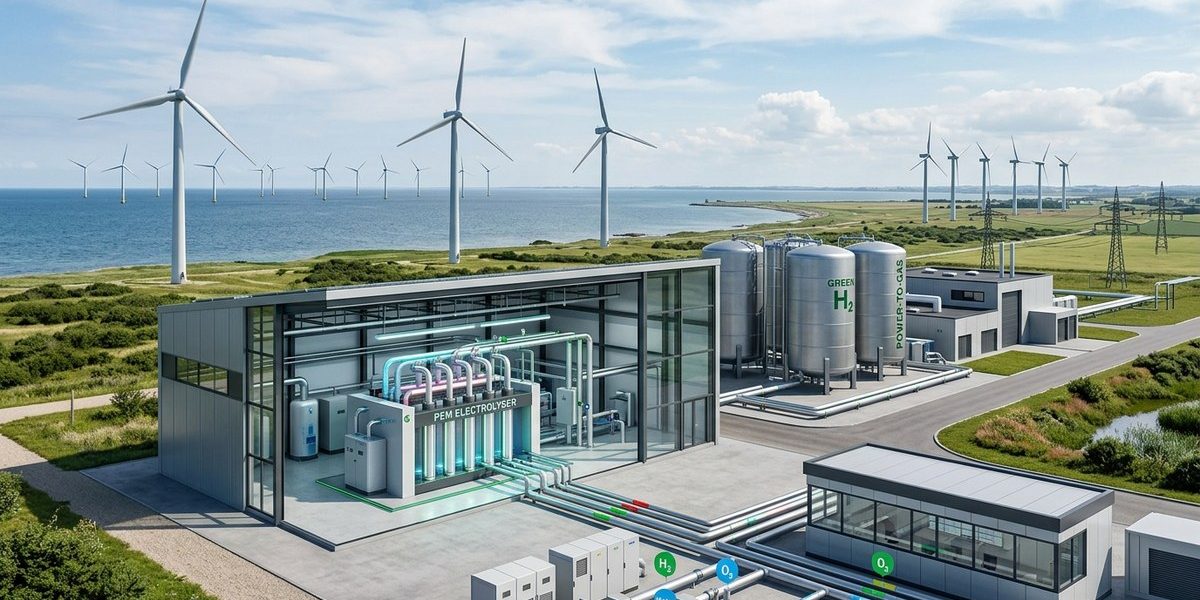
Denmark has set the pace for green hydrogen in Europe. Its power to gas strategy is ambitious, practical, and technically demanding. At the heart of this strategy lies one technology that has proven itself in the field: the proton exchange membrane (PEM) electrolyser. These devices convert renewable electricity directly into hydrogen gas, and they do it with a flexibility that matches the unpredictable output of Danish wind turbines. For researchers, policy analysts, and energy professionals looking to understand why PEM electrolysers are so critical to Denmark’s power to gas plans, this article provides the detail you need.
PEM electrolysers are the backbone of Denmark’s power to gas strategy because they offer rapid response times, high current densities, and excellent compatibility with variable renewable sources like wind and solar. Their ability to operate flexibly enables grid balancing, reduces curtailment, and supports the production of green hydrogen for industry, transport, and heating. In 2026, Denmark continues to rely on PEM technology to scale its hydrogen economy.
What Makes PEM Electrolysers Essential for Power-to-Gas in Denmark
Traditional alkaline electrolysers have been around for decades. They are robust and relatively cheap, but they struggle to follow the sharp fluctuations of wind power. PEM electrolysers, on the other hand, use a solid polymer electrolyte membrane that separates the hydrogen and oxygen production. This design allows them to ramp up or down in seconds, not minutes.
Why does that matter for Denmark? Because the country’s wind farms can go from full output to near zero in the space of a few gusts. A grid connected to such variable supply needs a flexible sink for excess power. PEM electrolysers provide exactly that: they can soak up surplus electricity when the wind blows hard and produce hydrogen that can be stored or fed into the natural gas network. When the wind drops, they can throttle down without damage, preserving energy for other uses.
Denmark’s power to gas strategy is built on this balancing act. According to the Danish Energy Agency, the goal is to have 6 GW of electrolysis capacity by 2030, with a significant share being PEM. The technology’s high efficiency (around 60-70% system efficiency, with potential for more in advanced designs) and its ability to produce hydrogen at pressures suitable for direct injection into the gas grid make it a natural choice.
How PEM Electrolysers Fit into Denmark’s Renewable Energy Grid
Denmark already generates more than half of its electricity from wind and solar. That share is growing each year. The challenge is not just producing clean power; it is using it when it is available. Power to gas bridges that gap.
PEM electrolysers sit at the interface between the electricity grid and the gas infrastructure. When wholesale electricity prices drop, often during periods of high wind, it becomes economical to run the electrolysers. The hydrogen produced can then be injected directly into the natural gas grid (up to a certain concentration) or stored in salt caverns and pipelines for later use.
A 2026 research paper from Aalborg University showed that deploying PEM electrolysers at strategic locations near offshore wind hubs could reduce curtailment by up to 40% compared to using fixed rate electrolysers. That is a huge gain for a country aiming to decarbonise its entire energy system.
Practical Steps in Power-to-Gas Operations
Here is how a typical PEM based power to gas installation works in Denmark today:
- Electrolysis using renewable electricity: Power from a nearby wind farm or solar array flows directly into the PEM stack. The current splits water molecules into hydrogen and oxygen. The oxygen is vented or captured for industrial use, the hydrogen is purified.
- Compression and drying: The hydrogen leaves the electrolyser at around 30 bar. It is further compressed to match the gas grid pressure (typically 40-70 bar for transmission networks) and dried to remove any moisture that could cause corrosion.
- Injection into the gas grid: The clean hydrogen is blended into the existing natural gas network at a controlled rate (up to 2-10% by volume, depending on local regulations and pipeline materials). Danish gas grid operator Energinet has been testing higher blends in dedicated sections.
- Optional methanation: Some projects add a methanation step, combining hydrogen with biogenic CO2 to produce synthetic methane. This enhances the compatibility with existing infrastructure and opens up new storage options.
Each step is optimised for the variable nature of renewable power. PEM electrolysers handle the ramping with ease, which is why Danish project developers favour them.
Comparing PEM Electrolysers with Other Technologies
Choosing the right electrolyser technology is a strategic decision. The table below summarises key differences relevant to Denmark’s power to gas context.
| Characteristic | PEM Electrolyser | Alkaline Electrolyser | Solid Oxide Electrolyser |
|---|---|---|---|
| Typical efficiency (system) | 60-70% | 63-70% | 70-80% (at high temperature) |
| Load following capability | Excellent (0-100% in seconds) | Moderate (20-100% in minutes) | Poor (slow ramp rates) |
| Current density | High (1-2 A/cm²) | Moderate (0.3-0.8 A/cm²) | Moderate (0.5-1 A/cm²) |
| Operational flexibility | Very high | Moderate | Low |
| Maturity | Commercial | Very mature | Pre-commercial |
| Best suited for | Variable renewables, small to large scale | Baseload, large scale | High temperature waste heat, constant operation |
| Project examples in Denmark | HyBalance, GreenHyScale, H2 Energy | Traditional chemical plants | None large scale yet |
The data clearly shows that for Denmark’s wind powered grid, PEM offers the best match. Alkaline electrolysers can be cheaper per kilowatt, but they require steady operation to avoid degradation. Solid oxide electrolysers promise higher efficiencies, but they are still in demonstration phase and cannot handle the rapid cycling that Danish wind patterns demand.
Real-World Danish Projects Demonstrating PEM Success
Denmark is not just talking about PEM electrolysers; it is building them. The HyBalance project in Hobro has been operating since 2019 with a 1.2 MW PEM system supplied by Siemens Energy. It produces hydrogen for industrial use and provides grid balancing services. The project was a proof of concept that convinced policymakers to scale up.
More recently, the GreenHyScale project aims to install a 100 MW PEM electrolyser at a coastal site in western Denmark. Due online in stages from 2026, it will supply hydrogen to a refinery and to a district heating network, using waste heat from the electrolysis process. This is a perfect example of sector coupling: electricity, gas, heat, and industry all linked through one PEM stack.
For a broader perspective on Danish electrolyser innovations, read more in Maximizing Green Hydrogen Production with Danish Electrolyser Technologies.
Key Considerations for Deploying PEM Electrolysers in Denmark
Deploying PEM electrolysers at scale is not without challenges. Energy professionals and policy analysts need to keep these points in mind:
- Operational flexibility is a double edged sword. The rapid ramping can stress the balance of plant components (power electronics, water purification, drying) if not designed for it. Good system engineering is essential.
- Efficiency varies with load. Running at partial load reduces efficiency, so optimal sizing relative to the renewable source is critical. Too big and you run at low load often; too small and you miss opportunities.
- Durability of the membrane and catalyst layers is improving, but stack lifetimes currently range from 40,000 to 80,000 hours. Replacement costs are still significant. Research into low iridium catalysts is a priority.
- Supply chain for precious metals (iridium, platinum) is a bottleneck. Denmark is supporting domestic recycling initiatives and alternative catalyst research to reduce reliance on imports.
- Infrastructure for hydrogen transport and storage is expanding. The Danish government is co funding the Hydrogen Backbone project, which will connect electrolysers to underground storage in northern Jutland by 2028.
Understanding these factors helps in making informed policy and investment decisions. Our article on Key Factors for Choosing Electrolyzer Technology in Denmark’s Green Hydrogen Sector provides a deeper analysis.
Expert Advice for Policy Analysts and Researchers
“PEM electrolysers are not just a technology choice; they are a strategic enabler for Denmark’s energy transition. Their ability to follow the wind means we can integrate more renewables without destabilising the grid. For policy makers, the focus should be on standardising grid connection procedures, supporting domestic manufacturing, and funding research into alternative catalysts to reduce cost. For researchers, the next frontier is improving stack lifetime and reducing iridium loading. Denmark has a unique opportunity to lead in PEM innovation, but we need to act now on the system level, not just the stack level.” — Dr. Mette Jørgensen, Senior Researcher at the Danish Energy & Innovation Centre in 2026.
This advice underscores the importance of looking beyond the electrolyser itself. The entire value chain from power source to end user must be aligned.
The Road Ahead: PEM Electrolysers in Denmark’s 2026 Energy Landscape
As of 2026, Denmark has over 500 MW of operational PEM electrolyser capacity, with another 2 GW in planning. The technology is moving from demonstration to commercial deployment. Costs have fallen by about 30% since 2020, driven by larger stacks and improved manufacturing.
Denmark’s power to gas strategy now includes specific incentives for projects that provide grid services. PEM electrolysers are uniquely positioned to participate in frequency regulation markets, earning revenue beyond hydrogen sales. This makes the business case stronger and encourages further investment.
For energy professionals, the message is clear: PEM electrolysers are the workhorse of Denmark’s hydrogen economy. They are not a silver bullet, but they are the most practical solution for a country that lives on wind power. The next few years will bring even larger installations, deeper integration with the gas grid, and new applications in heavy transport and industry.
To stay ahead, keep an eye on developments in How Danish Innovations Are Shaping the Future of Green Hydrogen Infrastructure and the ongoing efforts to scale up production.
No matter which part of the value chain you work in, understanding PEM electrolysers and their role in Denmark’s power to gas strategy gives you a solid foundation to contribute to the energy transition. The technology is proven, the strategy is sound, and the opportunity is huge. Now it is about execution.