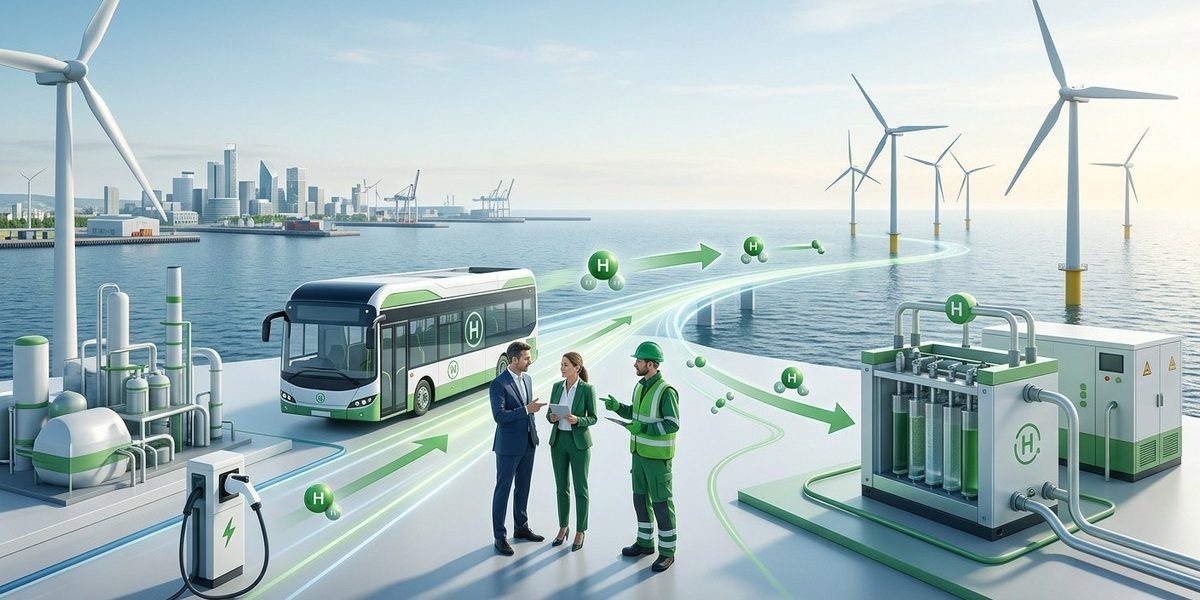
Denmark didn’t just build electrolysers; they created an ecosystem. By aligning renewable energy, regulation, and industrial demand, Denmark now produces green hydrogen at costs the UK can only dream of. For 2026, the lesson is clear: stop copying piecemeal policies. Adopt Denmark’s integrated model – grid-ready electrolysers, flexible power purchase agreements, and a shared hydrogen backbone – to unlock our own domestic hydrogen economy.
The UK has set ambitious targets for green hydrogen. But ambition alone won’t build a single electrolyser. Across the North Sea, Denmark has already turned those targets into working plants, shipping hydrogen to industrial users and blending it into gas grids. The question every UK policy maker and energy analyst should be asking is not whether we can do it, but what can we learn from the Danes who are already there?
Denmark’s pioneers didn’t invent new physics. They used existing technology smarter, they regulated with purpose, and they convinced industry to get on board early. Let’s look at the key lessons that can shape a practical UK strategy for 2026 and beyond.
What Makes Denmark’s Approach Different?
Denmark treats green hydrogen as a utility, not a niche experiment. From the start, they designed for scale. Their offshore wind farms connect directly to large electrolysers. The hydrogen is then piped into a dedicated network that serves refineries, ammonia plants, and steel works. This is not a collection of pilot projects. It is an integrated system.
In contrast, the UK has tended to fund separate demonstration units. Each one fights for grid connection, faces regulatory uncertainty, and struggles to secure offtake agreements. Denmark shows that coordinated planning from the beginning removes those bottlenecks. Their government set a clear target for electrolyser capacity by 2025, then back it with a national hydrogen strategy that aligned all the agencies.
Learning from Denmark’s Regulatory Playbook
Here is how Denmark turned policy into projects. The steps are replicable, but they require patience and cross-ministerial buy in.
-
Set a binding capacity target, not just a vague ambition. Denmark pledged 6 GW of electrolyser capacity by 2030. That target forced grid operators, regulators, and industry to start planning early. The UK currently has a target of 10 GW by 2030, but it is less anchored to concrete milestones.
-
Create a single hydrogen infrastructure body. Denmark established a state owned company to build the hydrogen backbone, similar to how the UK uses National Grid for electricity. This removed the chicken-and-egg problem: no one wants to build a hydrogen pipeline without guaranteed producers, and no producer invests without a pipeline. The state breaks that deadlock.
-
Use contracts for difference (CfDs) for hydrogen, not just electricity. The Danish government offers long term contracts that guarantee a floor price for green hydrogen. This gives project developers the certainty they need to raise capital. The UK has introduced CfDs for hydrogen, but the budget allocation is still too small to attract major international investors.
-
Integrate hydrogen into existing energy markets. Denmark allows hydrogen producers to participate in the balancing market. When the grid has excess wind power, electrolysers ramp up. When the grid needs power, they sell back or provide flexibility. This dual revenue stream improves project economics without extra subsidy.
The Technology Edge: What Denmark Is Doing Differently
Denmark’s lead is not just about policy. Their electrolyser deployment uses proven innovations that are often overlooked elsewhere. Here are the standouts:
- Dynamic operation. Danish electrolysers can ramp from 10% to 100% load in seconds. This allows them to follow the variable output of wind turbines, maximising running hours even during low wind.
- High temperature electrolysis. Several Danish projects use solid oxide electrolysers (SOECs) that operate at higher temperatures and achieve efficiency above 80%. This technology, while still maturing, is being deployed at industrial scale in Denmark ahead of most other countries.
- District heating integration. The waste heat from electrolysers is fed into Denmark’s extensive district heating networks. That turns an energy loss into a revenue stream, improving overall project economics by up to 15%.
- Methanation partnerships. Green hydrogen is combined with captured CO₂ to produce synthetic methane, which can be injected directly into the existing gas grid. This provides a flexible end use and supports the bioenergy sector.
Financing and Market Models That Worked
Denmark didn’t rely on subsidies alone. They created a market that rewards low cost production and high utilisation. The table below shows how their approach compares with the early UK model.
| Aspect | Denmark | UK (early approach) |
|---|---|---|
| Revenue source | CfDs + balancing market + heat sales | Mainly grants or single CfD |
| Grid connection | Fast track for hydrogen clusters | Slow, project by project |
| Offtake agreements | Long term with large industrial users | Short term, mostly pilots |
| Technology support | Focus on proven scalable tech | Multiple competing small pilots |
| Infrastructure | State backed hydrogen backbone | No coordinated pipeline plan |
The difference is clear. Denmark made it easy for developers to build at scale. The UK has been more cautious, funding multiple small projects that prove the concept but never achieve the cost reductions that come from volume.
Overlooked Lessons from Denmark
One thing that often gets missed in the policy papers is the human side. Danish energy companies were early adopters because they saw hydrogen as a natural extension of their existing wind business. The same companies that build offshore wind farms now operate electrolysers. That vertical integration reduces transaction costs and aligns incentives.
“The biggest mistake other countries make is thinking you can treat hydrogen as a separate industry,” says Mikael Hansen, former head of hydrogen strategy at a major Danish utility. “You have to build it as an add on to your existing renewables portfolio. That is what made the business case work for us, and it is what the UK needs to do if it wants to get past the pilot stage.”
Another overlooked lesson is the role of municipalities. In Denmark, local authorities actively supported hydrogen projects by offering land, permitting fast approvals, and connecting them to district heat schemes. This bottom up approach complements national targets and speeds up delivery.
Applying Danish Lessons to the UK Context
The UK cannot copy Denmark exactly. Our geography, energy mix, and regulatory system are different. But we can adapt the core principles. For example:
- Cluster approach first. Instead of spreading thin across the whole country, focus on a few hydrogen valleys where renewable energy, industrial demand, and pipeline routes align. The East Coast, Teesside, and South Wales all have strong potential.
- Use existing gas infrastructure. The UK’s gas network is extensive. Blending hydrogen up to 20% requires minimal changes. Denmark already blends 5% hydrogen into its gas grid and plans to increase that share.
- Align CfDs with flexibility services. Allow electrolysers to earn money from grid balancing while also producing hydrogen. This dual income model is proven in Denmark and can reduce the cost of UK government support.
- Invest in a shared backbone. Rather than leaving infrastructure to market forces, the UK should create a public hydrogen transport company along the lines of Ofgem but with a clear mandate to build pipelines between major hydrogen clusters.
For anyone wanting a deeper look at how Danish electrolyser technology scales, the article on maximizing green hydrogen production with Danish electrolyser technologies provides technical details. And if you are interested in how the Danes integrate hydrogen with the broader energy system, the piece on integrating power-to-gas systems for sustainable Danish industry is a good next read.
A Roadmap for UK Policy Makers in 2026
The window to learn from Denmark is not infinite. By 2026, Danish electrolyser capacity will have grown further, and their costs will have come down even more. The UK needs to act now to bridge the gap.
Here is a realistic sequence of actions for the next eighteen months:
- Designate two to three hydrogen clusters as national priority zones. Give them simplified planning, faster grid connections, and dedicated funding.
- Mandate that all new offshore wind farms include a connection point for electrolyser clusters. This avoids the grid upgrade delays that currently plague UK projects.
- Launch a pipeline infrastructure programme with a clear budget and timeline. Use the Danish model of a state backbone, co funded by industry.
- Expand the CfD budget for hydrogen and allow dual use of electrolysers in balancing markets.
- Support at least one large scale solid oxide electrolyser demonstration to build UK expertise in high temperature technology.
Denmark didn’t become a green hydrogen pioneer by accident. They made strategic choices, took coordinated action, and stayed committed. The UK has the wind, the ports, and the industrial base to do the same. The missing piece is the courage to copy what works.
Start small, but start with the right model. Pick one cluster, apply the Danish playbook, and prove the concept. Once that cluster is running, the rest of the country will follow. That is how any hydrogen economy begins: with one good project that everyone can point to and say “we did it here, and we can do it again.”