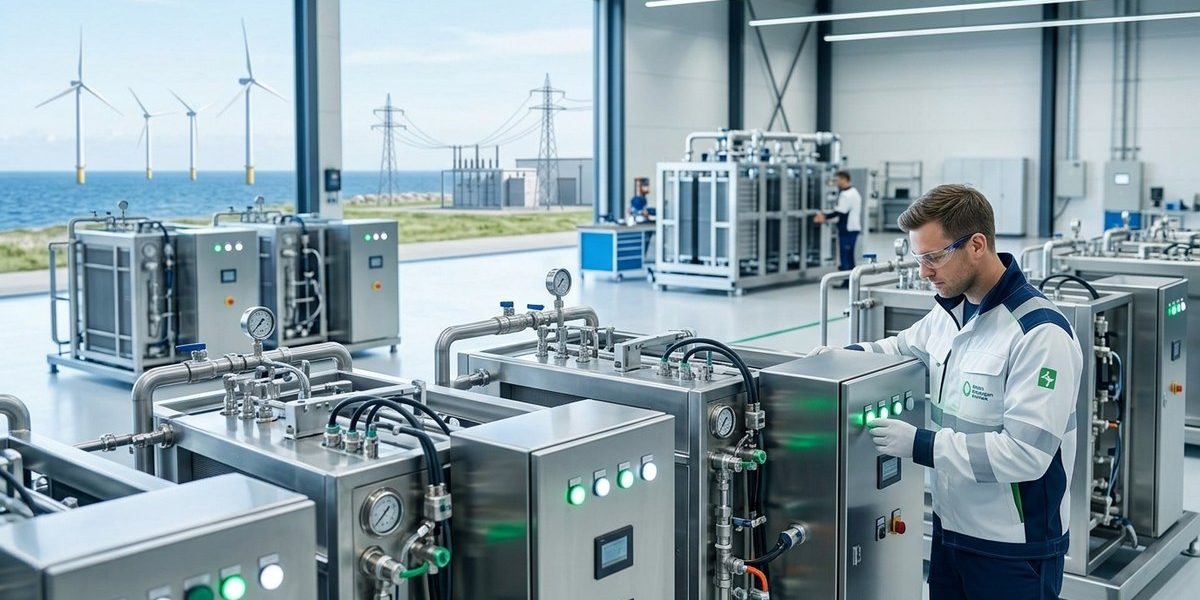
You might not expect a country of just under six million people to dominate a high-tech industry. Yet Denmark has become the go-to nation for electrolyser manufacturing. Its wind power legacy, stable policy framework, and world-class research institutions have created a perfect storm for green hydrogen innovation. Today, Danish companies are building some of the most efficient electrolysers on the planet, and the world is taking notice.
Denmark leads global electrolyser manufacturing thanks to three advantages: abundant renewable energy from wind, ambitious climate targets that drive demand, and a collaborative ecosystem connecting industry, academia and government. With companies like Topsoe and Green Hydrogen Systems pushing boundaries, Denmark is setting the standard for cost-effective, scalable green hydrogen production. This article explains what makes Denmark the hub for electrolyser manufacturing and how it can guide your hydrogen strategy.
Why Denmark dominates electrolyser manufacturing
Denmark’s journey to the top of electrolyser manufacturing did not happen overnight. It started decades ago with wind energy. The same turbines that power Danish homes now provide cheap, abundant electricity for electrolysis. When you combine this clean power with a government that has backed green hydrogen from the start, you get a manufacturing environment that is hard to beat.
Danish manufacturers benefit from a stable policy framework. The Danish Energy Agency has set clear targets for hydrogen capacity, and funding schemes like the Power-to-X strategy have unlocked billions of kroner in private investment. This predictability gives companies the confidence to build large factories, such as Topsoe’s SOEC facility in Herning and Green Hydrogen Systems’ assembly plant in Kolding.
Another factor is world-class research. Universities like DTU (Technical University of Denmark) and Aarhus University run dedicated hydrogen labs. They collaborate directly with industry on next-generation materials, stack design, and system integration. This flow of talent and ideas keeps Danish technology ahead of competitors.
Three pillars of Danish electrolyser leadership
If you want to understand Denmark’s edge, look at these three foundations:
-
Access to cheap renewable electricity. Denmark’s wind turbines often produce more power than the grid can absorb. Electrolysers can switch on when electricity prices are low, making green hydrogen cost-competitive. The country’s integrated energy system allows electrolysers to act as flexible demand, stabilising the grid while producing hydrogen profitably.
-
Strong public-private partnerships. The Danish government co-invests in demo projects and infrastructure. For example, the Hydrogen Valley project in Hobro tests electrolysers under real-world conditions, with data shared openly to accelerate learning. This reduces risk for manufacturers and speeds up commercialisation.
-
World-class testing and certification. Denmark hosts several testing centres where electrolysers are put through rigorous performance and durability trials. The Danish Technological Institute runs a certified test lab that helps manufacturers prove their stacks meet European standards. This builds trust with buyers and investors.
How Danish manufacturers turn theory into practice
Danish companies do not just design electrolysers in a lab. They build them at scale and operate them in harsh conditions. Here are the practical steps that set them apart:
- Continuous operation at variable loads. Danish electrolysers are designed to follow wind output, ramping up and down thousands of times without degradation. This is critical for integrating with renewables.
- Advanced materials. Danish researchers have developed new membrane and catalyst materials that boost efficiency and reduce the use of rare metals.
- Digital twinning. Manufacturers create digital copies of each electrolyser stack to predict maintenance needs and optimise performance remotely.
- Modular design. Factories in Denmark produce standardised modules that can be stacked into megawatt-scale installations, cutting installation time and cost.
Electroliser technology comparison
| Technology | Typical efficiency (kWh/kg H₂) | Scale range | Danish example | Maturity |
|---|---|---|---|---|
| PEM (Proton Exchange Membrane) | 50-55 | 1 kW – 10 MW | Green Hydrogen Systems | Commercial |
| Alkaline | 55-60 | 1 MW – 100 MW | NEL Hydrogen (Danish subsidiary) | Mature |
| SOEC (Solid Oxide) | 40-45 | 1 MW – 5 MW | Topsoe | Early commercial |
Each technology serves a different market segment. Danish manufacturers cover all three, giving buyers a full range of options for their specific project needs.
Common challenges and solutions in Danish electrolyser production
Even leaders face hurdles. Denmark deals with them head-on.
| Challenge | Danish solution |
|---|---|
| High upfront capital costs | Government grants and EU Innovation Fund support reduce financial barriers. |
| Intermittent renewable supply | Smart grid integration and large-scale hydrogen storage allow electrolysers to run flexibly. |
| Skilled labour shortage | Partnerships with technical colleges and DTU train a steady pipeline of engineers and technicians. |
| Global competition from China | Denmark focuses on high-efficiency, premium systems with longer lifetimes and lower operating costs. |
“Denmark’s success is not an accident. It comes from aligning policy, industry and research around a single goal: making green hydrogen affordable and reliable. Other countries can replicate this model, but they need the same long-term commitment.” – Dr. Karen Nielsen, Head of Hydrogen Research at DTU
What the future holds for Denmark’s electrolyser industry
Looking ahead to 2026, Denmark is on track to double its electrolyser manufacturing capacity. The government recently announced a new Power-to-X tender that will add 500 MW of hydrogen production by 2028. Manufacturers are expanding factories and hiring more staff.
Key trends to watch:
- Stack lifetime improvements. Danish companies target stack lifetimes of 80,000 hours for PEM and 100,000 hours for SOEC by 2027.
- Cost reduction. Learning curves suggest system costs will fall below €500 per kW by 2028, down from €1000 in 2023.
- Export growth. Danish electrolysers are already being shipped to Germany, the Netherlands and Australia. Export revenue is expected to exceed €2 billion by 2030.
For more detail on specific technology breakthroughs, see our article on top innovations in Danish electrolyser technologies for 2026.
Lessons from Denmark for global hydrogen players
If you are a renewable energy analyst, investor or policy maker, Denmark offers a roadmap. Start by building a stable policy environment that de-risks private investment. Support pilot projects that bring industry and academia together. And above all, ensure your grid can supply abundant, cheap renewable electricity.
Denmark also shows that manufacturing leadership is not just about volume. It is about quality, innovation and integration. The country’s electrolysers are designed to work with wind power in a way that others have not yet matched. That is the real competitive advantage.
To see how these electrolysers are deployed in real-world projects, check out our guide on how Denmark is leading the transition to green hydrogen infrastructure.
What Denmark’s success means for your hydrogen strategy
Whether you are an investor scouting for opportunities or a policy maker designing support schemes, Denmark offers a blueprint worth studying. The ingredients are clear: cheap renewables, strong R&D, smart policy and a willingness to collaborate. You do not need to copy everything. But you can adapt the principles to your local context.
Start by understanding your own energy resources and then build a supportive ecosystem around them. If you can match even half of Denmark’s focus, your green hydrogen ambitions will move much closer to reality. The race is on, and Denmark has already built a strong lead. Now it is up to the rest of the world to catch up.