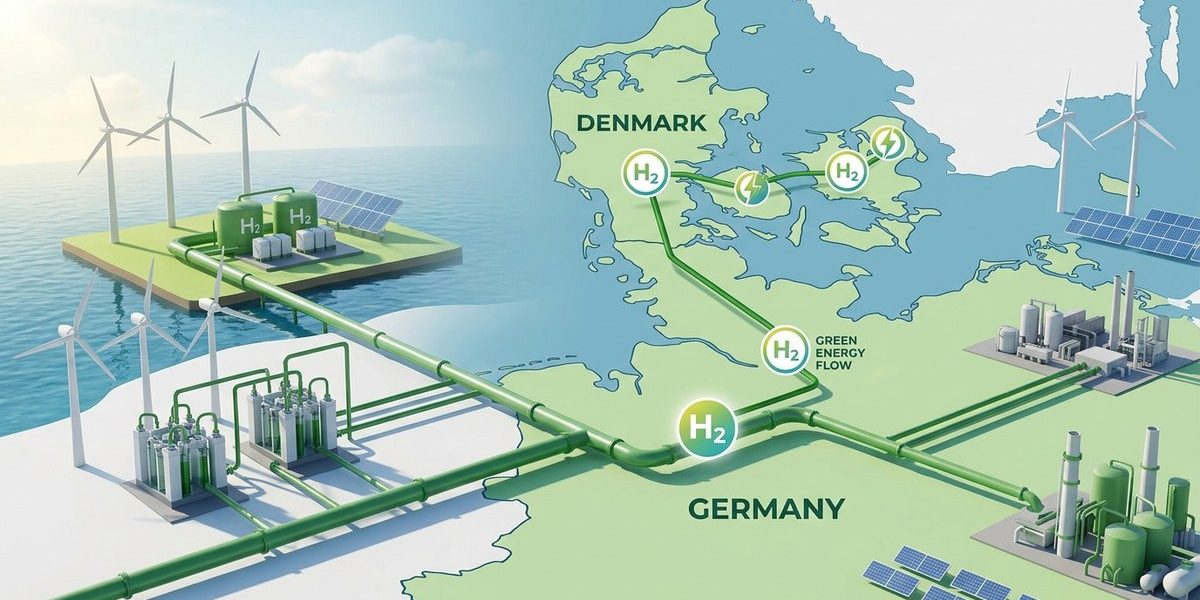
Denmark and Germany are building Europe’s first real hydrogen market. In June 2026, Germany confirmed €1.3 billion in support for three Danish green hydrogen projects, unlocking a pipeline that will run from western Jutland to the German border. This is not just another energy deal. It is a template for how two countries can share renewable resources, cut industrial emissions, and create a new trade route for clean fuel. If you work in energy policy, infrastructure, or investment, this corridor matters more than any other hydrogen development in Europe right now.
The Denmark Germany hydrogen trade is no longer a pilot project. With €1.3Bn in German subsidies, a dedicated pipeline planned for 2030, and strong political backing on both sides, this cross‑border corridor will supply large‑scale green hydrogen to German industry. For investors and policymakers, 2026 is the year real capital flows into infrastructure decisions.
The Big Picture: Why 2026 Is the Tipping Point
For years, hydrogen has been a promise. High costs, missing infrastructure, and uncertain demand kept it in the pilot phase. That changed in early 2025 when the Danish government approved the transition to the construction phase of the “Syvtallet” hydrogen backbone. The pipeline will connect western Jutland to the German border. In parallel, Germany’s federal government awarded €1.3 billion through the EU’s “Important Projects of Common European Interest” (IPCEI) mechanism to three Danish green hydrogen projects. Combined, these projects aim to produce about 78,000 tonnes of green hydrogen annually.
What makes 2026 different is alignment. Both countries have national hydrogen strategies. The European Hydrogen Backbone plan includes this corridor as a priority. And crucially, the German side has committed hard cash to kick‑start production. That de‑risks the investment case for project developers and pipeline operators.
If you want to understand how Denmark is positioning itself as a hydrogen hub, check out how Denmark is leading the transition to green hydrogen infrastructure. It shows how the country’s wind‑rich geography and advanced electrolyser industry create a natural advantage.
The Infrastructure: The Danish Hydrogen Backbone and the German Connection
The physical link is called “Syvtallet” (the Seven). It is a 210 km hydrogen pipeline that will run from the western part of Jutland to the German border near Ellund. The project is led by the Danish TSO Energinet. According to current plans, it should be ready by 2030. That may seem far away, but construction decisions must be made in 2026 and 2027.
On the German side, the country is building a core hydrogen network (Wasserstoff‑Kernnetz) that will connect to the Danish border and extend to industrial clusters in Lower Saxony, North Rhine‑Westphalia, and Bavaria. The two grids are designed to be interoperable, with the same pressure standards and purity requirements.
Here is a overview of the key infrastructure milestones:
| Year | Milestone | Significance |
|---|---|---|
| 2025 | Danish political agreement to proceed with Syvtallet | Formal commitment to build the backbone |
| 2026 | German IPCEI awards to Danish projects | First large‑scale funding for production |
| 2027 | Final investment decision on Syvtallet | Pipeline construction go‑ahead |
| 2028 | Start of electrolyser installation in Jutland | Capacity of up to 1 GW initially |
| 2030 | Planned pipeline commercial operation | First hydrogen flows to Germany |
The speed of this timeline depends on regulatory alignment. Both countries have harmonised their certification rules for green hydrogen under the EU’s delegated acts. That means hydrogen produced in Denmark using renewable electricity can be counted toward Germany’s national targets without extra paperwork. A big win for traders.
For more on how electrolysers will power this supply, read our guide on maximizing green hydrogen production with Danish electrolyser technologies.
The Funding: €1.3 Billion and What It Means
The €1.3 billion from Germany covers three projects. Each is at a different stage of development, but together they represent around 150 MW of electrolysis capacity. The money comes from the German federal budget via the EU IPCEI framework, which allows state aid for large‑scale infrastructure if it benefits multiple member states.
How does the funding work? It is not a grant in one lump sum. Instead, it covers a combination of capital expenditure and operating cost support over 10 years. This type of “contract for difference” structure guarantees a minimum price for hydrogen, making it attractive for offtakers like steelmakers and chemical plants.
Here is a simple breakdown of the three project types:
- Large‑scale electrolysis: Projects with capacity over 100 MW, using either PEM or alkaline technology, located near existing offshore wind parks.
- Integrated production and storage: Electrolysers combined with salt cavern storage so hydrogen can be delivered around the clock, not just when the wind blows.
- Cross‑border supply chain: Production sites that feed directly into the Danish backbone, with dedicated compression stations at the border.
Each project must demonstrate a clear offtake agreement with a German industrial customer. That is a new requirement that has forced producers to sign long‑term purchase agreements. It is good for market stability.
You can see how these innovations fit into Denmark’s wider strategy in our article on unlocking Denmark’s green hydrogen potential through advanced electrolyser deployment.
How the Trade Works: From Wind to Wheels
Let us walk through the chain. Denmark has abundant offshore wind. When turbines generate more electricity than the grid can use, electrolysers convert that surplus power into hydrogen. The gas is then compressed and sent through the Syvtallet pipeline to Germany. Once across the border, it enters the German hydrogen network and goes to industrial users.
The steps are:
- Generation: Offshore wind farms in the North Sea and Baltic Sea produce electricity.
- Electrolysis: Large‑scale electrolysers (PEM or alkaline) split water into hydrogen and oxygen. The oxygen is often vented or used in industrial processes.
- Compression and transmission: Hydrogen is compressed to pipeline pressure (around 50 bar) and fed into the backbone.
- Border crossing: A metering and quality control station ensures the gas meets German purity standards (hydrogen content above 99,97%).
- Distribution to customers: German steel, chemical, and refining plants receive the hydrogen directly via their own connections.
For the system to work, you need stable regulatory frameworks on both sides. That is where integrating power‑to‑gas systems for sustainable Danish industry becomes important.
Regulatory Hurdles and Solutions
Even with political support, there are obstacles. One of the biggest is the lack of a fully harmonised cross‑border tariff structure. Denmark and Germany have different transmission system operators and different methods for recovering pipeline costs. If not handled well, tariffs could make Danish hydrogen more expensive than German domestic production.
Industry groups have proposed a solution: a cross‑border “virtual interconnection point” that allows transport capacity trading between the two TSOs. This model works well in the natural gas market and could be adapted for hydrogen.
Another issue is the timeline. The pipeline is not expected until 2030, but electrolysers can be built faster. Some producers are considering temporary truck or rail transport for hydrogen to Germany before the pipe is ready. It is not ideal, but it keeps the market moving.
“The real challenge is not technology or money. It is timing. We need to synchronise pipeline construction with electrolyser commissioning. Otherwise you end up with stranded production capacity or a pipe with nothing to carry. The Danish and German governments are working on a joint implementation plan to avoid that mismatch.” — Source: Danish Energy Agency official, June 2026.
What This Means for Investors and Policymakers
For investors, the Denmark Germany hydrogen trade offers a rare combination of government backed revenue and growing industrial demand. The offtake agreements are signed with companies like Thyssenkrupp and ArcelorMittal, which need hydrogen to decarbonise steel production. These are not speculative markets. They are mandatory because of EU carbon pricing and national climate laws.
Policymakers should pay attention to the financing model. The combination of IPCEI state aid, contracts for difference, and pipeline tolling creates a blueprint that could be replicated for other routes, for example from Norway to Germany or from the UK to the Netherlands.
If you are looking at electrolyser investment, read our analysis on 5 ways Danish electrolysers are reducing green hydrogen costs. It explains why Denmark is leading on cost reduction.
The Road Ahead: From 2026 to 2030
This is not a case of build and forget. The first hydrogen flows are planned for 2030, but the decisions that make that happen are being taken now. The Danish government is expected to make a final investment decision on the Syvtallet pipeline in 2027. The German TSOs will finalise their core network plan by 2028.
Meanwhile, the IPCEI projects will begin construction next year. By 2029, you will see the first major electrolyser parks in Jutland, complete with storage and compression.
For the UK audience, this corridor matters because it shows how a small country with strong renewables can become a hydrogen exporter. There are lessons for Scotland, the East of England, and Yorkshire, which all have offshore wind potential.
To stay ahead, keep an eye on the regulatory details: tariff methodology, cross‑border capacity booking, and the evolution of European hydrogen certification. Those are the variables that will determine whether this trade corridor delivers on its promise.
The future of European energy is being written on a map that connects the Danish wind fields to German factories. If you are involved in that story, 2026 is the year you want to be part of it.