When you are sizing up an electrolyser for a Danish energy project, the first question is always about efficiency. But efficiency is not one number. It is a set of measurements that together tell you how much hydrogen you get for every kWh of renewable electricity, how long your stack will last, and how well the system handles the wind-and-sun rhythm of Danish power. If you are an engineer or project manager working with green hydrogen in Denmark, you need to know which metrics matter most and how to benchmark them against real-world targets. That is exactly what this article covers.
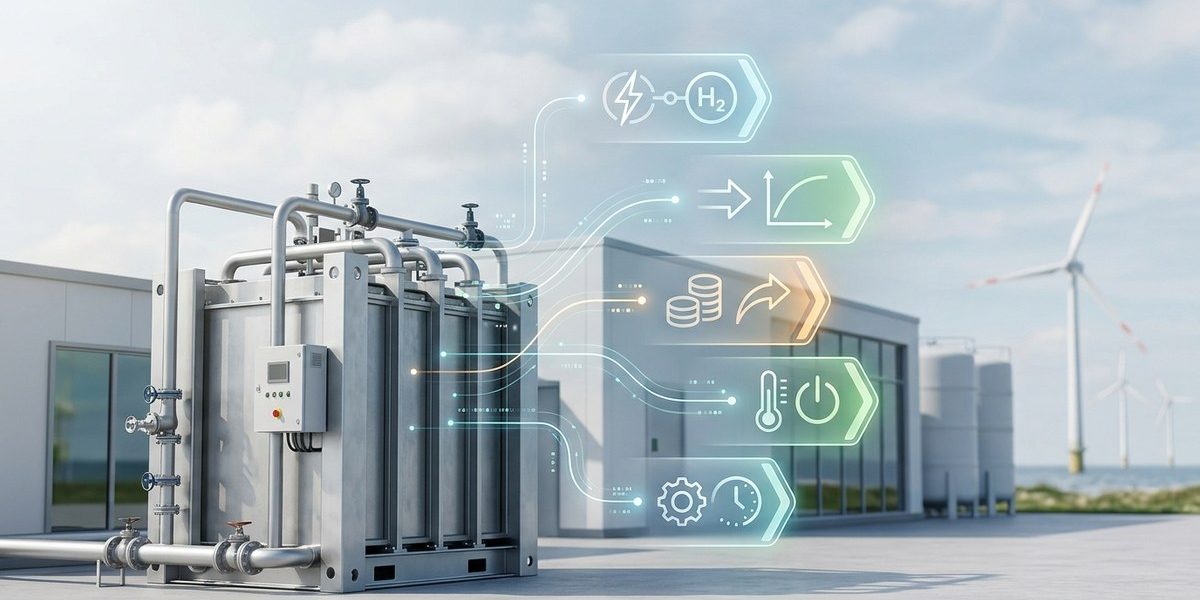
Electrolyser efficiency KPIs go far beyond a single percentage. Five metrics (system energy consumption, cell voltage efficiency, current density with Faradaic efficiency, stack degradation rate, and ramp rate) give a complete picture. For Danish projects, prioritising load flexibility and degradation is especially important because of the variable renewable energy supply. Use these KPIs to compare technologies, predict costs, and secure funding.
Why Electrolyser Efficiency Deserves a Closer Look
Denmark is pushing hard on green hydrogen. By 2026, several large-scale electrolyser plants are either operational or under construction across Jutland, Zealand, and Bornholm. But the success of these projects depends on one thing: getting as much hydrogen out of every renewable kilowatt-hour as possible. That is where KPIs come in.
Efficiency is not just a technical curiosity. It directly affects the levelised cost of hydrogen (LCOH). A difference of just a few percentage points in system energy consumption can shift a project from viable to marginal. For Danish project developers, who often rely on Power Purchase Agreements (PPAs) from offshore wind, a highly efficient electrolyser means better economics and a stronger business case.
However, not all efficiency metrics are created equal. Some are easy to measure but misleading. Others are harder to track but tell you more about long-term performance. The trick is to know which ones to use and when.
The 5 Key Performance Indicators for Electrolyser Efficiency
Let us walk through the five metrics that every Danish energy project should track. These are the same indicators used by the Clean Hydrogen Joint Undertaking and by leading Danish research institutions.
1. System Energy Consumption (kWh per kg H2)
This is the headline number. It tells you the total electrical energy the entire electrolyser system consumes to produce one kilogram of hydrogen. It includes the stack, the balance of plant (pumps, cooling, gas purification), and all auxiliary loads.
Typical values for commercial alkaline electrolysers in 2026 range from 50 to 55 kWh/kg at rated power. PEM electrolysers are slightly higher, around 52 to 58 kWh/kg. For Danish projects, the target set by the Danish Energy Agency is below 52 kWh/kg for new installations.
Why it matters: This KPI is directly linked to electricity cost. If your PPA price is 30 EUR/MWh, a drop of 2 kWh/kg translates into a significant saving in operational expenditure over a 20-year lifetime.
2. Cell Voltage Efficiency
Cell voltage efficiency (η_v) is the ratio of the thermoneutral voltage (1.481 V at 80°C) to the actual operating voltage of a single cell. A voltage efficiency of 80% means you are running at about 1.85 V per cell.
This metric is important because it separates the electrochemical performance from the balance-of-plant losses. A high voltage efficiency indicates good catalyst activity and low ohmic resistance, both goals of Danish research into advanced membranes and electrode coatings.
In practice, PEM cells often achieve higher voltage efficiencies (75 to 85%) than alkaline cells (70 to 80%), but they come with higher cost. For a Danish project, choose based on your hydrogen purity requirements and tolerance for precious metals.
3. Current Density and Faradaic Efficiency
Current density (measured in mA/cm²) tells you how hard you are pushing the stack. Higher current density usually means more hydrogen per unit area, but it also increases resistive losses and reduces voltage efficiency.
Faradaic efficiency (η_f) is the fraction of current that actually produces hydrogen. The rest goes into side reactions, heat, or gas crossover. In modern alkaline and PEM electrolysers, Faradaic efficiency stays above 95% under normal conditions. But at low loads (below 20% of rated capacity), it can drop because of increased gas permeability in the membranes.
For Danish projects, where the electrolyser will often run at partial load due to wind variability, tracking Faradaic efficiency at low current densities is critical. A drop from 98% to 90% might not look dramatic, but it can waste 8% of your renewable electricity.
4. Stack Degradation Rate
Degradation is the silent killer of project economics. The stack degradation rate, usually reported as microvolts per hour (µV/h) or percentage voltage increase per 1000 hours, tells you how quickly the stack performance declines. Typical values for well-designed stacks are 1 to 3 µV/h, corresponding to a total voltage increase of about 5 to 15% over 60,000 hours.
In Denmark, operators are seeing slightly higher degradation in units that follow wind variations aggressively. Rapid load changes cause thermal and mechanical stress that accelerates membrane thinning and catalyst leaching. That is why many Danish project owners now specify a maximum degradation rate of 2 µV/h in their tender documents.
5. Ramp Rate and Load Flexibility
This KPI is not about steady-state efficiency but about how efficiently the electrolyser can respond to changes in renewable power output. Ramp rate is measured in percentage of rated power per second. A typical alkaline electrolyser can ramp at about 2 to 4% per second; a PEM unit can hit 10 to 20% per second.
Load flexibility also includes the minimum turndown ratio (how low you can go without shutting down). For Danish offshore wind, a turndown of 10% or lower is desirable, because the wind can drop suddenly. If your electrolyser has to shut off every time the wind dips below 30%, you lose production.
Why this matters: The Danish grid is becoming more volatile as wind capacity grows. Projects that can ride through fluctuations without protective shutdowns will have higher capacity factors and better profitability.
How to Interpret These Metrics: A Practical Guide
Knowing the numbers is one thing. Using them correctly is another. Here are common pitfalls and how to avoid them.
- Don’t compare kWh/kg across different system boundaries. Some manufacturers include compression, some do not. Always check the system scope.
- Cell voltage efficiency alone can be misleading. A high voltage efficiency might come with high current density, which in turn increases degradation. Look at the pair.
- Faradaic efficiency is not constant. It varies with load, temperature, and pressure. Test your electrolyser across the operating envelope.
- Stack degradation is not linear. The first 1000 hours often show a higher degradation rate (break-in) before stabilising. Use the long-term trend, not the early data.
Here is a simple table to summarise the techniques and common mistakes.
| Metric | How to Measure | Common Mistake | Correct Approach |
|---|---|---|---|
| System energy consumption | DC power meter on entire system plus hydrogen flow meter | Including gas drying energy in the stack only | Measure from grid connection to hydrogen outlet |
| Cell voltage efficiency | Average cell voltage divided by thermoneutral voltage | Using nameplate voltage instead of real-time | Log cell voltages at steady state |
| Faradaic efficiency | (Measured hydrogen flow / theoretical flow from current) × 100 | Assuming 100% at all loads | Measure at 10%, 50%, and 100% load |
| Stack degradation | ΔV over time (µV/h) | Comparing values from different temperatures | Normalise to a reference temperature (e.g., 80°C) |
| Ramp rate | Maximum change in power per second during startup | Using manufacturer spec without validation | Verify with a grid simulator on site |
Expert Advice: Benchmarking Your Electrolyser
“In Danish projects, we often see teams focus on the kWh/kg number and ignore everything else. But the stack degradation rate and load flexibility are just as important for the long-term business case. I tell them: benchmark your system against the Danish Energy Agency’s technology catalogue, not against a lab test from five years ago. Field data always trumps brochure numbers.”
– Henrik Sørensen, Senior Engineer at a Danish electrolyser OEM (paraphrased from industry discussions, 2026)
That advice rings true. With 2026 being a year of rapid scale-up in Denmark, the gap between lab efficiency and real-world efficiency is closing, but it is still significant. Always ask for guaranteed performance curves over the entire load range, not just at the design point.
Looking Ahead: 2026 Targets for Danish Projects
The Danish government’s hydrogen strategy, updated in 2025, sets ambitious targets for electrolyser efficiency. By 2026, new projects supported by the Hydrogen Infrastructure Fund must demonstrate a system energy consumption below 52 kWh/kg and a degradation rate under 2.5 µV/h. These targets align with the Clean Hydrogen Joint Undertaking’s 2026 goals for large-scale electrolysers.
Innovation in Danish electrolyser technologies is pushing those boundaries further. Companies are testing advanced alkaline designs with zero-gap configurations and improved separators, as well as PEM stacks using thinner membranes with lower iridium loading. For a deeper look at the latest developments, read about Top Innovations in Danish Electrolyser Technologies for 2026. And if you are selecting a technology for your next project, the Key Factors for Choosing Electrolyzer Technology in Denmark’s Green Hydrogen Sector will help you weigh trade-offs.
Beyond 2026, the expectation is that system energy consumption will drop to 48 kWh/kg for alkaline and 49 kWh/kg for PEM. That would make green hydrogen cost-competitive with grey hydrogen without carbon pricing, a milestone Denmark is determined to reach first.
Your Electrolyser Efficiency Toolkit
Now you have the five KPIs and how to apply them. Start by collecting baseline data for your own system or the system you are evaluating. Use the table above to avoid the most common mistakes. Talk to your stack supplier about guaranteed degradation curves, not just initial performance. And if you are designing a new project, run a full year simulation using Danish wind data (the Danish Energy Agency publishes hourly profiles). That simulation will tell you exactly how your chosen electrolyser will perform under real conditions.
Efficiency is never static. As Danish projects scale up and the grid evolves, these KPIs will help you stay ahead. Keep measuring, keep comparing, and keep pushing for better performance. Your hydrogen will thank you, and so will the planet.
For more on the broader context, check out How Denmark Is Leading the Transition to Green Hydrogen Infrastructure and Optimizing Electrolyzer Systems for Green Hydrogen Production in Denmark. Together, these resources give you everything you need to benchmark and improve electrolyser efficiency in your own projects.